| CAS Number | 6873-09-2 |
|---|---|
| Molecular Formula | C20H18NO4+ |
| Molecular Weight | 336.4 |
| InChI Key | FPJQGFLUORYYPE-UHFFFAOYSA-N |
| LogP | 3.6 |
| Synonyms |
|
Applications:
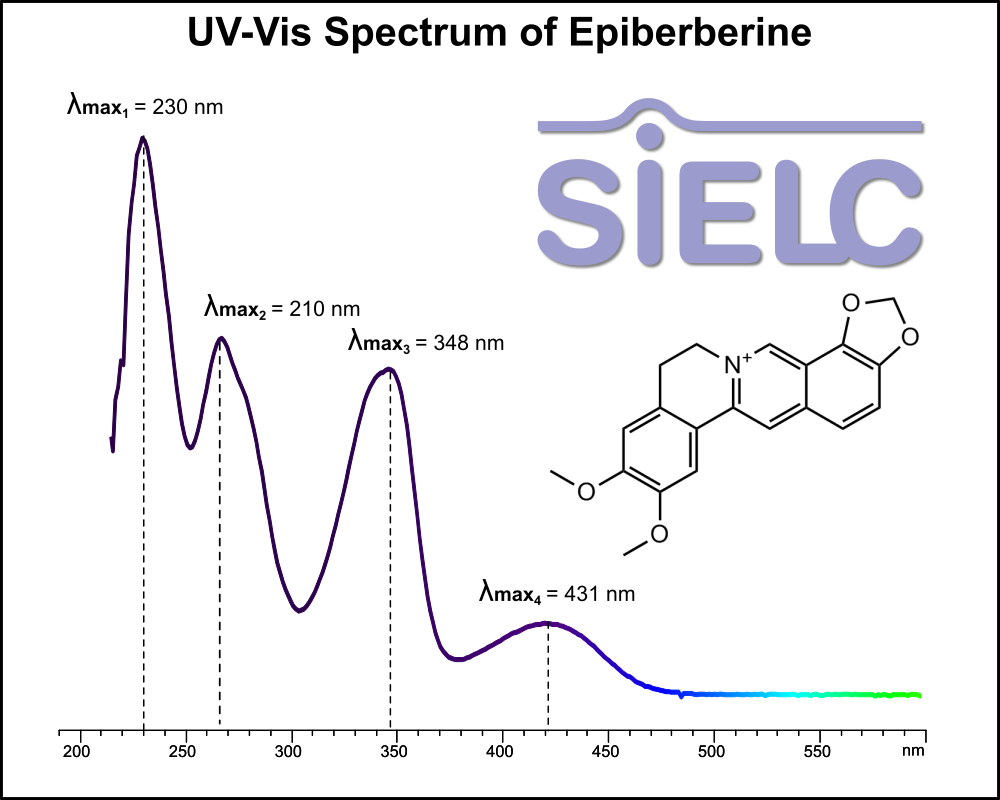
Uv-Vis Spectrum of Epiberberine
March 9, 2026
Access the UV-Vis Spectrum SIELC Library
If you are looking for optimized HPLC method to analyze Epiberberine check our HPLC Applications library
For optimal results in HPLC analysis, it is recommended to measure absorbance at a wavelength that matches the absorption maximum of the compound(s) being analyzed. The UV spectrum shown can assist in selecting an appropriate wavelength for your analysis. Please note that certain mobile phases and buffers may block wavelengths below 230 nm, rendering absorbance measurement at these wavelengths ineffective. If detection below 230 nm is required, it is recommended to use acetonitrile and water as low UV-transparent mobile phases, with phosphoric acid and its salts, sulfuric acid, and TFA as buffers.
For some compounds, the UV-Vis Spectrum is affected by the pH of the mobile phase. The spectra presented here are measured with an acidic mobile phase that has a pH of 3 or lower.

Alltesta HPLC Method for Analysis of Epiberberine and Berberine on Primesep B Column
February 3, 2025
Alltesta HPLC Method for Berberine, Epiberberine on Primesep B by SIELC Technologies
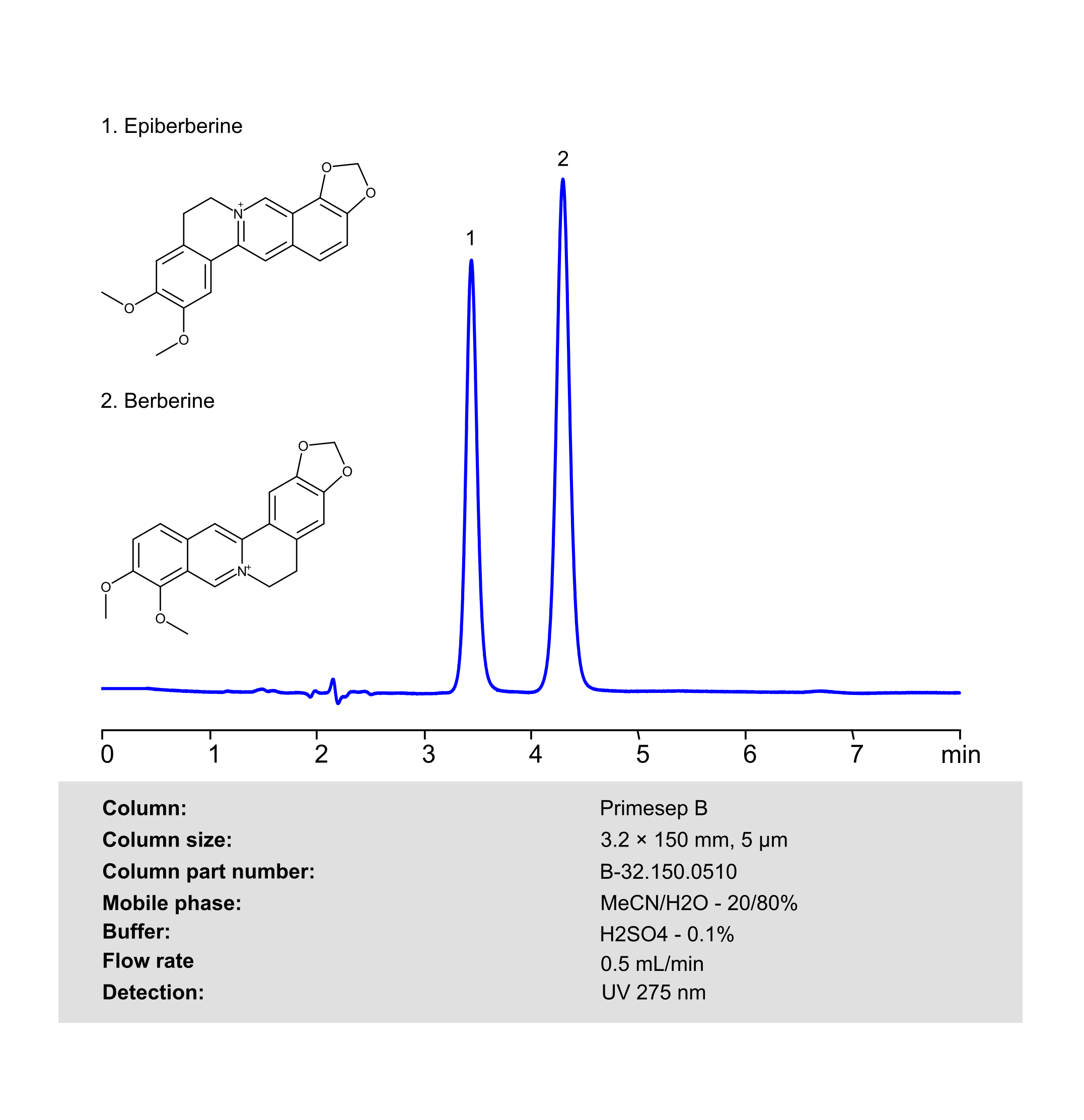
High Performance Liquid Chromatography (HPLC) Method for Analysis of Berberine, Epiberberine
Epiberberine and Berberine are both natural alkaloids found in various medicinal plants, particularly in the Berberis species. They share a similar chemical structure and biological properties but have distinct effects.
Berberine is well-known for its antimicrobial, anti-inflammatory, and metabolic benefits, including blood sugar regulation and cholesterol reduction. It is commonly used for diabetes, gut health, and cardiovascular support.
Epiberberine is a structural isomer of berberine and is believed to enhance its bioavailability and metabolic effects. Research suggests it may contribute to glucose metabolism and lipid regulation, making it a potential complementary compound in berberine-based supplements.
Epiberberine and berberine can be retained and analyzed using a Primesep B mixed-mode stationary phase column. The analysis employs an isocratic method with a simple mobile phase composed of water, acetonitrile (MeCN), and sulfuric acid as a buffer. Detection is performed using UV at 275 nm.
| Column | Primesep B, 3.2 x 150 mm, 5 µm, 100 A, dual ended |
| Mobile Phase | MeCN/H2O – 20/80% |
| Buffer | H2SO4 -0.1% |
| Flow Rate | 0.5 ml/min |
| Detection | UV 275 nm |
| Class of Compounds | Isoquinoline Alkaloid |
| Analyzing Compounds | Berberine, Epiberberine |
You can view examples of chromatograms obtained using the Allesta instrument and Sielc columns by clicking here.
Application Column
Primesep B
Column Diameter: 3.2 mm
Column Length: 150 mm
Particle Size: 5 µm
Pore Size: 100 A
Column options: dual ended
Epiberberine
