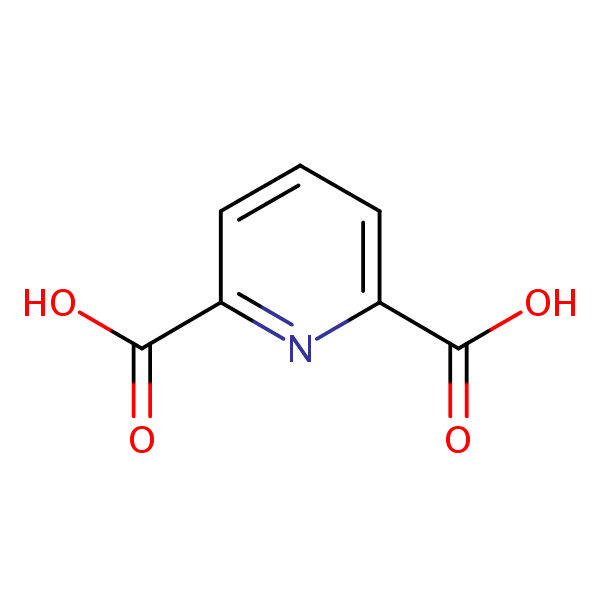
| CAS Number | 499-83-2 |
|---|---|
| Molecular Formula | C7H5NO4 |
| Molecular Weight | 167.120 |
| InChI Key | WJJMNDUMQPNECX-UHFFFAOYSA-N |
| LogP | 0.0746 |
| Synonyms |
|
Applications:
HPLC Method for Simultaneous Determination of Nicotinic Acid, Nicotinamide, Pyridine Dicarboxylic Acid, Ethyl Methyl Pyridine and Ethyl Nicotinate on Primesep 100 Column
August 29, 2022
HPLC Method for Nicotinic Acid (Vitamin B3), Nicotinamide, Pyridinedicarboxylic Acid, 2,5-Pyridinedicarboxylic acid, 5-Ethyl-2-methylpyridine, Ethyl nicotinate on Primesep 100 by SIELC Technologies
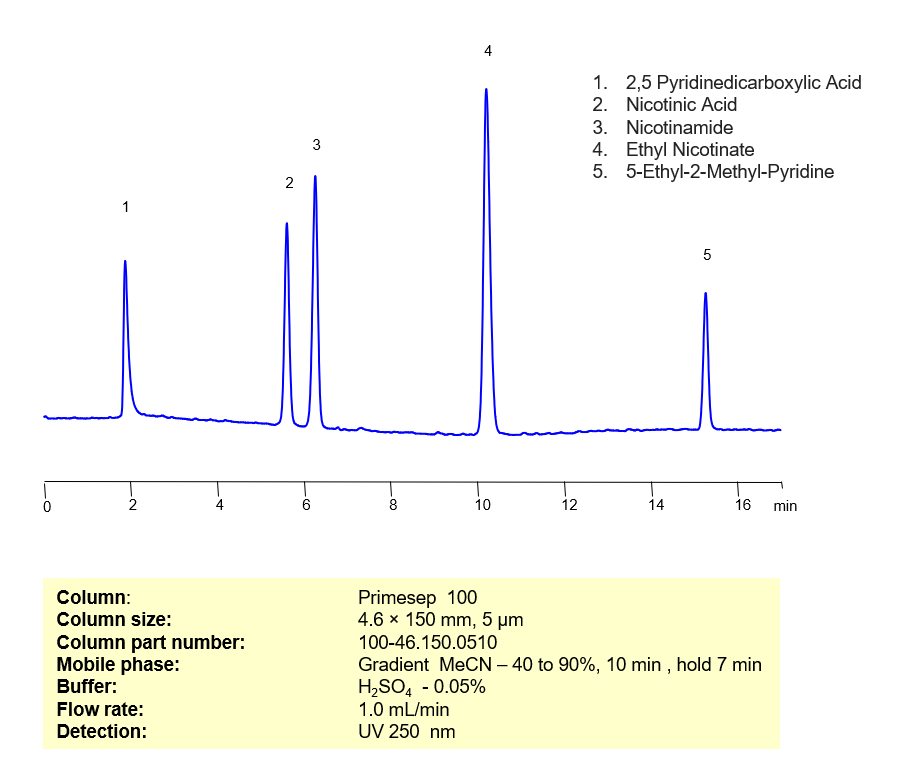
High Performance Liquid Chromatography (HPLC) Method for Analysis of Nicotinic Acid (Vitamin B3), Nicotinamide, Pyridinedicarboxylic Acid, 2,5-Pyridinedicarboxylic acid, 5-Ethyl-2-methylpyridine, Ethyl nicotinate.
2,5-Pyridinedicarboxylic acid (PDA), also known as Dipicolinic acid (DPA), is a key factor in bacterial endospore heat resistance. It also plays an important role in preparing transition metal complexes for ion chromatography.
Nicotinic acid, also known as niacin, is a water-soluble B vitamin with C6H5NO2 molecular formula. It is an essential nutrient that plants and animals synthesize from tryptophan. It is also used as a dietary supplement to treat pellagra, which is characterized by dermatitis of sunlight-exposed skin and is said to be caused by a corn-based diet. Nicotinic acid was found on asteroids and meteorites.
Nicotinamide, also known as niacinaminde, is a form of vitamin B3 with the chemical formula C6H6N2O2. It is preferred treatment for pellagra and is a common treatment for acne due to it’s anti-inflammatory properties. If consumed daily, it is shown to decrease the risk of skin cancers other than melanoma. It is a derivative of Nicotinic acid and is a key component of the coenzymes nicotinamide adenine dinucleotide (NAD) and nicotinamide adenine dinucleotide phosphate (NADP+). You can find detailed UV spectra of Nicotinamide and information about its various lambda maxima by visiting the following link.
Ethyl nicotinate, also known as nicotine acid ethyl ester, has the chemical formula C8H9NO2. It is a popular topical treatment for ligament, joint, and muscle pain.
5-Ethyl-2-methylpyridine is a common precursor to Nicotinic acid with the chemical formula C8H11N. It is produced by condensation of paraldehyde and ammonia.
Nicotinic Acid (Vitamin B3), Nicotinamide, Pyridinedicarboxylic Acid, 2,5-Pyridinedicarboxylic acid, 5-Ethyl-2-methylpyridine, Ethyl nicotinate can be separated, retained, and analyzed on a Primesep 100 mixed-mode column using an analytical method with a simple gradient mobile phase of water, Acetonitrile (MeCN), and a sulfuric acid (H2SO4) buffer. This analysis method can be UV detected at 250 nm with high resolution and peak symmetry.
| Column | Primesep 100, 4.6 x 150 mm, 5 µm, 100 A, dual ended |
| Mobile Phase | MeCN – Gradient |
| Buffer | H2SO4 – 0.05% |
| Flow Rate | 1.0 ml/min |
| Detection | UV 250 nm |
| Class of Compounds | Drug, Acid |
| Analyzing Compounds | Nicotinic Acid (Vitamin B3), Nicotinamide, Pyridinedicarboxylic Acid, 2,5-Pyridinedicarboxylic acid, 5-Ethyl-2-methylpyridine, Ethyl nicotinate |
Application Column
Primesep 100
Column Diameter: 4.6 mm
Column Length: 150 mm
Particle Size: 5 µm
Pore Size: 100 A
Column options: dual ended
5-Ethyl-2-methylpyridine
Ethyl nicotinate
Nicotinamide
Nicotinic Acid (Vitamin B3)
Pyridinedicarboxylic Acid

HPLC Separation of Pyridinecarboxylic Acids
March 27, 2011
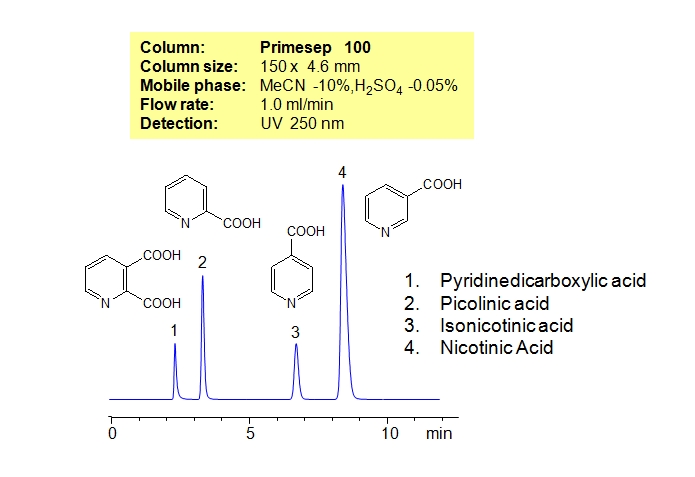
Pyridinecarboxylic acids exist as three isomers with different position of carboxylic acid relative to nitrogen in pyridine. Three isomers of pyridinecarboxylic acid (picolinic or 2-pyridinecarvoxylic acid, niacin or 3-pyridinecarboxylic acid, isonicotinic or 4-pyridinecarboxylic acid), along with pyridinedicarboxylic acid, are separated on a Primesep 100 column. Pyridinecarboxylic acids have a similar empirical formula, and are very similar in terms of hydrophobicity and ionic properties. Small differences in these properties are enough to achieve good separation on cation-exchange mixed-mode HPLC column like Primesep 100. Retention time for all compounds is controlled by the amount of acetonitrile and amount of ions in the mobile phase. Ions in the mobile phase can be created by organic and inorganic acids and corresponding salt buffers. Various detection techniques can be used for monitoring pyridinecarboxylic acids. Other ionizable isomers can be successfully separated on mixed-mode columns.
Application Column
Primesep 100
The Primesep family of mixed-mode columns offers a wide variety of stationary phases, boasting unprecedented selectivity in the separation of a broad array of chemical compounds across multiple applications. Corresponding Primesep guard columns, available with all stationary phases, do not require holders. SIELC provides a method development service available to all customers. Inquire about our specially-tailored custom LC-phases for specific separations.
Select optionsNicotinic Acid (Vitamin B3)
Organic Acids
Picolinic Acid
Pyridinedicarboxylic Acid
