
| CAS Number | 2519-30-4 |
|---|---|
| Molecular Formula | C28H17N5Na4O14S4 |
| Molecular Weight | 867.7 |
| InChI Key | GMMAPXRGRVJYJY-UHFFFAOYSA-J |
| Synonyms |
|
Applications:
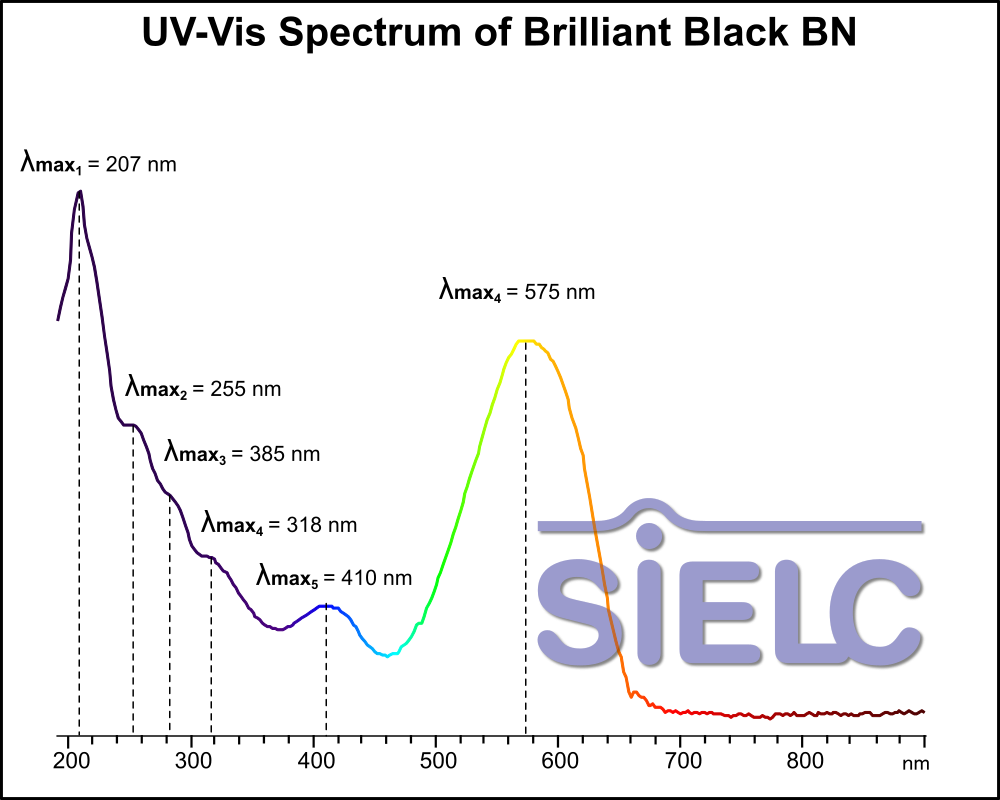
Uv-Vis Spectrum of Brilliant Black BN
April 8, 2026
Access the UV-Vis Spectrum SIELC Library
If you are looking for optimized HPLC method to analyze Brilliant Black BN check our HPLC Applications library
For optimal results in HPLC analysis, it is recommended to measure absorbance at a wavelength that matches the absorption maximum of the compound(s) being analyzed. The UV spectrum shown can assist in selecting an appropriate wavelength for your analysis. Please note that certain mobile phases and buffers may block wavelengths below 230 nm, rendering absorbance measurement at these wavelengths ineffective. If detection below 230 nm is required, it is recommended to use acetonitrile and water as low UV-transparent mobile phases, with phosphoric acid and its salts, sulfuric acid, and TFA as buffers.
For some compounds, the UV-Vis Spectrum is affected by the pH of the mobile phase. The compound was dissolved with water. This analysis was done with the mobile phase made of 20% acetonitrile and 80% water.

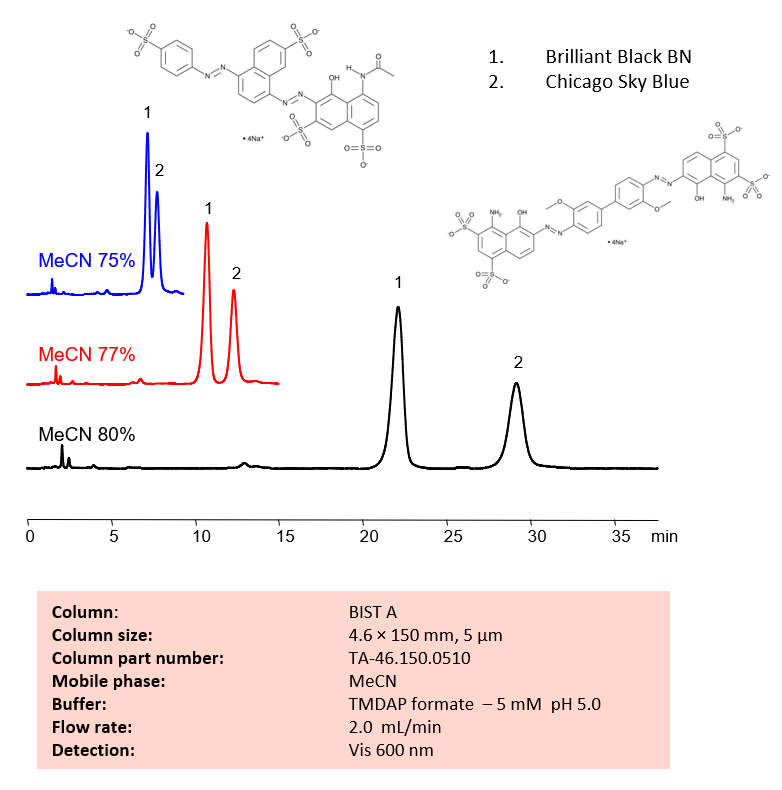
HPLC Method for Analysis of Brilliant Black BN and Chicago Sky Blue on BIST A Column by SIELC Technologies
November 30, 2022
HPLC Method for Brilliant Black BN, Chicago Sky Blue 6B on BIST A by SIELC Technologies
Brilliant Black BN (Food Black 1, E151) is a synthetic black daizo dye with the chemical formula C28H17N5Na4O14S4. It is also known as Food Black 1 and Napthol Black. It is approved for use in the European Union, but is banned in United States and Japan. It is often used in food for decorating. You can find detailed UV spectra of Brilliant Black BN and information about its various lambda maxima by visiting the following link.
Chicago Skye Blue 6B is an organic dye also known as Direct Blue 1 and has the chemical formula C34H24N6Na4O16S4. It is typically sold as a blue powder and is primarily used in histochemistry. Commercially, it is also used in dyeing textiles with high contents of cellulose. You can find detailed UV spectra of Chicago Skye Blue 6B and information about its various lambda maxima by visiting the following link.
Brilliant Black BN, Chicago Sky Blue 6B are azo dyes with the unique property that they have 4 sulfonate groups. Using SIELC’s newly introduced BIST™ method, Brilliant Black BN, Chicago Sky Blue 6B can be retained and separated into its component compounds easily on a negatively-charged, cation-exchange BIST A column. There are two keys to this retention method: 1) a multi-charged, positive buffer, such as N,N,N’,N’-Tetramethyl-1,3-propanediamine (TMDAP), which acts as a bridge, linking the negatively-charged anion analytes to the negatively-charged column surface and 2) a mobile phase consisting mostly of organic solvent (such as MeCN) to minimize the formation of a solvation layer around the charged analytes. While both of these sulfonated dyes have the same charge, their molecular structure (and therefore charge distribution) differs just enough to allow them to be separated in a high-organic MP.
Other positively-charged buffers that can generate BIST™ include DMP, Calcium acetate, and Magnesium acetate. Using this new and unique analysis method, Brilliant Black BN and Chicago Sky Blue can be retained and separated with high selectivity and great peak shape. This method can be detected and is compatible with ELSD, CAD, and Mass Spectrometry (LC-MS).
Condition
| Column | BIST A, 4.6 x 150 mm, 5 µm, 100 A, dual ended |
| Mobile Phase | MeCN |
| Buffer | TMDAP phosphate – 5 mM pH 4.0 |
| Flow Rate | 2.0 mL/min |
| Detection | Vis 600 nm |
Description
| Class of Compounds | Dyes |
| Analyzing Compounds | Brilliant Black BN, Chicago Sky Blue 6B |
Application Column
BIST A
Column Diameter: 4.6 mm
Column Length: 150 mm
Particle Size: 5 µm
Pore Size: 100 A
Column options: dual ended
Chicago Sky Blue 6B
