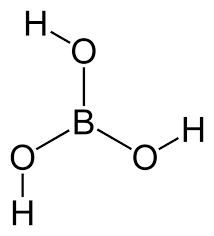
| CAS Number | 10043-35-3 |
|---|---|
| Molecular Formula | H3BO3 |
| Molecular Weight | 61.84 |
| InChI Key | KGBXLFKZBHKPEV-UHFFFAOYSA-N |
| Synonyms |
|
Applications:
HPLC Method for Determination of Borate Ion in Boric Acid and Borax on Chromni Column
October 9, 2026
HPLC Method for Analysis of Borate Ion in Boric Acid on Chromni Column by SIELC Technologies
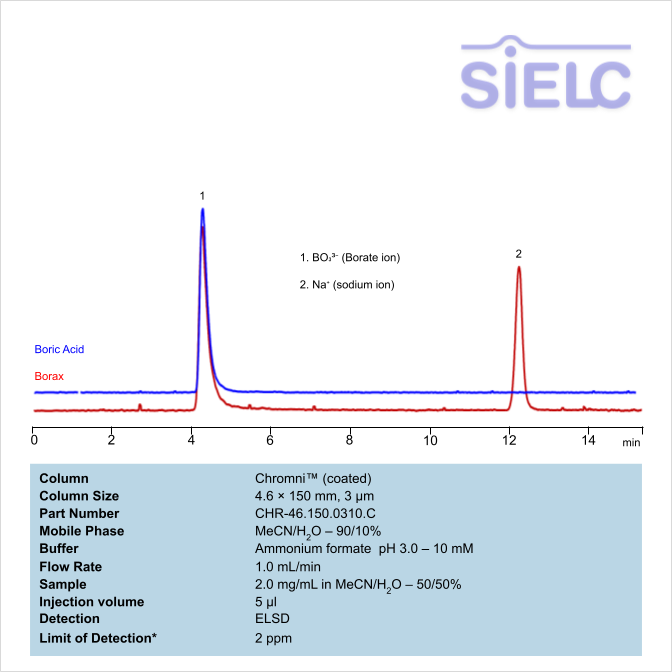
High Performance Liquid Chromatography (HPLC) Method for Analysis of Orthoborate, Boric acid.
Sodium, which has a chemical symbol of Na, is a soft alkali metal that is highly reactive. It is found in abundance in everyday materials like table salt, sea water, and even the Earth’s crust. It is crucial for the body’s function and fluid balance.
Borate ion, also known as Orthoborate, is a polyatomic anion with the formula BO33-. It is used primarily in the making of boric acid and orthoborate salts.
Orthoborate, Boric acid can be retained and analyzed using the Chromni stationary phase column. The analysis utilizes an isocratic method with a simple mobile phase consisting of water and acetonitrile (MeCN). Detection is performed using ELSD.
Condition
| Column | Chromni, 4.6 x 150 mm, 3 µm, 100 A, surface coated |
| Mobile Phase | MeCN/H2O – 90/10 |
| Buffer | AmFM pH 3.0 – 10 mM |
| Flow Rate | 1.0 ml/min |
| Detection | ELSD, the nebulizer and evaporator temperatures 50°C with a gas flow rate of 1.6 Standard Liters per Minute (SLM) |
Description
| Class of Compounds | Ions |
| Analyzing Compounds | Orthoborate, Boric acid |
Application Column
Chromni
Column Diameter: 4.6 mm
Column Length: 150 mm
Particle Size: 3 µm
Pore Size: 100 A
Column options: surface coated
Orthoborate

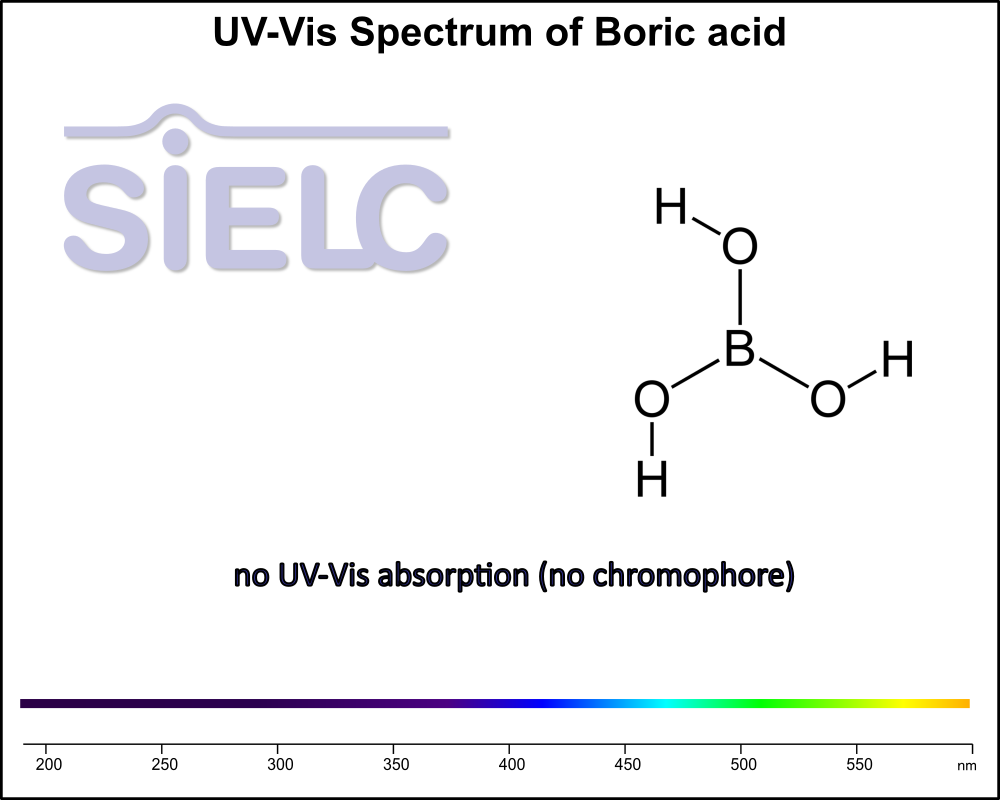
Uv-Vis Spectrum of Boric acid
February 13, 2026
If you are looking for optimized HPLC method to analyze Boric acid check our HPLC Applications library
For optimal results in HPLC analysis, it is recommended to measure absorbance at a wavelength that matches the absorption maximum of the compound(s) being analyzed. The UV spectrum shown can assist in selecting an appropriate wavelength for your analysis. Please note that certain mobile phases and buffers may block wavelengths below 230 nm, rendering absorbance measurement at these wavelengths ineffective. If detection below 230 nm is required, it is recommended to use acetonitrile and water as low UV-transparent mobile phases, with phosphoric acid and its salts, sulfuric acid, and TFA as buffers.
For some compounds, the UV-Vis Spectrum is affected by the pH of the mobile phase. The spectra presented here are measured with an acidic mobile phase that has a pH of 3 or lower.
