HPLC Method for Oligonucleotides on Chromni by SIELC Technologies
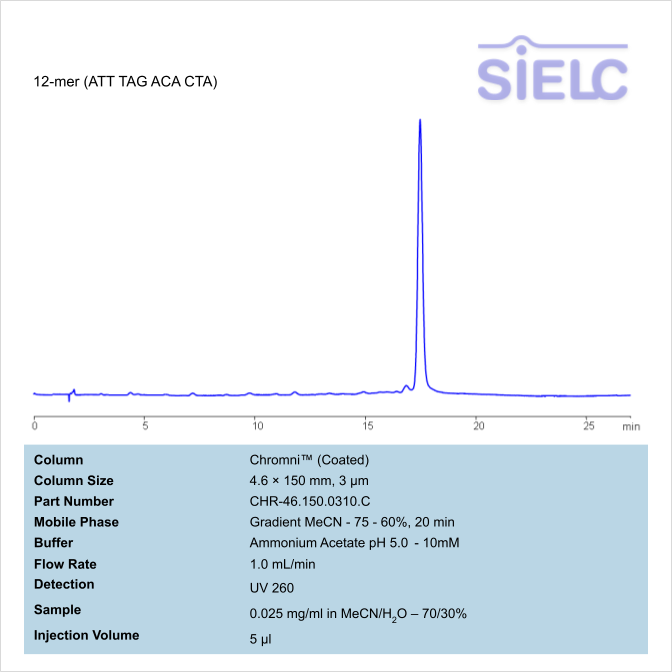
High Performance Liquid Chromatography (HPLC) Method for Analysis of Oligonucleotides
Oligonucleotides are short sequences of nucleotides that serve as essential tools in molecular biology. These oligonucleotides can be composed of any combination of the four standard nucleotides: adenine (A), thymine (T), cytosine (C), and guanine (G).
Research and Studies:
- Molecular Biology: In molecular biology, such oligos can be used as primers for PCR, sequencing, or as probes in hybridization experiments.
- Binding Studies: The poly(A) sequence may be used to study binding interactions with proteins, such as DNA-binding proteins or enzymes.
Medical and Diagnostic Applications:
- As part of diagnostic kits, especially in assays that require hybridization to a complementary sequence.
Educational Purposes:
Demonstrating basic principles of nucleic acid chemistry and genetics.
Nanotechnology:
In DNA nanotechnology, specific sequences of DNA are used to form structures and shapes at the nanoscale. A poly(A) sequence might be part of a larger structure.
Oligonucleotides can be retained and analyzed using the Chromni stationary phase column. The analysis utilizes an gradient method with a simple mobile phase consisting of water and acetonitrile (MeCN) with a ammonium acetate as a buffer. Detection is performed using UV.
| Column | Chromni, 4.6 x 150 mm, 3 µm, 100 A, surface coated |
| Mobile Phase | Gradient MeCN – 75 – 60%, 20 min |
| Buffer | Ammonium Acetate pH 5.0 – 10mM |
| Flow Rate | 1.0 ml/min |
| Detection | UV 260 |
| Class of Compounds | Oligonucleotide |
| Analyzing Compounds | Oligonucleotides |
Application Column
Chromni
Column Diameter: 4.6 mm
Column Length: 150 mm
Particle Size: 3 µm
Pore Size: 100 A
Column options: surface coated