HPLC Method for Nicotinamide Adenine Dinucleotide (NAD), Nicotinamide Adenine Dinucleotide (reduced) (NADH) on Chromni by SIELC Technologies
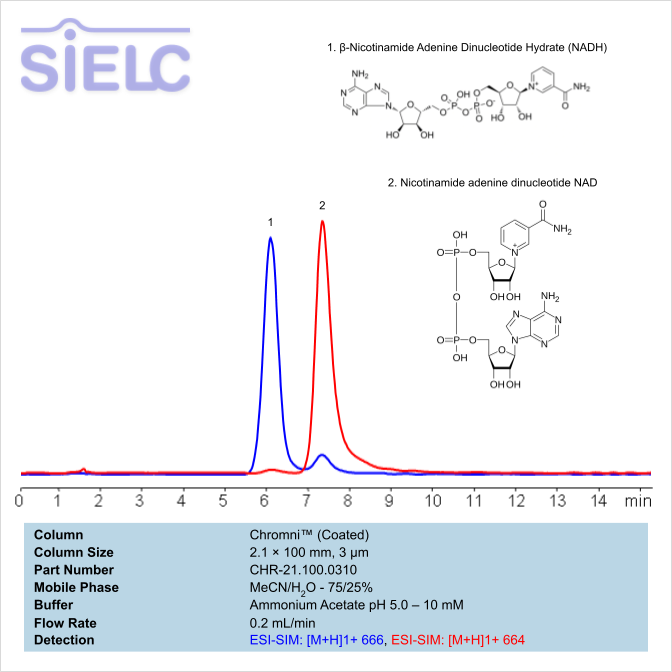
High Performance Liquid Chromatography (HPLC) Method for Analysis of Nicotinamide Adenine Dinucleotide (NAD), Nicotinamide Adenine Dinucleotide (reduced) (NADH).
Nicotinamide adenine dinucleotide (NAD), is a coenzyme found in every single living cell. NAD can exist in two forms: NAD+ and NADH. The conversion of NAD from its oxidized form (NAD+) to its reduced form (NADH), and back, provides the cell with a mechanism for accepting and donating electrons.. You can find detailed UV spectra of NAD and information about its various lambda maxima by visiting the following link. You can find detailed UV spectra of NADH and information about its various lambda maxima by visiting the following link.
Nicotinamide Adenine Dinucleotide (NAD), Nicotinamide Adenine Dinucleotide (reduced) (NADH) can be retained and analyzed using the Chromni stationary phase column. The analysis utilizes an isocratic method with a simple mobile phase consisting of water and acetonitrile (MeCN) with an Ammonium Acetate buffer. Detection is performed using MS.
| Column | Chromni, 2.1 x 100 mm, 3 µm, 100 A, surface coated |
| Mobile Phase | MeCN/H2O – 75/25% |
| Buffer | Ammonium Acetate pH 5.0 – 10 mM |
| Flow Rate | 1.0 mL/min |
| Detection | ESI-SIM: [M+H]1+ 666, ESI-SIM: [M+H]1+ 664 |
| Class of Compounds | Enzyme |
| Analyzing Compounds | Nicotinamide Adenine Dinucleotide (NAD), Nicotinamide Adenine Dinucleotide (reduced) (NADH) |
Application Column
Chromni
Column Diameter: 2.1 mm
Column Length: 100 mm
Particle Size: 3 µm
Pore Size: 100 A
Column options: surface coated
Nicotinamide Adenine Dinucleotide (reduced) (NADH)