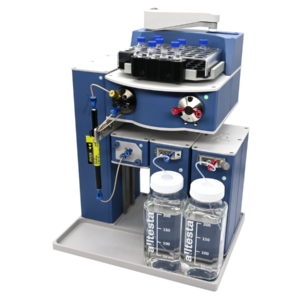
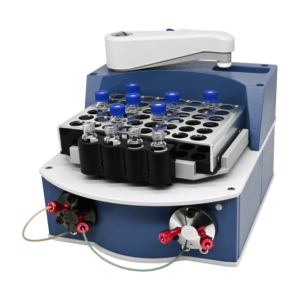
HPLC Method for Analysis of Cytochrome C on BIST B+ by SIELC Technologies.
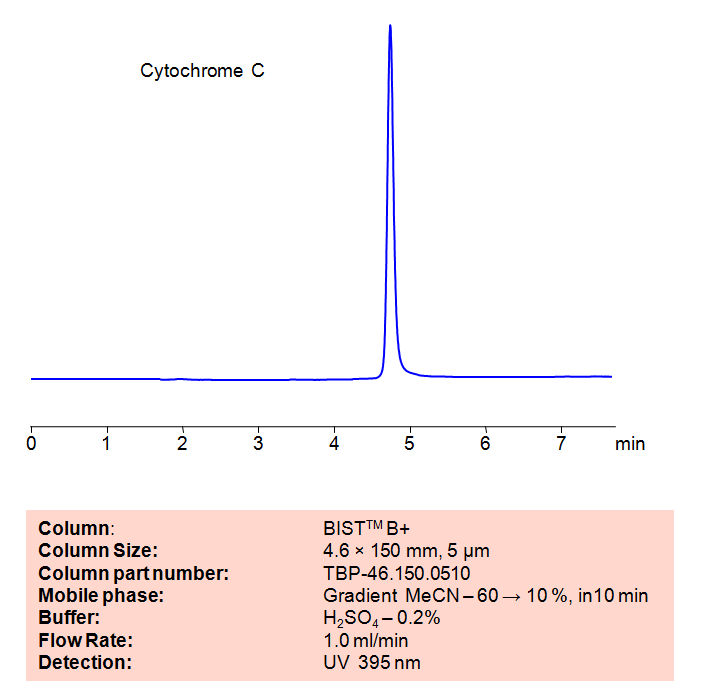
Cytochrome C, also known as cytochrome complex, is a mitochondrial protein that is essential to both the respiratory electron transport chain and the apoptosis cycle of cells with the chemical formula C42H52FeN8O6S2. It is a small hemeprotein that is usually associated with the inner membrane of the mitochondrion. It is primarily used to detect peroxide production in biological systems.
Using SIELC’s newly introduced BIST™ method, this essential protein can be retained on a positively-charged anion-exchange BIST B+ column. There are two keys to this retention method: 1) a multi-charged, negative buffer, such as Sulfuric acid (H2SO4), which acts as a bridge, linking the positively-charged amine analytes to the positively-charged column surface and 2) a mobile phase consisting mostly of organic solvent to minimize the formation of a solvation layer around the charged analytes. Using this new and unique analysis method, Cytochrome C can be retained and UV detected at 395 nm.
Condition
| Column | BIST B+, 4.6 x 150 mm, 5 µm, 100 A, dual ended |
| Mobile Phase | MeCN |
| Buffer | H2SO4 – 0.2% |
| Flow Rate | 1.0 ml/min |
| Detection | UV 395 nm |
| Peak Retention Time | 4.9 min |
Description
| Class of Compounds | Protein, Hemeprotein |
| Analyzing Compounds | Cytochrome C |
Application Column
BIST B+
Column Diameter: 4.6 mm
Column Length: 150 mm
Particle Size: 5 µm
Pore Size: 100 A
Column options: dual ended