HPLC Method for DMF (Dimethylformamide), DMA (Dimethylacetamide) on Primesep 100 by SIELC Technologies
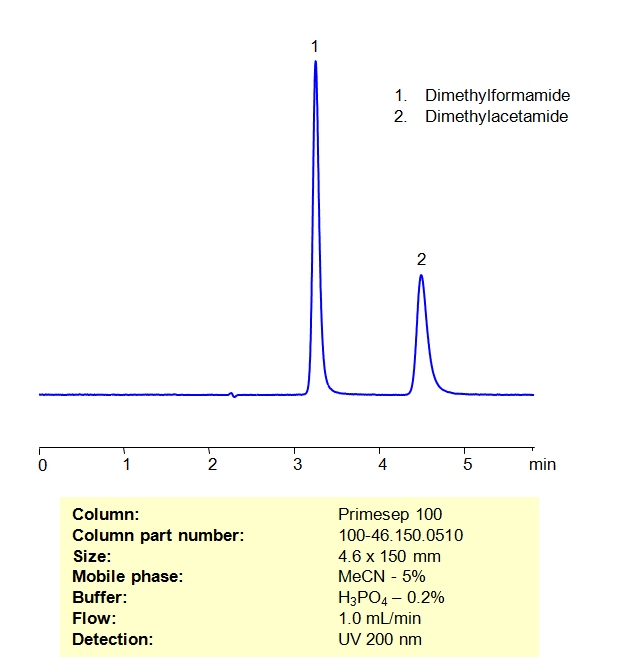
High Performance Liquid Chromatography (HPLC) Method for Analysis of DMF (Dimethylformamide), DMA (Dimethylacetamide).
Dimethylformamide, also written as DMF, is an organic compound with the chemical formula HCON(CH3)2. It is primarily used as a solvent for chemical reactions due to it’s low evaporation rate. It is used in the production of acrylic fibers, adhesives, synthetic leathers, and plastics. Pharmaceutically, it is used as a solvent in peptide coupling and the production of pesticides.
Dimethylacetamide, also written as DMAc and DMA, is an organic compound with the chemical formula C4H9NO. It is used primarily as a polar solvent in organic synthesis. Since 2014, DMA has been under investigation due to it’s toxicity.
DMF (Dimethylformamide), DMA (Dimethylacetamide) can be retained and analyzed using the Primesep 100 stationary phase column. The analysis utilizes an isocratic method with a simple mobile phase consisting of water and acetonitrile (MeCN) with a [buffer] buffer. Detection is performed using UV.
| Column | Primesep 100, 4.6 x 150 mm, 5 µm, 100 A, dual ended |
| Mobile Phase | MeCN/H2O – 5/95% |
| Buffer | H3PO4 – 0.2% |
| Flow Rate | 1.0 ml/min |
| Detection | UV, 200 nm, |
| Class of Compounds |
Amide |
| Analyzing Compounds | DMF (Dimethylformamide), DMA (Dimethylacetamide) |
Application Column
Primesep 100
Column Diameter: 4.6 mm
Column Length: 150 mm
Particle Size: 5 µm
Pore Size: 100 A
Column options: dual ended
DMF (Dimethylformamide)