HPLC Method for Analysis of Mellitic acid on Newcrom BH Column by SIELC Technologies
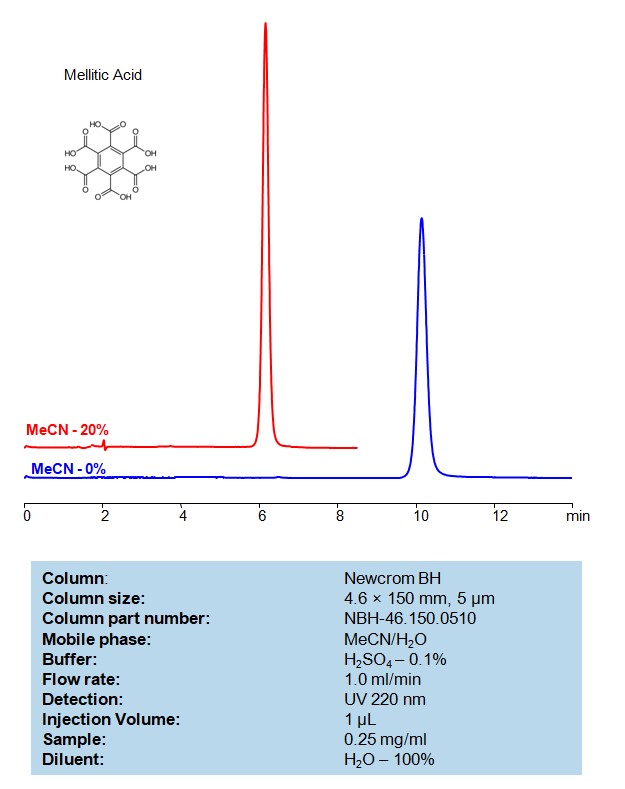
Mellitic Acid is an aromatic dicarboxylic acid with the chemical formula C12H6O12. It is a white crystalline solid and is derived from benzoic acid. Mellitic acid is named after mellite, a mineral in which it was first discovered. It is not commonly encountered in everyday use and does not have widespread applications. It is more commonly encountered in scientific contexts and research. Mellitic acid can form various derivatives, and some of its salts and esters have been studied for specific purposes. It consists of a benzene ring with six carboxylic acid functional groups (-COOH) attached to it, forming a hexacarboxylic acid. Mellitic acid is not a naturally abundant compound and is primarily known for its existence as a mineral, mellite, which contains mellitic acid.
Mellitic acid can be retained and analyzed on a reversed-phase Newcrom BH column with a mobile phase consisting of water, Acetonitrile (MeCN), and sulfuric acid. This analytical method can be detected with high resolution and peak symmetry at a wavelength of 220 nm using UV detection
Condition
| Column | Newcrom BH, 4.6 x 150 mm, 5 µm, 100 A, dual ended |
| Mobile Phase | MeCN/H2O |
| Buffer | H2SO4 – 0.1% |
| Flow Rate | 1.0 ml/min |
| Detection | UV 220 nm |
| Injection volume: | 1 µL |
| Sample | 0.25 mg/ml |
| Sample Diluent | H2O – 100% |
Description
| Class of Compounds | Acid |
| Analyzing Compounds | Mellitic acid |
Application Column
Newcrom BH
Column Diameter: 4.6 mm
Column Length: 150 mm
Particle Size: 5 µm
Pore Size: 100 A
Column options: dual ended