HPLC Chiral Method for Analysis of Chlorthalidone Enantiomers on Cyralis CL Column by SIELC Technologies
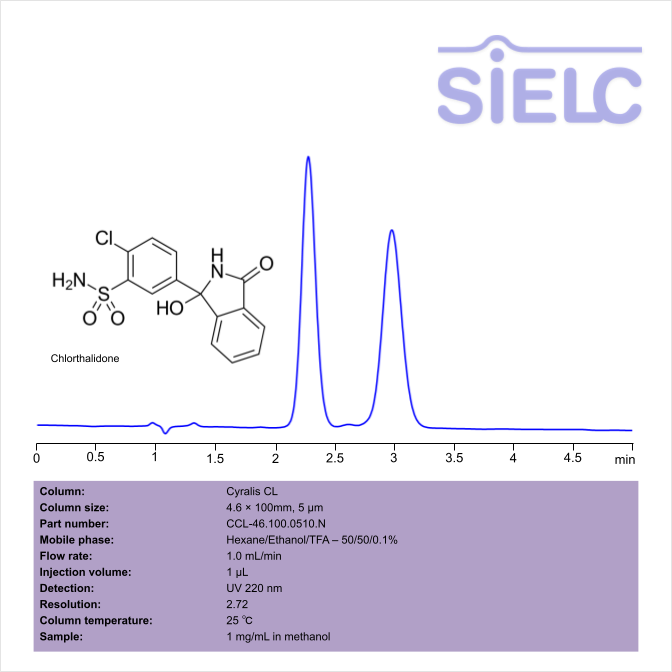
High Performance Liquid Chromatography (HPLC) Method for Analysis of Chlorthalidone.
Chlorthalidone, also known as Chloratalidone, is a thiazide-like diuretic drug with the chemical formula C14H11ClN2O4S. It is used primarily in treatment of high blood pressure, swelling caused by heart and liver failure, renal tubular acidosis, and more. Less commonly, itis used to treat calcium-based kidney stones. It works through reducing the reabsorption of sodium and chloride by inhibiting the Na+/Cl– symporter in the apical membrane of distal convoluted tubule cells in the kidney. It is banned in cricket, wrestling, and boxing.
This application describes a normal-phase chiral HPLC method for the separation of Chlorthalidone enantiomers using SIELC’s Cyralis CL chiral column. Cyralis CL is a cellulose-based chiral stationary phase (CSP) designed for enantiomeric separations, optical purity testing, chiral impurity analysis, and stereoisomer characterization in pharmaceutical, chemical, agrochemical, and fine chemical applications.
Chlorthalidone can be retained and analyzed using the Cyralis CL stationary phase column. The analysis utilizes an isocratic method with a mobile phase consisting of hexane, ethanol, and TFA. Detection is performed using UV.
Condition
| Column | Cyralis CL, 4.6 x 100 mm, 5 µm, 100 A, normal phase |
| Mobile Phase | Hexane/Ethanol/TFA– 50/50/0.1% |
| Flow Rate | 1.0 mL/min |
| Detection | UV 220 nm |
| Resolution | 2.72 |
Description
| Class of Compounds | Drug |
| Analyzing Compounds | Chlorthalidone |
Application Column
Cyralis CL
Column Diameter: 4.6 mm
Column Length: 100 mm
Particle Size: 5 µm
Pore Size: 100 A
Column options: normal phase