HPLC Method for Donepezil, 1-Benzylpiperidine-4-carbaldehyde on Primesep 100 by SIELC Technologies
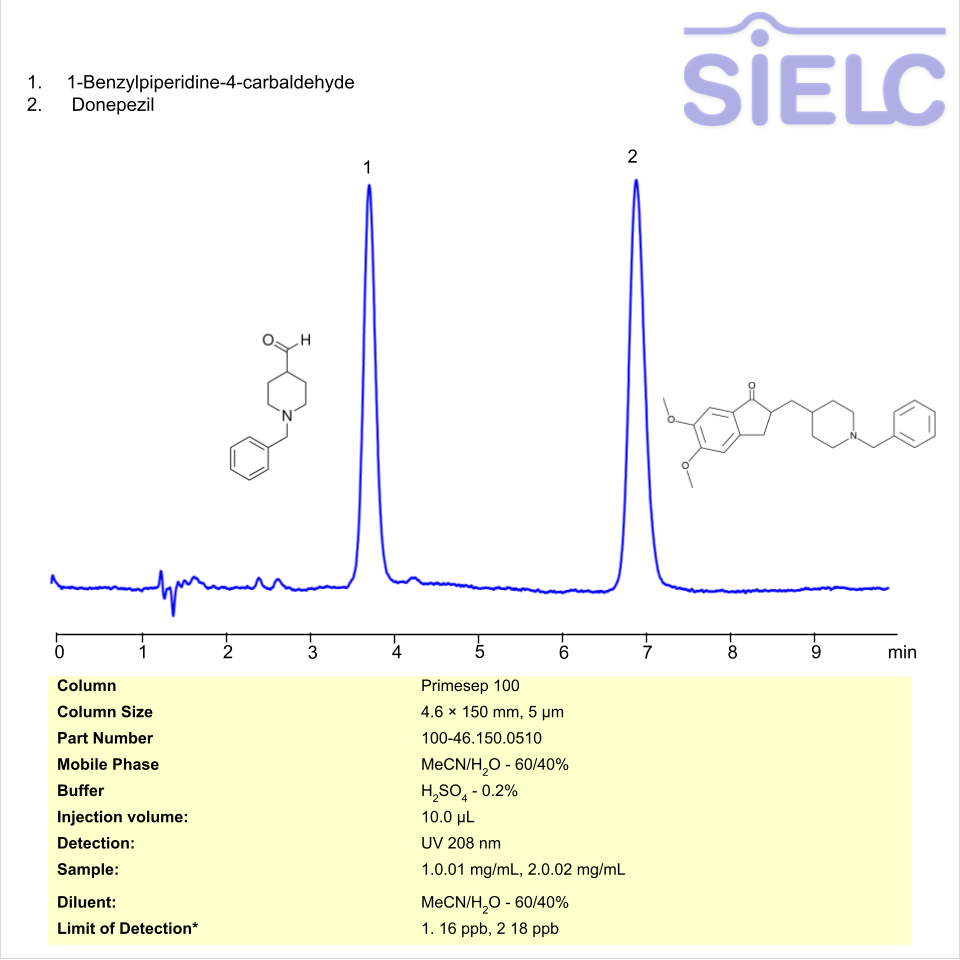
High Performance Liquid Chromatography (HPLC) Method for Analysis of Donepezil, 1-Benzylpiperidine-4-carbaldehyde
Donepezil is a medication with the chemical formula C24H29NO3. It is primarily used to treat dementia and improve cognition, but has not shown to cause any change in the progression of the disease. Some research suggests that it can be used to treat Lewy body dementia, effects of traumatic brain injury, and vascular dementia. 1-Benzylpiperidine-4-carbaldehyde is an important intermediate used in pharmaceutical and medicinal chemistry research. Its reactive aldehyde group and piperidine ring make it useful for synthesizing biologically active compounds.
You can find detailed UV spectra of Donepezil, 1-Benzylpiperidine-4-carbaldehyde and information about its various lambda maxima by visiting the following link.
Donepezil, 1-Benzylpiperidine-4-carbaldehyde can be retained and analyzed using the Primesep 100 stationary phase column. The analysis utilizes an isocratic method with a simple mobile phase consisting of acetonitrile (MeCN). Detection is performed using UV.
| Column | Primesep 100, 4.6 x 150 mm, 5 µm, 100 A, dual ended |
| Mobile Phase | MeCN/H2O – 60/40% |
| Buffer | Sulfuric Acid – 0.2% |
| Flow Rate | 1.0 ml/min |
| Detection | UV 208 nm |
| Limit of Detection* | 1. 16 ppb, 2.0 18 ppb |
| Class of Compounds | Drug |
| Analyzing Compounds | Donepezil, 1-Benzylpiperidine-4-carbaldehyde |
Application Column
Primesep 100
Column Diameter: 4.6 mm
Column Length: 150 mm
Particle Size: 5 µm
Pore Size: 100 A
Column options: dual ended
Donepezil