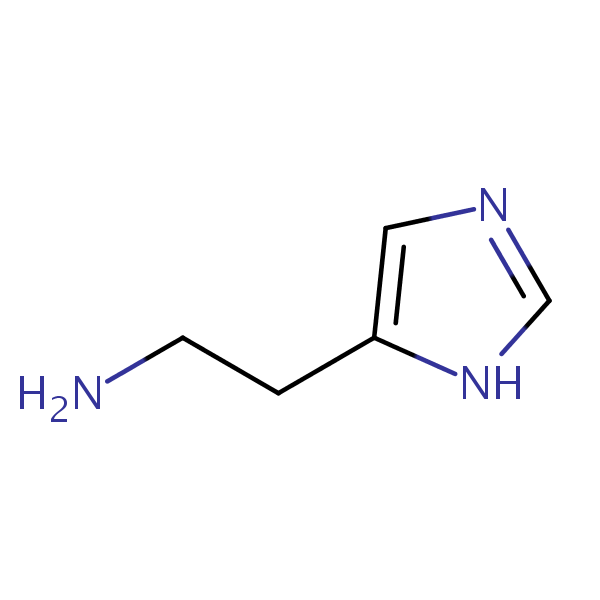
| CAS Number | 51-45-6 |
|---|---|
| Molecular Formula | C5H9N3 |
| Molecular Weight | 111.149 |
| InChI Key | NTYJJOPFIAHURM-UHFFFAOYSA-N |
| LogP | -0.700 |
| Synonyms |
|
Applications:
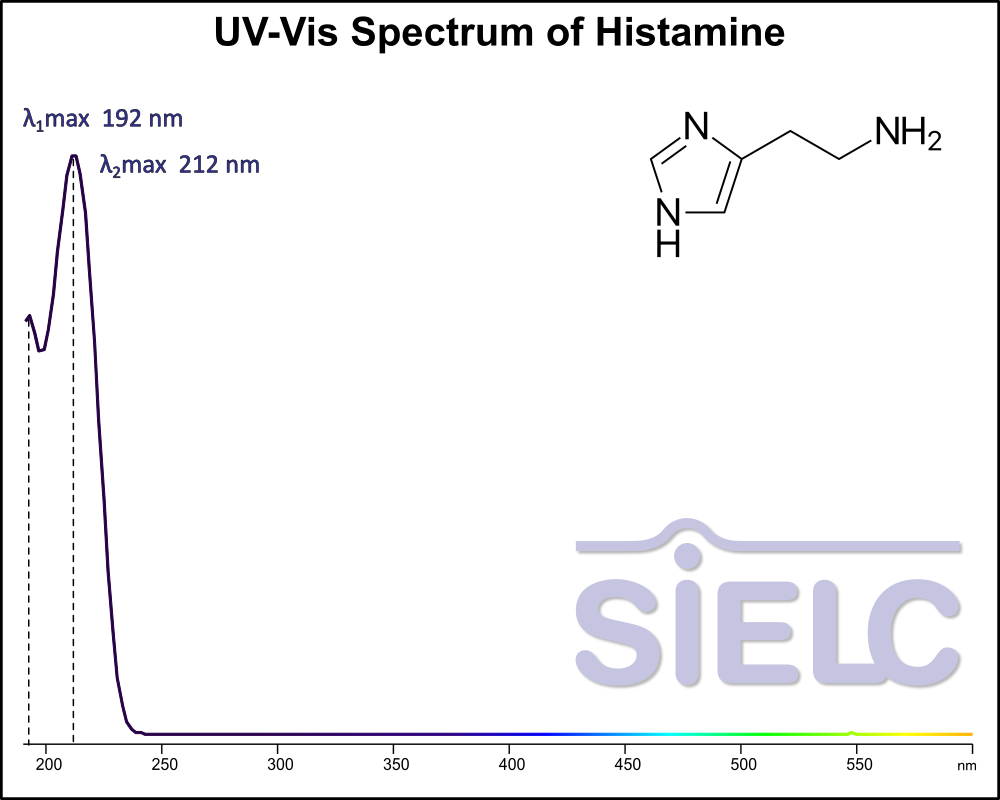
Uv-Vis Spectrum of Histamine
January 19, 2026
If you are looking for optimized HPLC method to analyze Histamine check our HPLC Applications library
For optimal results in HPLC analysis, it is recommended to measure absorbance at a wavelength that matches the absorption maximum of the compound(s) being analyzed. The UV spectrum shown can assist in selecting an appropriate wavelength for your analysis. Please note that certain mobile phases and buffers may block wavelengths below 230 nm, rendering absorbance measurement at these wavelengths ineffective. If detection below 230 nm is required, it is recommended to use acetonitrile and water as low UV-transparent mobile phases, with phosphoric acid and its salts, sulfuric acid, and TFA as buffers.
For some compounds, the UV-Vis Spectrum is affected by the pH of the mobile phase. The spectra presented here are measured with an acidic mobile phase that has a pH of 3 or lower.

HPLC Method for Determination of Histamine on BIST A+ Column by SIELC Technologies
October 18, 2022
HPLC Method for Determination of Histamine on BIST A+ Column by SIELC Technologies
Histamine dihydrochloride, also known as Ceplene, is a medication with the chemical formula C5H11Cl2N3. It is used primarily to prevent a relapse of acute myeloid leukemia. Other pharmaceutical applications include as a topical analgesic to treat arthritis, aches, bruises, sprains, and strains. Brand names it is sold under include Australian Dream and Alo.
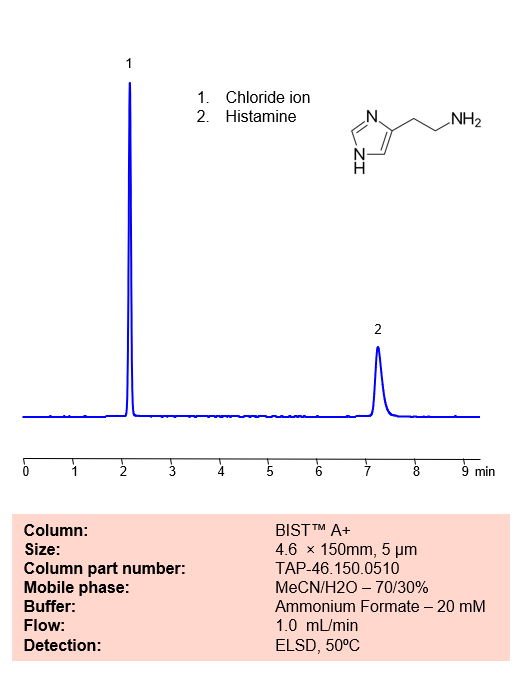
Histamine dihydrochloride can be detected in the low UV regime. Using a BIST A+ column and a mobile phase consisting of water and Acetonitrile (MeCN) with an ammonium formate (AmFm) buffer, Histamine chloride can be retained, separated, and analyzed. This analysis method can be detected and is compatible with Mass Spectrometry (MS), ELSD, and CAD.
Condition
| Column | BIST A+, 4.6 x 150 mm, 5 µm, 100 A, dual ended |
| Mobile Phase | MeCN – 70% |
| Buffer | Ammonium Formate pH 3.0 – 20 mM |
| Flow Rate | 1.0 ml/min |
| Detection | ELSD, 50C |
Description
| Class of Compounds | Drug |
| Analyzing Compounds | Histamine |
Application Column
BIST A+
Column Diameter: 4.6 mm
Column Length: 150 mm
Particle Size: 5 µm
Pore Size: 100 A
Column options: dual ended
HPLC Separation of Histamine and Phenethylamine on Primesep C Column
August 7, 2010

Histamine is a basic compound that acts like neurotransmitter. Phenethylamine is a natural amine alkaloid psychoactive compound with stimulant effects. It forms by enzymatic decarboxylation of phenylalanine, and also acts as neurotransmitter. Both compounds are separated in one HPLC run on Primesep C and Primesep 200 columns by reversed-phase cation-exchange mechanism. Primesep C provides shorter retention time and histamine and phenethylamine can be separated within 5 minutes. Primesep C and Primesep 200 columns do not require ion-pairing reagent as it is attached to the surface of Primesep silica gel. Method can be used for analysis of these two compounds in plasma, blood and urine with UV, ELSD, CAD or LC/MS detection.
Application Column
Primesep C
Column Diameter: 3.2 mm
Column Length: 50 mm
Particle Size: 5 µm
Pore Size: 100 A
Column options: dual ended
Phenethylamine
HPLC Separation of Histamine and Phenethylamine on Primesep 200 Column
June 12, 2004
Histamine is a basic compound that acts like neurotransmitter. Phenethylamine is a natural amine alkaloid psychoactive compound with stimulant effects. It forms by enzymatic decarboxylation of phenylalanine, and also acts as neurotransmitter. Both compounds are separated in one HPLC run on Primesep C and Primesep 200 columns by reversed-phase cation-exchange mechanism. Primesep C provides shorter retention time and histamine and phenethylamine can be separated within 5 minutes. Primesep C and Primesep 200 columns do not require ion-pairing reagent as it is attached to the surface of Primesep silica gel. Method can be used for analysis of these two compounds in plasma, blood and urine with UV, ELSD, CAD or LC/MS detection.
Application Column
Primesep 200
Column Diameter: 3.2 mm
Column Length: 150 mm
Particle Size: 5 µm
Pore Size: 100 A
Column options: dual ended
Phenethylamine
