
| CAS Number | 1637-71-4 |
|---|---|
| Molecular Formula | C3H7NO5S2 |
| Molecular Weight | 201.210 |
| InChI Key | NOKPBJYHPHHWAN-REOHCLBHSA-N |
| LogP | -1.93 |
| Synonyms |
|
Applications:
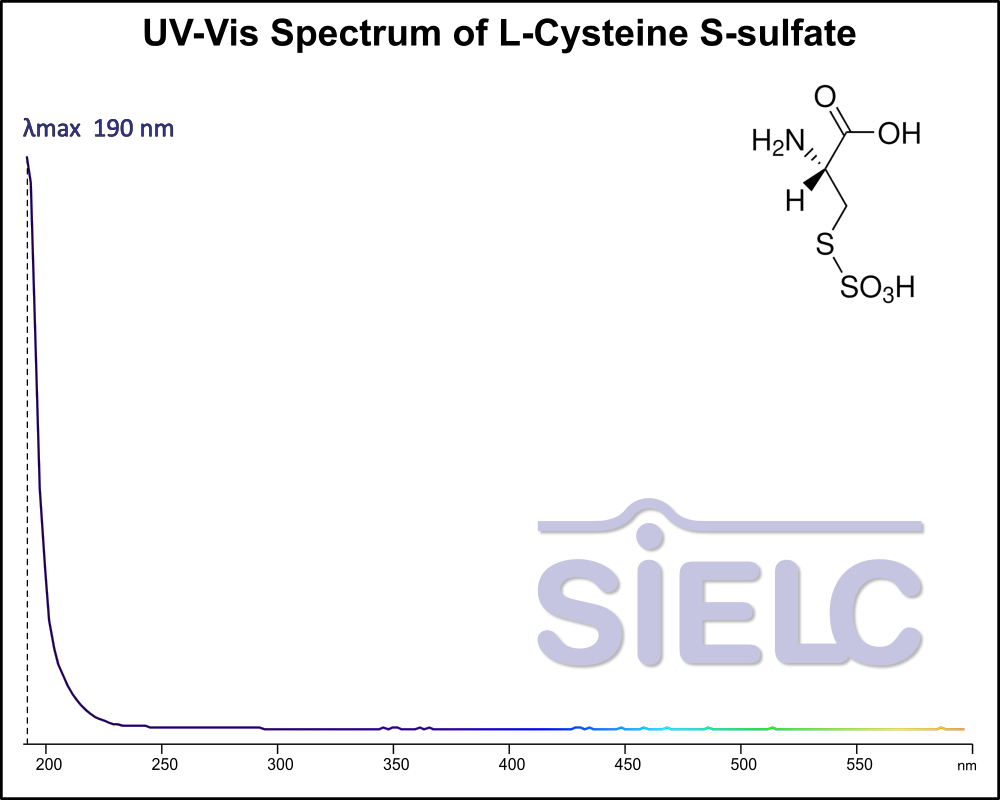
Uv-Vis Spectrum of L-Cysteine S-sulfate
January 13, 2026
If you are looking for optimized HPLC method to analyze L-Cysteine-S-Sulfate check our HPLC Applications library
For optimal results in HPLC analysis, it is recommended to measure absorbance at a wavelength that matches the absorption maximum of the compound(s) being analyzed. The UV spectrum shown can assist in selecting an appropriate wavelength for your analysis. Please note that certain mobile phases and buffers may block wavelengths below 230 nm, rendering absorbance measurement at these wavelengths ineffective. If detection below 230 nm is required, it is recommended to use acetonitrile and water as low UV-transparent mobile phases, with phosphoric acid and its salts, sulfuric acid, and TFA as buffers.
For some compounds, the UV-Vis Spectrum is affected by the pH of the mobile phase. The spectra presented here are measured with an acidic mobile phase that has a pH of 3 or lower.

HPLC Analysis of L-Cysteine-S-Sulfate on Primesep SB Column
October 14, 2010
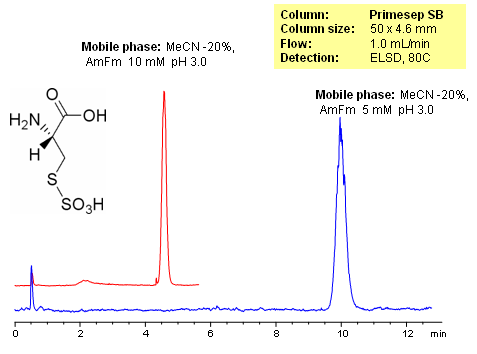
Cysteine-S-sulfate (SSC) is produced by reaction of inorganic sulfite and cystine by a as-yet-unknown pathway, and is a very potent NMDA-receptor antagonist. Cysteine-S-sulfate is a very polar molecule with one basic group, one carboxylic group and one sulfate group. It is retained by Primesep SB column by combination of strong anion-exchange mechanism and weak reversed-phase mechanism. Compound can be monitored by LC/MS, ELSD, Corona or UV detectors. This HPLC method can be adopted as generic approach for analysis of acidic and hydrophobic drugs.
Application Column
Primesep SB
Column Diameter: 4.6 mm
Column Length: 50 mm
Particle Size: 5 µm
Pore Size: 100 A
Column options: dual ended
