HPLC MS Method for Analysis of Procainamide on Primesep 200 Column by SIELC Technologies
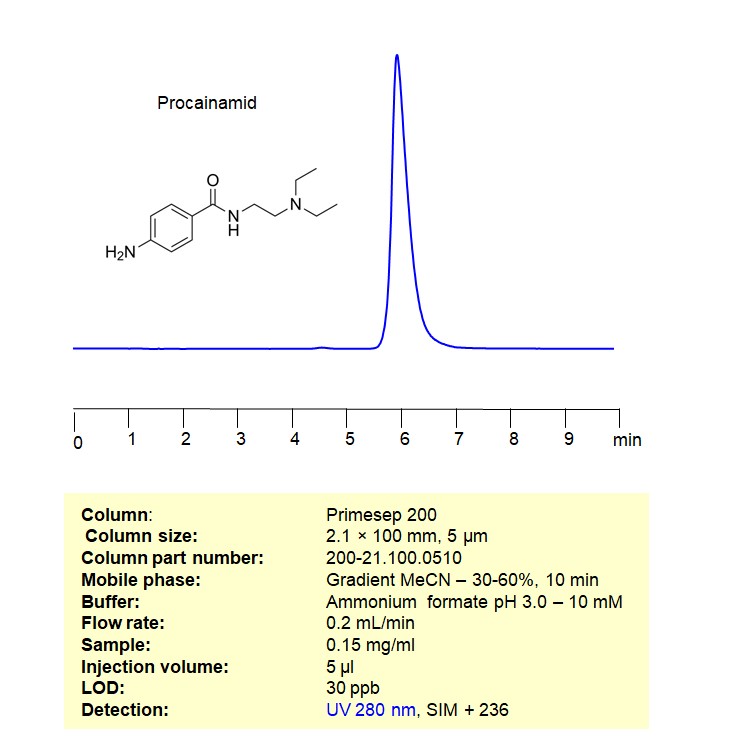
High Performance Liquid Chromatography (HPLC) Method for Analysis of Procainamide
Procainamide is an antiarrhythmic medication with the chemical formula C13H21N3O. It belongs to the Class Ia antiarrhythmic drugs. It is used to treat certain types of abnormal heart rhythms (arrhythmias) by stabilizing the cell membrane and reducing excitability in the heart muscle. Procainamide works by inhibiting sodium channels in cardiac cells, prolonging the action potential duration and refractory period, which helps in controlling irregular heartbeats. It is typically administered intravenously or orally under medical supervision. You can find detailed UV spectra of Procainamide and information about its various lambda maxima by visiting the following link.
Procainamide can be retained and analyzed using a [comlumn] mixed-mode stationary phase column. The analysis employs an isocratic method with a simple mobile phase comprising water, acetonitrile (MeCN), and ammonium formate as a buffer. This method allows for detection using UV at 280 nm
| Column | Primesep 200, 2.1 x 100 mm, 5 µm, 100 A, dual ended |
| Mobile Phase | Gradient MeCN 30-60%, 10 min |
| Buffer | AmFm pH 3.0 – 10 mM |
| Flow Rate | 0.2 ml/min |
| Detection | UV 280nm, SIM + 236 |
| Samples | 0.15mg/ml |
| Injection volume | 5 µl |
| LOD* | 30 ppb |
| Class of Compounds | Antiarrhythmic agent, Amide |
| Analyzing Compounds | Procainamide |
Application Column
Primesep 200
Column Diameter: 2.1 mm
Column Length: 100 mm
Particle Size: 5 µm
Pore Size: 100 A
Column options: dual ended
LC MS Detection