HPLC Method for Analysis of Tetraxetan (DOTA), DO3A on BIST B+ Column by SIELC Technologies
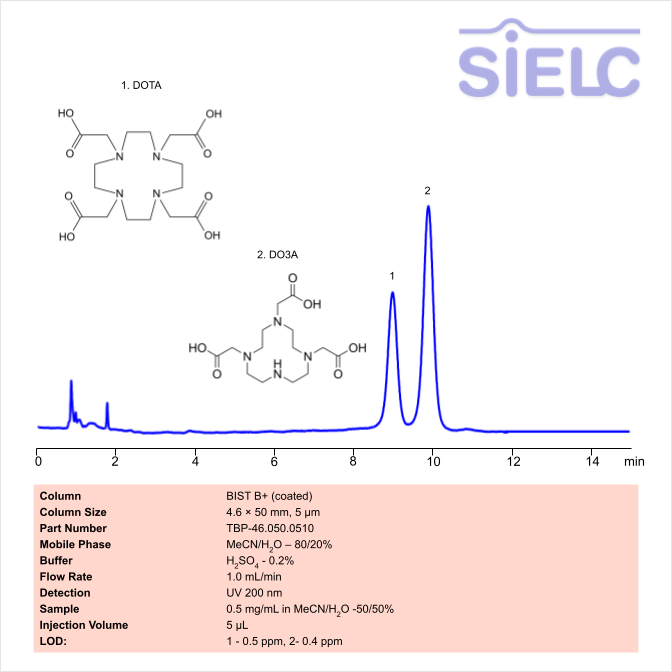
High Performance Liquid Chromatography (HPLC) Method for Analysis of Tetraxetan (DOTA), DO3A.
DOTA is a macrocyclic cheating agent with the chemical formula C16H28N4O8. DOTA is actually an acronym for 1,4,7,10-tetraazacyclododecane-1,4,7,10-tetraacetic acid. It is used to bind metal ions, partially due to it’s stability. It is often employed in biomedical applications including but not limited to MRI contrast agents and targeted cancer therapy. You can find detailed UV spectra of DOTA and information about its various lambda maxima by visiting the following link.
DO3A is a derivative of DOTA with the chemical formula C₁₄H₂₃N₄O₆Na₃. It is primarily used in pre-clinical research as a chelator, which binds radiometals. lanthanides, and manganese.
Tetraxetan (DOTA), DO3A can be retained and analyzed using the BIST B+ stationary phase column. The analysis utilizes an isocratic method with a simple mobile phase consisting of water and acetonitrile (MeCN) with a sulfuric acid buffer. Detection is performed using UV.
Condition
| Column | BIST B+, 4.6 x 50 mm, 5 µm, 100 A, surface coated |
| Mobile Phase | MeCN/H2O – 80/20% |
| Buffer | H2SO4 – 0.2% |
| Flow Rate | 1.0 ml/min |
| Detection | UV 200 |
| Limit Of Detection* | 1 – 0.5 ppm, 2- 0.4 ppm |
Description
| Class of Compounds | Chealting Agent |
| Analyzing Compounds | Tetraxetan (DOTA), DO3A |
Application Column
BIST B+
Column Diameter: 4.6 mm
Column Length: 50 mm
Particle Size: 5 µm
Pore Size: 100 A
Column options: surface coated
Tetraxetan (DOTA)