HPLC Method for Analysis of Cyanocobalamin on Chromni Column by SIELC Technologies
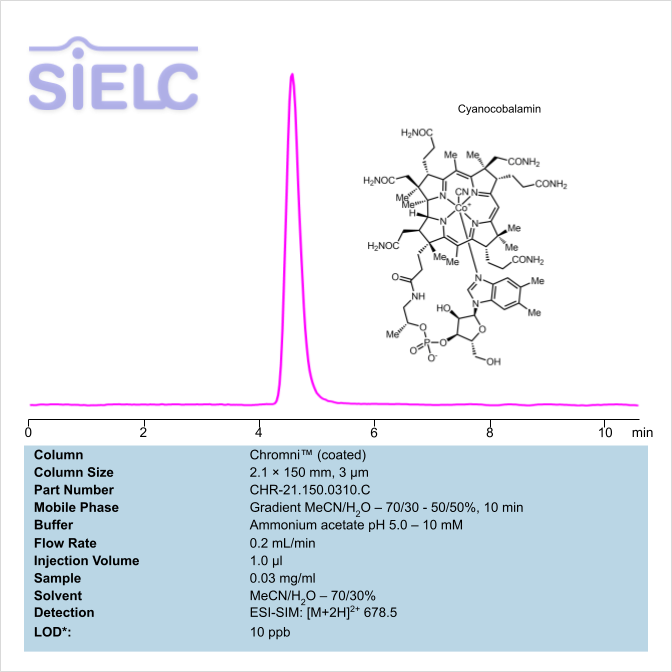
High Performance Liquid Chromatography (HPLC) Method for Analysis of Cyanocobalamin.
Cyanocobalamin, also known as vitamin B12, is an essential nutrient with the chemical formula C63H88CoN14O14P. It is naturally present in some foods and available as a dietary supplement and as prescription medication. Vitamin B12 exists in several forms and contains the mineral cobalt, so compounds with vitamin B12 activity are collectively called “cobalamins”. It plays an essential role in the production of the red blood cells and DNA, as well as in the proper functioning of the nervous system. You can find detailed UV spectra of Cyanocobalamin and information about its various lambda maxima by visiting the following link.
Cyanocobalamin can be retained and analyzed using the Chromni stationary phase column. The analysis utilizes an gradient method with a simple mobile phase consisting of water and acetonitrile (MeCN) with a ammonium acetate buffer. Detection is performed using LC MS.
Condition
| Column | Chromni, 2.1 x 150 mm, 3 µm, 100 A, surface coated |
| Mobile Phase | Gradient MeCN/H2O – 70/30 – 50/50%, 10 min |
| Buffer | Ammonium acetate pH 5.0 – 20 mM |
| Flow Rate | 0.2 ml/min |
| Detection | ESI-SIM: [M+2H]2+ 265.1 |
| Limit Of Detection* | 10 ppb |
Description
| Class of Compounds | Vitamin |
| Analyzing Compounds | Cyanocobalamin |
Application Column
Chromni
Column Diameter: 2.1 mm
Column Length: 150 mm
Particle Size: 3 µm
Pore Size: 100 A
Column options: surface coated