HPLC Method for Analysis of Sulfonic acids on BIST A+ Column by SIELC Technologies
Methanesulfonic acid, written on occasion as MsOH or MSA, is a non-volatile catalyst with the chemical formula CH4O3S. It is used primarily as a replacement for other acids in industrial and laboratory applications due to being biodegradable. It is used often in electroplating of tin and tin0lead soldiers sa well as a key ingredient in rust and scale removers.
1-Pentanesulfonic acid is an organosulfonic acid with the chemical formula C5H12O3S. It is primarily used in it’s sodium salt form as an anionic pairing agent. You can find detailed UV spectra of 1-Pentanesulfonic acid and information about its various lambda maxima by visiting the following link.
1-Heptanesulfonic acid is an organosulfonic acid with the chemical formula C7H16O3S. It is primarily used in it’s sodium salt form as an ion-pairing agent. You can find detailed UV spectra of 1-Heptanesulfonic acid and information about its various lambda maxima by visiting the following link.
1-Decanesulfonic acid is an alkyl sulfonic acid with the chemical formula C10H21NaO3S. It is primarily used in it’s sodium salt form as an ion-pairing agent. You can find detailed UV spectra of 1-Decanesulfonic acid and information about its various lambda maxima by visiting the following link.
1-Dodecanesulfonic acid is an organosulfonic acid with the chemical formula C12H26O3S. It is primarily used in it’s sodium salt form as an anionic surfactant and ion-pair reagent, especially in seapration of peptides and proteins in HPLC.
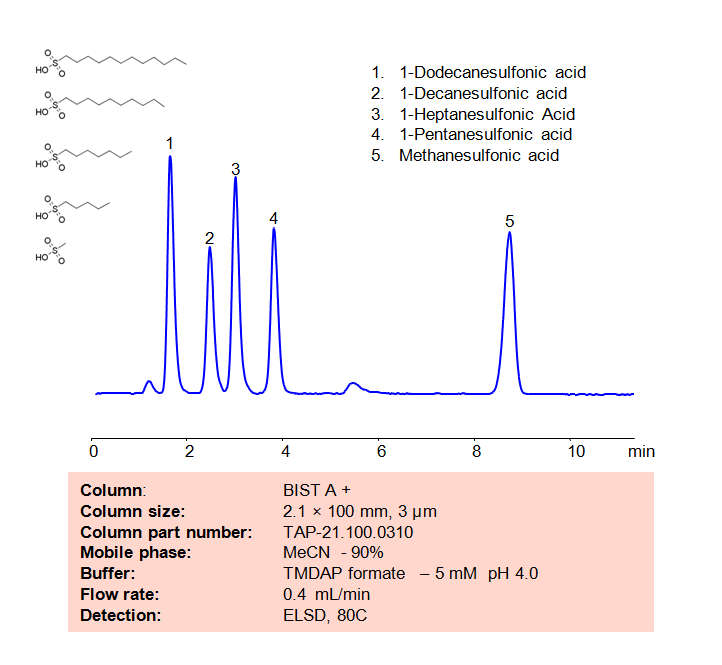
Using SIELC’s newly introduced BIST™ method, a mixture of these Sulfonic acids can be separated on a negatively-charged, cation-exchange BIST A+ column, contrary to conventional chromatographic wisdom. There are two keys to this retention method: 1) a multi-charged, positive buffer, such as N,N,N’,N’-Tetramethyl-1,3-propanediamine (TMDAP), which acts as a bridge, linking the negatively-charged anion analytes to the negatively-charged column surface and 2) a mobile phase consisting mostly of organic solvent (such as MeCN) to minimize the formation of a solvation layer around the charged analytes. Other positively-charged buffers that can generate BIST™ include Calcium acetate and Magnesium acetate. Using this new and unique analysis method, these Sulfonic acids can be separated, retained, and detected through ELSD. This method is also compatible with Mass Spectrometry (LC-MS) and CAD.
Condition
| Column | BIST A+, 2.1 x 100 mm, 3 µm, 100 A, dual ended |
| Mobile Phase | MeCN – 90% |
| Buffer | TMDAP formate pH 4.0 – 5,0 mM |
| Flow Rate | 0.4 ml/min |
| Detection | ELSD, 80C |
Description
| Class of Compounds | Acid, Sulfonic acid |
| Analyzing Compounds | Methanesulfonic Acid, 1-Dodecanesulfonic acid, 1-Decanesulfonic acid, 1-Heptanesulfonic acid, 1-Pentanesulfonic acid |
Application Column
BIST A+
Column Diameter: 2.1 mm
Column Length: 100 mm
Particle Size: 3 µm
Pore Size: 100 A
Column options: dual ended
1-Dodecanesulfonic acid
1-Heptanesulfonic acid
1-Pentanesulfonic acid
Methanesulfonic Acid