HPLC Method for Bismuth subgallate, Gallic acid on Newcrom BH by SIELC Technologies
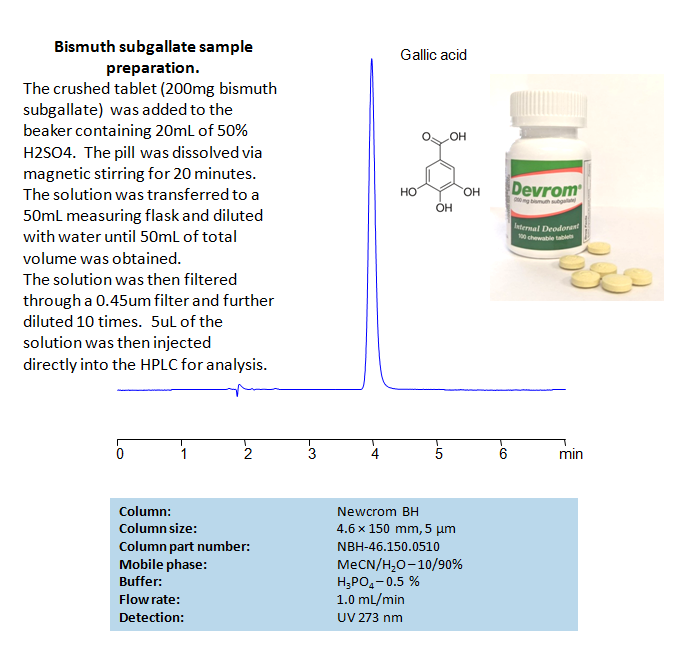
High Performance Liquid Chromatography (HPLC) Method for Analysis of Bismuth subgallate, Gallic acid.
Gallic acid is a naturally-occurring phenolic acid with the chemical formula the chemical formula C7H6O5. It can be found in gallnuts, sumac, witch hazel, tea leaves, oak bark, and other plants. Historically, it was a key ingredient in European iron gall ink. The use of it spanned from its first discovery in the 12th century into the 19th century. In the modern times, it is used as an antioxidant and a preservative. You can find detailed UV spectra of Gallic acid and information about its various lambda maxima by visiting the following link.
Bismuth subgallate is a medication with the chemical formula C7H5BiO6. It is primarily used to deodorize flatulence and stools. Additionally, it is used to treat the Helicobacter pylori infection.
Bismuth subgallate, Gallic acid can be retained and analyzed using the Newcrom BH stationary phase column. The analysis utilizes an isocratic method with a simple mobile phase consisting of water and acetonitrile (MeCN) with a phosphoric acid buffer. Detection is performed using UV.
| Column | Newcrom BH, 4.6 x 150 mm, 5 µm, 100 A, dual ended |
| Mobile Phase | MeCN – 10% |
| Buffer | H3PO4 – 0.5% |
| Flow Rate | 1.0 ml/min |
| Detection | UV 273nm |
| Class of Compounds | Acid, Hydrophilic |
| Analyzing Compounds | Bismuth subgallate, Gallic acid |
Application Column
Newcrom BH
Column Diameter: 4.6 mm
Column Length: 150 mm
Particle Size: 5 µm
Pore Size: 100 A
Column options: dual ended
Gallic acid