HPLC Chiral Method for Analysis of Fluroxypyr-meptyl Enantiomers on Enantiomers Cyralis CM Column by SIELC Technologies
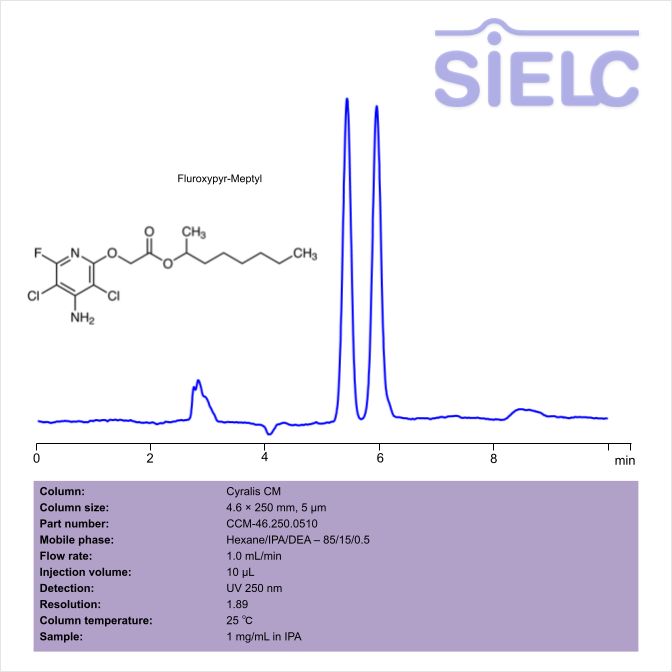
High Performance Liquid Chromatography (HPLC) Method for Analysis of Fluroxypyr-meptyl.
Fluroxypyr-Meptyl is a herbicide with the chemical formula C15H21Cl2FN2O3. It is used for the control of broad-leaved weeds in cereals, pastures, and non-crop areas. It belongs to a class of herbicides known as synthetic auxins. Fluroxypyr-meptyl is effective against a range of weed species, including some that are resistant to other types of herbicides. You can find detailed UV spectra of Fluroxypyr-meptyl and information about its various lambda maxima by visiting the following link.
This application describes a normal-phase chiral HPLC method for the separation of Fluroxypyr-meptyl enantiomers using SIELC’s Cyralis CM chiral column. Cyralis CM is a cellulose-based chiral stationary phase (CSP) designed for enantiomeric separations, optical purity testing, chiral impurity analysis, and stereoisomer characterization in pharmaceutical, chemical, agrochemical, and fine chemical applications.
Fluroxypyr-meptyl can be retained and analyzed using the Cyralis CM stationary phase column. The analysis utilizes an isocratic method with a mobile phase consisting of Hexane, IPA, and DEA. Detection is performed using UV.
Condition
| Column | Cyralis CM, 4.6 x 250 mm, 5 µm, 100 A, normal phase |
| Mobile Phase | Hexane/IPA/DEA – 85/15/0.5% |
| Flow Rate | 1.0 mL/min |
| Detection | UV 250 nm |
| Resolution | 1.89 |
Description
| Class of Compounds | Herbicide |
| Analyzing Compounds | Fluroxypyr-meptyl |
Application Column
Cyralis CM
Column Diameter: 4.6 mm
Column Length: 250 mm
Particle Size: 5 µm
Pore Size: 100 A
Column options: normal phase