HPLC Method for Analysis of Aconitic Acid on BIST A Column by SIELC Technologies
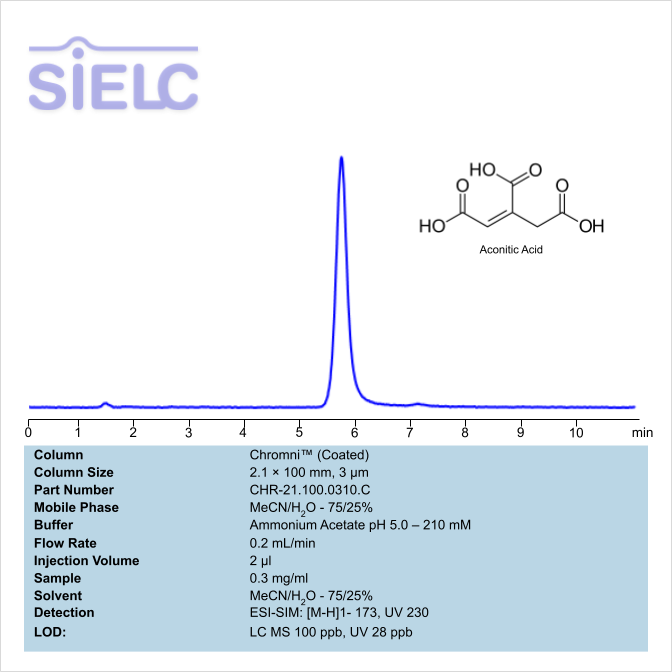
High Performance Liquid Chromatography (HPLC) Method for Analysis of Aconitic acid, trans-Aconitic acid.
Aconitic acid is an organic compound with the chemical formula C6H6O6. It is primarily used to create nutty flavors in foods. It is also a common intermediate in the Kreb’s cycle when Citrate is changed into D-isocitrate. You can find detailed UV spectra of Aconitic acid, trans-Aconitic acid and information about its various lambda maxima by visiting the following link.
Aconitic acid, trans-Aconitic acid can be retained and analyzed using the Chromni stationary phase column. The analysis utilizes an isocratic method with a simple mobile phase consisting of water and acetonitrile (MeCN) with a [buffer] buffer. Detection is performed using UV.
Condition
| Column | Chromni, 2.1 x 100 mm, 3 µm, 100 A, surface coated |
| Mobile Phase | MeCN – 75/25% |
| Buffer | Ammonium acetate pH 5.0 – 210 mM |
| Flow Rate | 0.2 ml/min |
| Detection | ESI-SIM: [M-H]1- 173, UV 230 |
| Limit Of Detection* | LC MS 100 ppb, UV 28 ppb |
Description
| Class of Compounds | Acid, Carboxylic acids, Tricarboxylic acids |
| Analyzing Compounds | Aconitic acid, trans-Aconitic acid |
Application Column
Chromni
Column Diameter: 2.1 mm
Column Length: 100 mm
Particle Size: 3 µm
Pore Size: 100 A
Column options: surface coated
trans-Aconitic acid