HPLC Method for Analysis of Creatinine on BIST B+ by SIELC Technologies.
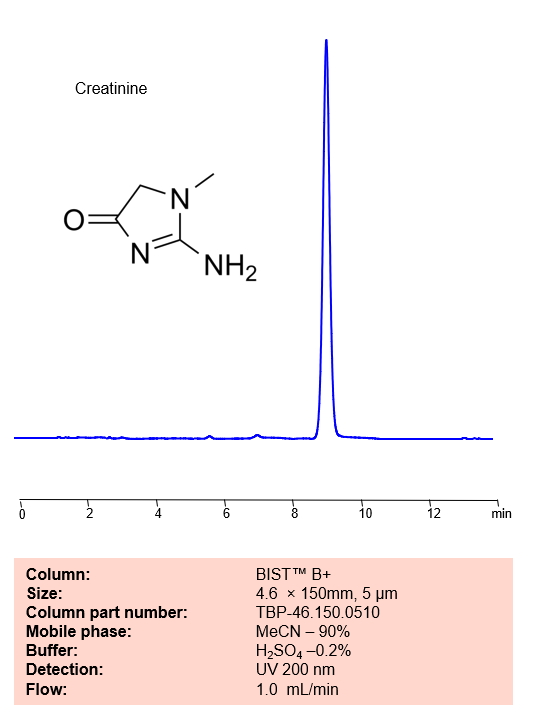
Creatine is a naturally occurring compound found in muscles and is used to produce energy during high-intensity exercise. It is synthesized in the body from amino acids and stored in muscles for quick energy release. You can find detailed UV spectra of Creatinine and information about its various lambda maxima by visiting the following link.
Creatinine can be retained and analyzed using the BIST B+ stationary phase column. The analysis utilizes an isocratic method with a simple mobile phase consisting of water and acetonitrile (MeCN) with a Sulfuric Acid buffer. Detection is performed using UV.
Condition
| Column | BIST B+, 4.6 x 150 mm, 5 µm, 100 A, dual ended |
| Mobile Phase | MeCN – 85% |
| Buffer | H2SO4 – 0.2% |
| Flow Rate | 1.0 ml/min |
| Detection | UV 200 nm |
| Peak Retention Time | 9.09 min |
Description
| Class of Compounds | Xanthines |
| Analyzing Compounds | Creatinine |
Application Column
BIST B+
Column Diameter: 4.6 mm
Column Length: 150 mm
Particle Size: 5 µm
Pore Size: 100 A
Column options: dual ended
Application Analytes:
CreatinineApplication Detection:
UV Detection
SIELC Technologies usually develops more than one method for each compound. Therefore, this particular method may not be the best available method from our portfolio for your specific application. Before you decide to implement this method in your research, please send us an email to research@sielc.com so we can ensure you get optimal results for your compound/s of interest.