High Performance Liquid Chromatography (HPLC) Method for Analysis of Mixture of Tryptophan and its Catabolites on Primesep 100 by SIELC Technologies
Tryptophan and its catabolites participate in several biological pathways, having roles in protein synthesis, serving as precursors to bioactive molecules, and influencing several physiological processes.
Tryptophan is an essential amino acid with the chemical formula C11H12N2O2. It cannot be produced within the body and must be obtained through consuming it. Like the other essential proteins, it is a building block for protein and muscle tissue, but it is also converted in the body into serotonin, which affects mood. L-Tryptophan is also used in treatments for severe PMS symptoms, depression, and insomnia. It is naturally found in red meat, poultry eggs, and dairy. You can find detailed UV spectra of Tryptophan and information about its various lambda maxima by visiting the following link.
3-Hydroxyanthranilic acid is an intermediate in the metabolism of tryptophan with the chemical formula C7H7NO3. It is used primarily to prevent the autoxidation of soybean oil and powder. You can find detailed UV spectra of 3-Hydroxyanthranilic acid and information about its various lambda maxima by visiting the following link.
3-Hydroxykynurenine is a metabolite of tryptophan with the chemical formula C10H12N2O4. It can generate reactive oxygen species, potentially contributing to cellular stress and is one of the two known pigments responsible for the yellow coloration of goldenrod crab spiders.
Kynurenine is a metabolite of L-tryptophan with the chemical formula C10H12N2O3. It is primarily used in the production of niacin. It protects the eye by absorbing UV light alongside 3-hydroxykynurenine.
Kynurenine is a key metabolite in the tryptophan catabolic pathway, often referred to as the kynurenine pathway. This pathway is responsible for breaking down the essential amino acid tryptophan into several bioactive compounds. You can find detailed UV spectra of Kynurenine and information about its various lambda maxima by visiting the following link.
Picolinic Acid is a derivative of pyridine with the chemical formula C6H5NO2. It’s function remains a mystery to this day, but it is suspected to have a wide variety of neuroprotective, immunological, and anti-proliferative effects. You can find detailed UV spectra of Picolinic Acid and information about its various lambda maxima by visiting the following link.
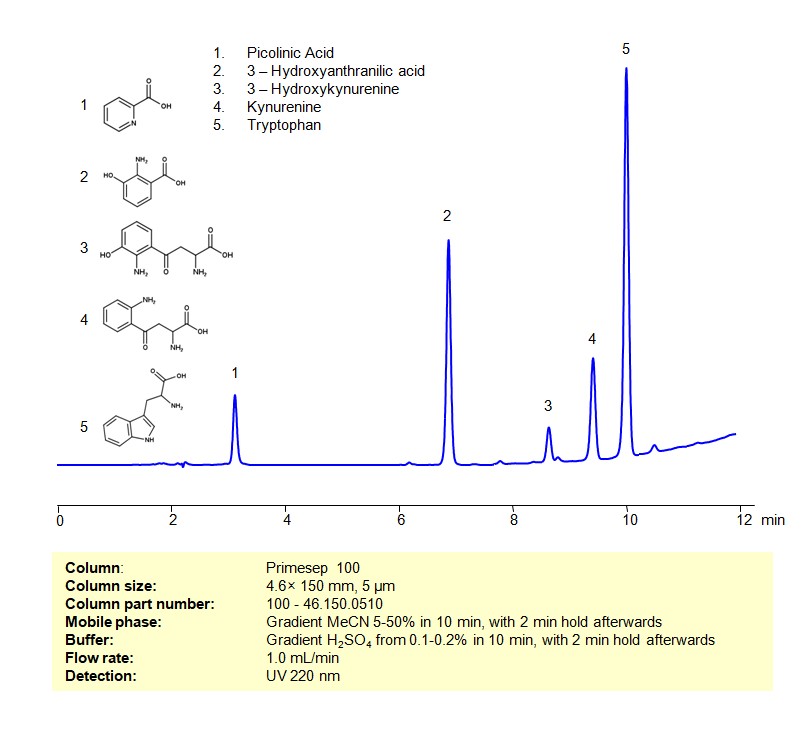
Tryptophan, Picolinic Acid, Kynurenine, 3-Hydroxykynurenine, 3-Hydroxyanthranilic acid can be retained, separated and analyzed on a Primesep 100 mixed-mode stationary phase column using an gradient analytical method with a simple mobile phase of water, Acetonitrile (MeCN), and a sulfuric acid as a buffer. This analysis method can be detected using UV at 220 nm.
Condition
| Column | Primesep 100, 4.6 x 150 mm, 5 µm, 100 A, dual ended |
| Mobile Phase | Gradient MeCN 5-50% in 10 min, with 2 min hold afterwards |
| Buffer | Gradient H2SO4 from 0.1-0.2% in 10 min, with 2 min hold afterwards |
| Flow Rate | 1.0 ml/min |
| Detection | UV 220 nm |
Description
| Class of Compounds | Essential Amino Acid Tryptophan and its Catabolites |
| Analyzing Compounds | Tryptophan, Picolinic Acid, Kynurenine, 3-Hydroxykynurenine, 3-Hydroxyanthranilic acid |
Application Column
Primesep 100
Column Diameter: 4.6 mm
Column Length: 150 mm
Particle Size: 5 µm
Pore Size: 100 A
Column options: dual ended
3-Hydroxykynurenine
Kynurenine
Picolinic Acid
Tryptophan