HPLC Chiral Method for Analysis of (1S,2R)-(+)-2-Amino-1,2-diphenylethanol Enantiomers on Cyralis AM Column by SIELC Technologies
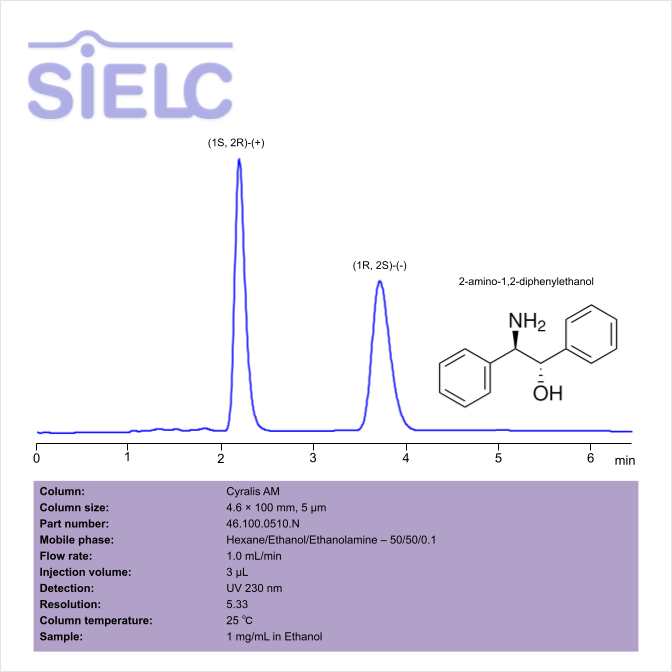
High Performance Liquid Chromatography (HPLC) Method for Analysis of (1S,2R)-(+)-2-Amino-1,2-diphenylethanol.
2-amino-1,2-diphenylethanol is a chiral organic chemical compound with the chemical formula C14H15NO. It is used primarily in asymmetric synthesis as a chiral auxiliary or ligand for enantioselective reactions. You can find detailed UV spectra of (1S,2R)-(+)-2-Amino-1,2-diphenylethanol and information about its various lambda maxima by visiting the following link.
This application describes a normal-phase chiral HPLC method for the separation of (1S,2R)-(+)-2-Amino-1,2-diphenylethanol enantiomers using SIELC’s Cyralis AM chiral column. Cyralis AM is an amylose-based chiral stationary phase (CSP) designed for enantiomeric separations, optical purity testing, chiral impurity analysis, and stereoisomer characterization in pharmaceutical, chemical, agrochemical, and fine chemical applications.
(1S,2R)-(+)-2-Amino-1,2-diphenylethanol can be retained and analyzed using the Cyralis AM stationary phase column. The analysis utilizes an isocratic method with a mobile phase consisting of Hexane, Ethanol, and Ethanolamine. Detection is performed using UV.
Condition
| Column | Cyralis AM, 4.6 x 100 mm, 5 µm, 100 A, normal phase |
| Mobile Phase | Hexane/Ethanol/Ethanolamine |
| Flow Rate | 1.0 mL/min |
| Detection | UV 230 nm |
| Resolution | 5.33 |
Description
| Class of Compounds | Compound |
| Analyzing Compounds | (1S,2R)-(+)-2-Amino-1,2-diphenylethanol |
Application Column
Cyralis AM
Column Diameter: 4.6 mm
Column Length: 100 mm
Particle Size: 5 µm
Pore Size: 100 A
Column options: normal phase