HPLC Method for Phosphonoacetic acid on Chromni by SIELC Technologies
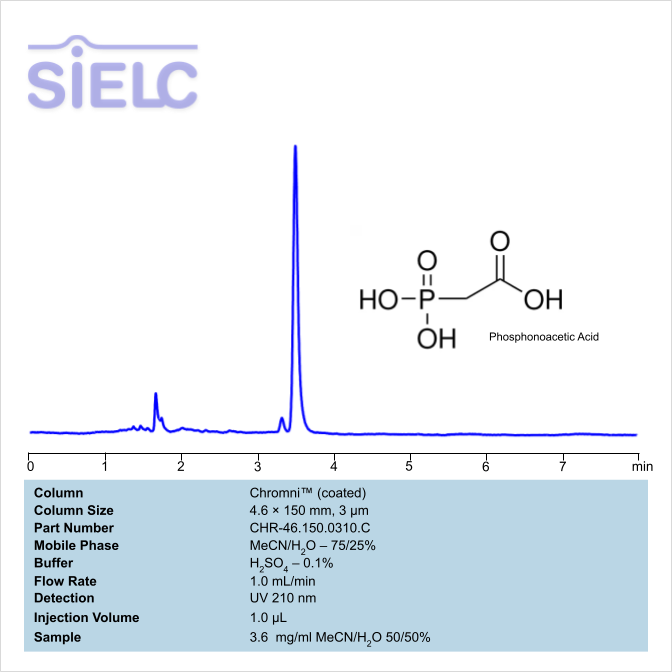
High Performance Liquid Chromatography (HPLC) Method for Analysis of Phosphonoacetic acid
Phosphonoacetic Acid, also written as PAA, is an organophosphorus compound with the chemical formula C2H5O5P. It is used primarily in research as a targeted inhibitor of DNA polymerase in herpesviruses, cytomegalovirus, and orthopoxyviruses. It is also a structural precursor and model in broad-spectrum antiviral agents.
Phosphonoacetic acid can be retained and analyzed using the Chromni stationary phase column. The analysis utilizes a gradient method with a simple mobile phase consisting of water and acetonitrile (MeCN) with an sulfuric acid as a buffer. Detection is performed using UV.
| Column | Chromni, 4.6 x 150 mm, 3 µm, 100 A, surface coated |
| Mobile Phase | MeCN/H2O – 75/25% |
| Buffer | H2SO4 – 0.1% |
| Flow Rate | 1.0 ml/min |
| Detection | UV 210 nm |
| Class of Compounds | Acid |
| Analyzing Compounds | Phosphonoacetic acid |
Application Column
Chromni
Column Diameter: 4.6 mm
Column Length: 150 mm
Particle Size: 3 µm
Pore Size: 100 A
Column options: surface coated