
| CAS Number | 9005-49-6 |
|---|---|
| Molecular Formula | C26H42N2O37S5 |
| Molecular Weight | 1134.899 |
| InChI Key | HTTJABKRGRZYRN-UHFFFAOYSA-N |
| LogP | -10.8 |
| Synonyms |
|
Applications:
Uv-Vis Spectrum of Heparin
January 19, 2026
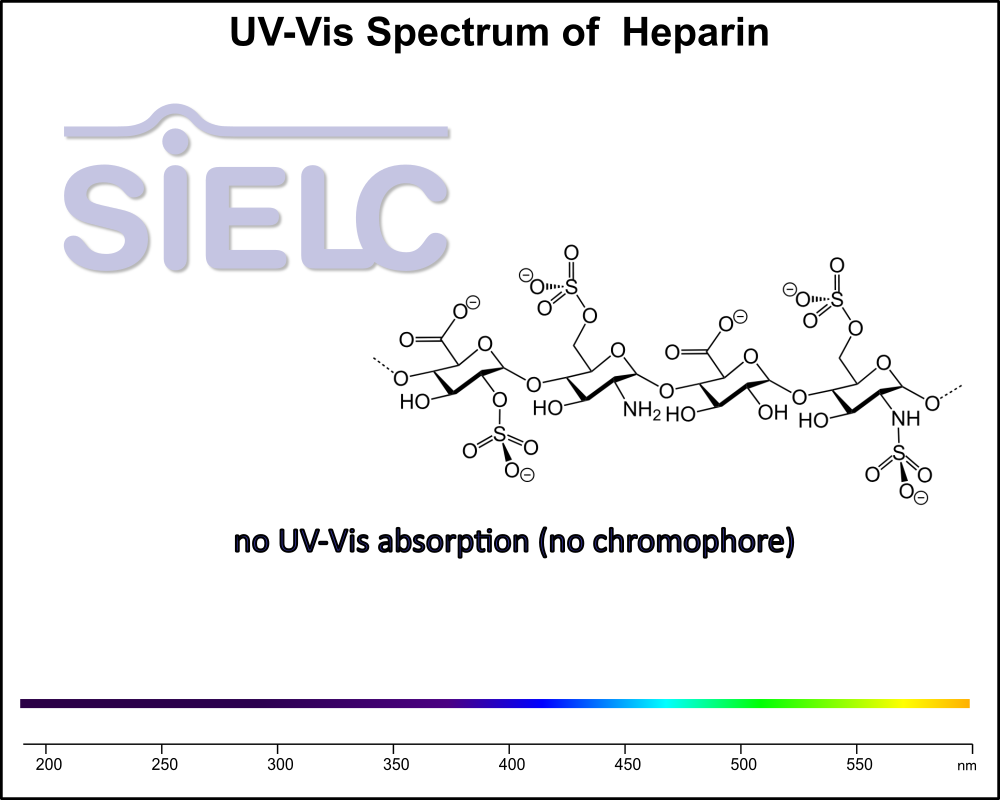
If you are looking for optimized HPLC method to analyze Heparin check our HPLC Applications library
For optimal results in HPLC analysis, it is recommended to measure absorbance at a wavelength that matches the absorption maximum of the compound(s) being analyzed. The UV spectrum shown can assist in selecting an appropriate wavelength for your analysis. Please note that certain mobile phases and buffers may block wavelengths below 230 nm, rendering absorbance measurement at these wavelengths ineffective. If detection below 230 nm is required, it is recommended to use acetonitrile and water as low UV-transparent mobile phases, with phosphoric acid and its salts, sulfuric acid, and TFA as buffers.
For some compounds, the UV-Vis Spectrum is affected by the pH of the mobile phase. The spectra presented here are measured with an acidic mobile phase that has a pH of 3 or lower.

HPLC Method for Analysis of Heparin on BIST™ A Column
June 15, 2022
HPLC Method for Heparin on BIST A by SIELC Technologies
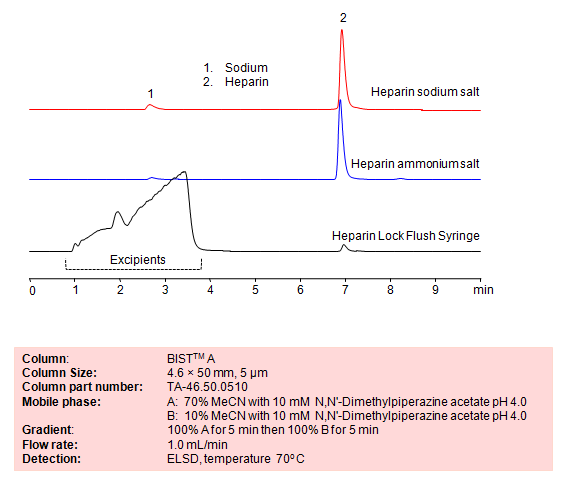
High Performance Liquid Chromatography (HPLC) Method for Analysis of Heparin.
Heparin, also known as unfractionated heparin and UFH, is a WHO-recognized essential medicine with the chemical formula C26H42N2O37S5. It is known for its anticoagulant properties and used to treat heart attacks, angina, deep-vein thrombosis, and more. It works through inhibiting thrombin, which prevents new blood clots from forming, but does not break down existing ones. You can find detailed UV spectra of Heparin and information about its various lambda maxima by visiting the following link.
Due to its very polar and polymeric nature, separating and quantifying Heparin using traditional HPLC methods can be quite difficult. Using SIELC’s newly introduced BIST™ method, however, Heparin and its salts can be separated easily on a negatively-charged, cation-exchange BIST A column. There are two keys to this retention method: 1) a multi-charged, positive buffer, such as N,N’-Dimethylpiperazine (DMP), which acts as a bridge, linking the negatively-charged anion analytes to the negatively-charged column surface and 2) a mobile phase consisting mostly of organic solvent (such as MeCN) to minimize the formation of a solvation layer around the charged analytes. Other positively-charged buffers that can generate BIST™ include TMDAP, Calcium acetate, and Magnesium acetate. Using this new and unique analysis method, Heparin and its salts can be separated and retained with high selectivity and great peak shape. This method can be detected and is compatible with ELSD, CAD, and Mass Spectrometry (LC-MS).
| Column | BIST A, 4.6 x 50 mm, 5 µm, 100 A, dual ended |
| Mobile Phase | Gradient MeCN |
| Buffer | N,N’-Dimethylpiperazine acetate pH 4.0 |
| Flow Rate | 1.0 ml/min |
| Detection | ELSD, 70C |
| Class of Compounds |
Drug, Glycosaminoglycan |
| Analyzing Compounds | Heparin |
Application Column
BIST A
Column Diameter: 4.6 mm
Column Length: 50 mm
Particle Size: 5 µm
Pore Size: 100 A
Column options: dual ended
HPLC Separation of Heparines and Pentosan
June 4, 2011
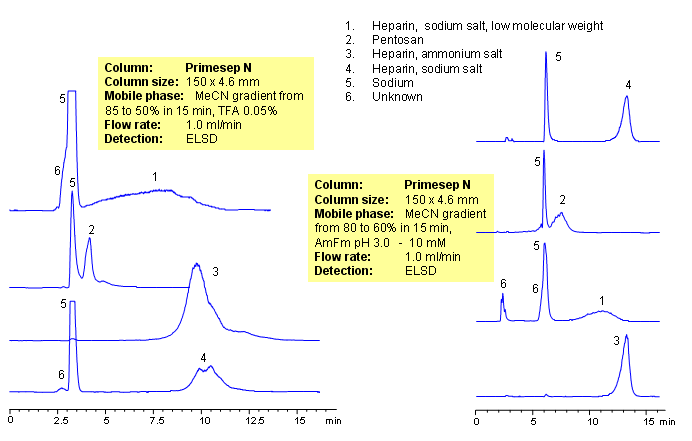
Heparin and pentosan are highly-sulfated glucosaminoglucan, widely used in pharmaceutical industry. Both molecules carry a high negative density attributed to multiple sulfate groups. Due to a very polar and polymeric nature of these compounds, separating and quantifying them is a very difficult task. Heparin and its salt, along with pentosan, are separated on a Primesep N column in HILIC/anion-exclusion mode. Method can be used for quantitation of heparin and pentosan in biofluids and formulations. Elution is monitored by ELSD, CAD or LC/MS.
Application Column
Primesep N
The Primesep family of mixed-mode columns offers a wide variety of stationary phases, boasting unprecedented selectivity in the separation of a broad array of chemical compounds across multiple applications. Corresponding Primesep guard columns, available with all stationary phases, do not require holders. SIELC provides a method development service available to all customers. Inquire about our specially-tailored custom LC-phases for specific separations.
Select optionsPentosan
