
| CAS Number | 108-24-7 |
|---|---|
| Molecular Formula | C4H6O3 |
| Molecular Weight | 102.09 |
| InChI Key | WFDIJRYMOXRFFG-UHFFFAOYSA-N |
| LogP | -0.1 |
| Synonyms |
|
Applications:
HPLC Method for Analysis of Acetic Anhydride, Benzyl Alcohol and Benzoic Anhydride on Newcrom R1 Column
June 3, 2022
HPLC Method for Acetic anhydride, Benzoic anhydride, Benzyl alcohol on Newcrom R1 by SIELC Technologies
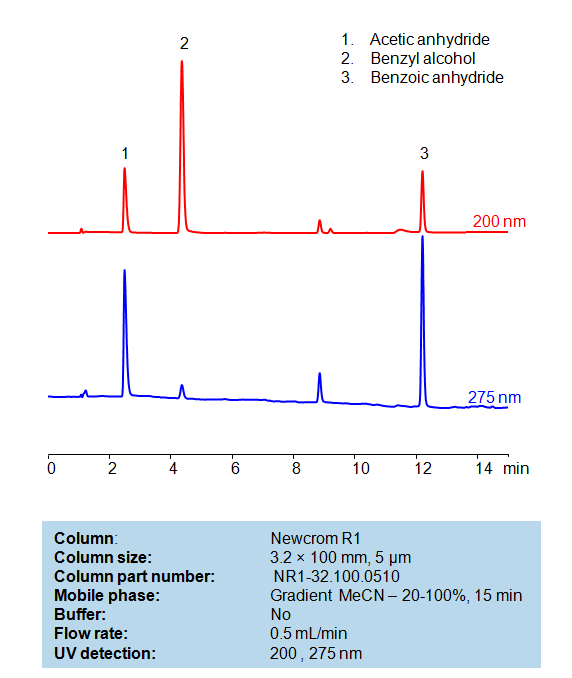
High Performance Liquid Chromatography (HPLC) Method for Analysis of Acetic anhydride, Benzoic anhydride, Benzyl alcohol.
Acetic Anyhydride, also known as ethanoic anhydride and Ac2O, is a compound with the chemical formula C4H6O3. It is a common reagent in organic synthesis, particularly in the acetylation of alcohols, amines, and aromatic rings. It is used widely in the production of cellulose acetate and heroin. It’s most common use is in the conversion of cellulose to cellulose acetate as well as in the production of aspirin, which is also known as acetylsalicylic acid).
Benzyl alcohol, also known as a-cresol) is a popular organic solvent and preservative with the chemical formula C7H8O. It is found in over-the-counter medications, topical creams, lotions, shampoos, and facial cleansers as an antibacterial, preservative, and fungicide. It’s a colorless liquid with a mild pleasant aromatic scent and is found in a variety of plants, primarily fruit, teas, and essential oils. You can find detailed UV spectra of Benzyl alcohol and information about its various lambda maxima by visiting the following link.
Benzoic Anhydride is the more active analogue of benzoic acid formed via dehydration. It has the chemical formula C14H10O3. Benzoic anhydride is used as a benzoylating agent in the manufacture of pharmaceuticals, intermediates and dyes. It is considered the simplest symmetrical aromatic acid anhydride. You can find detailed UV spectra of Benzoic anhydride and information about its various lambda maxima by visiting the following link.
Acetic anhydride, Benzoic anhydride, Benzyl alcohol can be retained and analyzed using the Newcrom R1 stationary phase column. The analysis utilizes a gradient method with a simple mobile phase consisting of water and acetonitrile (MeCN). Detection is performed using UV.
| Column | Newcrom R1, 3.2 x 100 mm, 5 µm, 100 A, dual ended |
| Mobile Phase | Gradient MeCN – 20-100% |
| Buffer | No |
| Flow Rate | 0.5 ml/min |
| Detection | UV 200, 275nm |
| Class of Compounds | Acid, Hydrophilic |
| Analyzing Compounds | Acetic anhydride, Benzoic anhydride, Benzyl alcohol |
Application Column
Newcrom R1
Column Diameter: 3.2 mm
Column Length: 100 mm
Particle Size: 5 µm
Pore Size: 100 A
Column options: dual ended
Benzoic anhydride
Benzyl alcohol

Separation of (2H3)Acetic anhydride on Newcrom R1 HPLC column
May 16, 2018
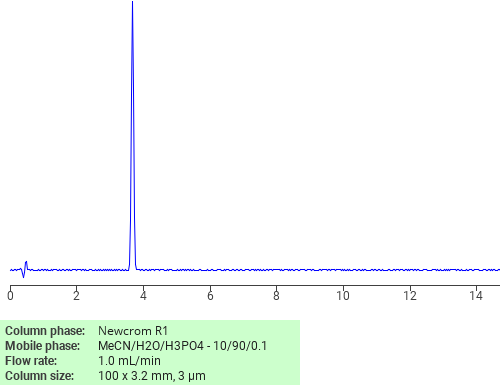
(2H3)Acetic anhydride can be analyzed by this reverse phase (RP) HPLC method with simple conditions. The mobile phase contains an acetonitrile (MeCN), water, and phosphoric acid. For Mass-Spec (MS) compatible applications the phosphoric acid needs to be replaced with formic acid. Smaller 3 µm particles columns available for fast UPLC applications. This liquid chromatography method is scalable and can be used for isolation impurities in preparative separation. It also suitable for pharmacokinetics.
Application Column
Newcrom R1
The Newcrom columns are a family of reverse-phase-based columns. Newcrom A, AH, B, and BH are all mixed-mode columns with either positive or negative ion-pairing groups attached to either short (25 Å) or long (100 Å) ligand chains. Newcrom R1 is a special reverse-phase column with low silanol activity.
Select options