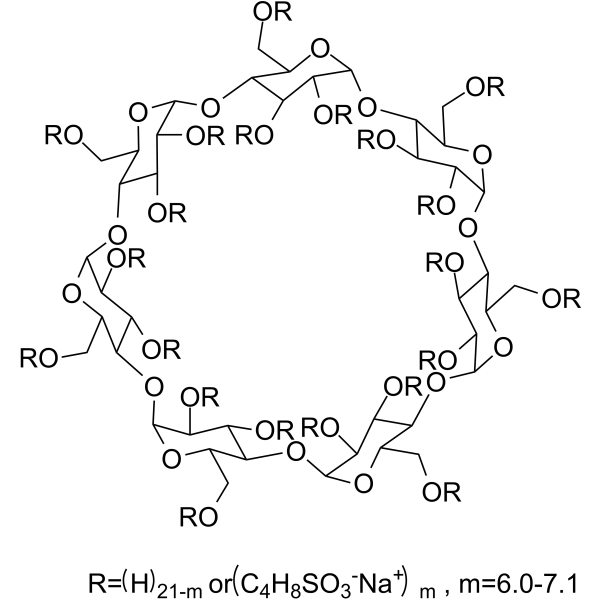
| Molecular Formula | C50H84Na2O41S2 |
|---|---|
| Molecular Weight | 1451.3 |
| InChI Key | RGQYVQYXCZODQW-UHFFFAOYSA-L |
| Synonyms |
|
Applications:
Uv-Vis Spectrum of Sulfobutyl Ether-beta-cyclodextrin
February 6, 2026
If you are looking for optimized HPLC method to analyze Sulfobutyl Ether-beta-cyclodextrin check our HPLC Applications library
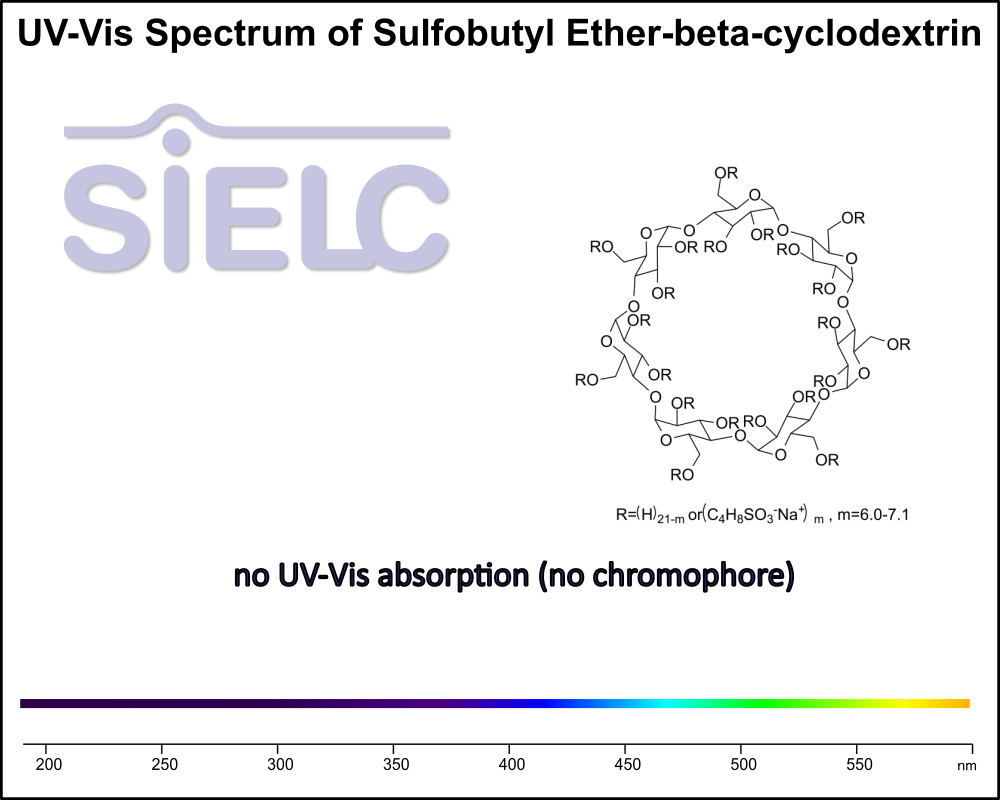
For optimal results in HPLC analysis, it is recommended to measure absorbance at a wavelength that matches the absorption maximum of the compound(s) being analyzed. The UV spectrum shown can assist in selecting an appropriate wavelength for your analysis. Please note that certain mobile phases and buffers may block wavelengths below 230 nm, rendering absorbance measurement at these wavelengths ineffective. If detection below 230 nm is required, it is recommended to use acetonitrile and water as low UV-transparent mobile phases, with phosphoric acid and its salts, sulfuric acid, and TFA as buffers.
For some compounds, the UV-Vis Spectrum is affected by the pH of the mobile phase. The spectra presented here are measured with an acidic mobile phase that has a pH of 3 or lower.

HPLC Method for Analysis of Sulfobutyl ether Beta Cyclodextrin Sodium (SBECD) on BIST™A Column
July 8, 2022
Separation type: Bridge Ion Separation Technology, or BIST™
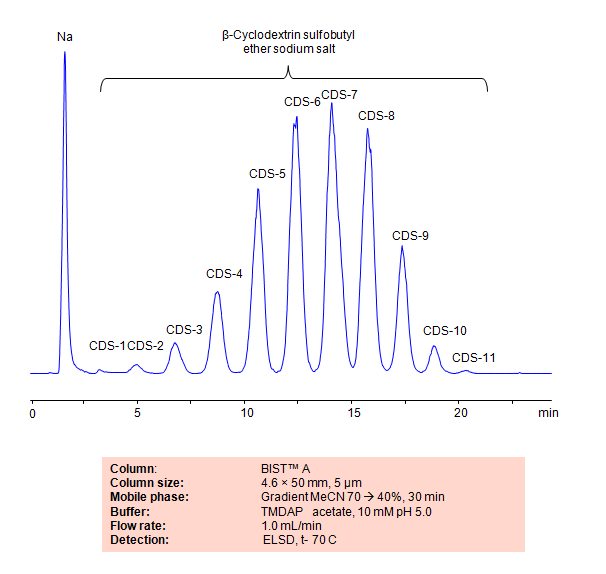
HPLC Method for Analysis of B-Cyclodextrins sulfobutyl ether on a BIST A.
Cyclodextrins are ring-shaped oligosaccharides formed in nature by the digestion of cellulose by bacteria. Cyclodextrins have utility for solubilizing and stabilizing drugs. B-Cyclodextrins sulfobutyl ether is a cyclodextrin made of 7 glucose subunits, each with a negatively-charged sulfobutyl ether group attached.
Using SIELC’s newly introduced BIST™method, B-Cyclodextrins from different manufacturers, can be retained on a negatively-charged, cation-exchange BIST™ A column. There are two keys to this retention method: 1) a multi-charged, positive buffer, such as N,N,N’,N’-Tetramethyl-1,3-propanediamine (TMDAP), which acts as a bridge, linking the negatively-charged B-Cyclodextrin analytes to the negatively-charged column surface and 2) a mobile phase consisting mostly of organic solvent (such as MeCN) to minimize the formation of a solvation layer around the charged analytes. With a fairly simple gradient, these cyclodextrins can be separated and retained on a BIST™ A column. The gradient is necessary because of the extremely strong retention in BIST™. By slowly transitioning to a low-organic mobile phase, the solvation layer increases, reducing BIST™ interactions, and the analytes are able to elute in an appropriate amount of time. Various manufacturers’ B-Cyclodextrins can be retained and separated using BIST™, and this method is compatible with mass spectrometry (MS), evaporative light scattering detection (ELSD), charged aerosol detection (CAD).
| Column | BIST A, 4.6 x 50 mm, 5 µm, 100 A, dual ended |
| Mobile Phase | MeCN Gradient |
| Buffer | TMDAP ( N,N,N’,N’-Tetramethyl-1,3-diaminopropane) acetae – 5 mM pH 5.0 |
| Flow Rate | 1.0 ml/min |
| Detection | ELSD, 70C |
| Class of Compounds |
Polymer, Drug |
| Analyzing Compounds | Sulfobutyl Ether-beta-cyclodextrin |
Application Column
BIST A
Column Diameter: 4.6 mm
Column Length: 50 mm
Particle Size: 5 µm
Pore Size: 100 A
Column options: dual ended
