
| Synonyms |
|---|
Applications:
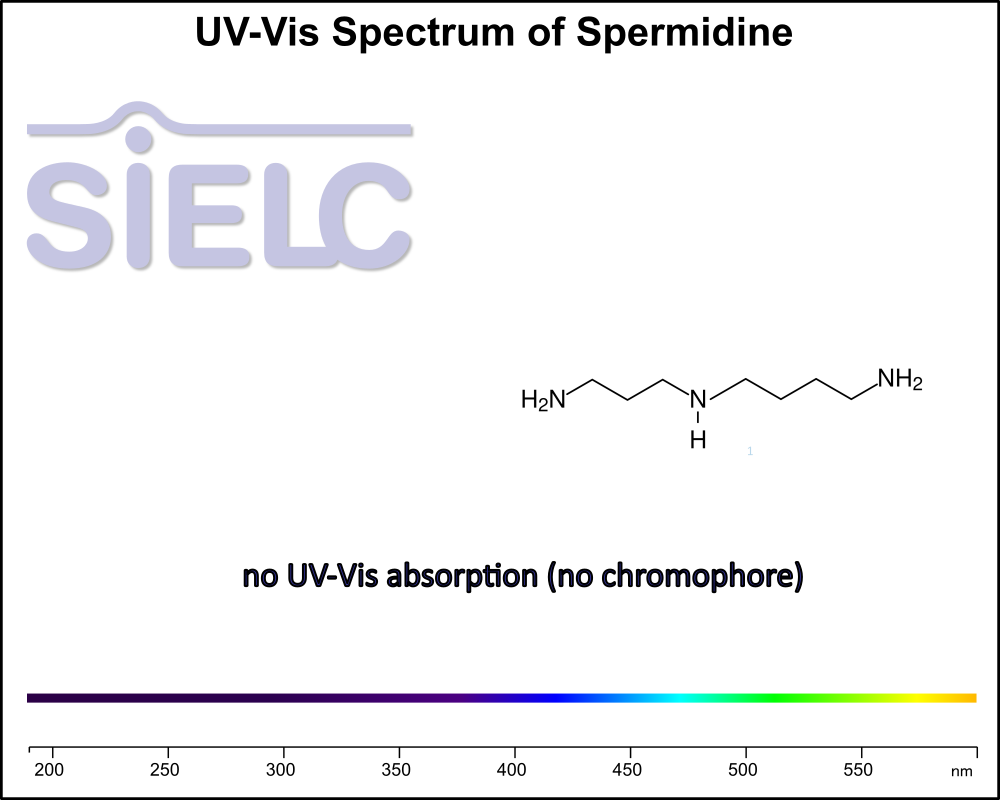
Uv-Vis Spectrum of Spermidine
February 9, 2026
If you are looking for optimized HPLC method to analyze Spermidine check our HPLC Applications library
For optimal results in HPLC analysis, it is recommended to measure absorbance at a wavelength that matches the absorption maximum of the compound(s) being analyzed. The UV spectrum shown can assist in selecting an appropriate wavelength for your analysis. Please note that certain mobile phases and buffers may block wavelengths below 230 nm, rendering absorbance measurement at these wavelengths ineffective. If detection below 230 nm is required, it is recommended to use acetonitrile and water as low UV-transparent mobile phases, with phosphoric acid and its salts, sulfuric acid, and TFA as buffers.
For some compounds, the UV-Vis Spectrum is affected by the pH of the mobile phase. The spectra presented here are measured with an acidic mobile phase that has a pH of 3 or lower.

HPLC ELSD Method for Analysis of Spermidine on Obelisc R Column
January 31, 2024
HPLC Method for Analysis of Spermidine on Obelisc R by SIELC Technologies

Spermidine is a polyamine compound with the chemical formula C7H19N3 that is found in all living cells. It is a biogenic amine and is involved in various cellular processes.
Biological Roles:
- Cell Growth and Proliferation: Spermidine is involved in the regulation of cell growth and proliferation.
- DNA Stability: It interacts with DNA and RNA, contributing to their stability.
- Antioxidant Properties: Spermidine has been suggested to have antioxidant properties, potentially protecting cells from oxidative stress.
- Autophagy Induction: Spermidine has been shown to induce autophagy, a cellular process that involves the degradation of cellular components.
Natural Sources:
- Spermidine is found in various foods, including wheat germ, soybeans, mushrooms, and aged cheese.
- It is also synthesized within the body from other polyamines.
Research and Health Implications:
- Research on spermidine has gained attention for its potential health benefits, including its role in promoting longevity and protecting against age-related diseases.
- Some studies suggest that spermidine supplementation may have positive effects on cardiovascular health, neuroprotection, and other aspects of aging.
Supplementation:
- Spermidine is available as a dietary supplement, and some people choose to take it for its potential health benefits.
- However, it’s important to note that while research is ongoing, the long-term effects and optimal dosage for supplementation are not fully established.
You can find detailed UV spectra of Spermidine and information about its various lambda maxima by visiting the following link.
Spermidine can be retained and analyzed using an Obelisc R mixed-mode stationary phase column. The analysis employs an isocratic method with a simple mobile phase consisting of water, acetonitrile (MeCN), and ammonium formate as a buffer. Detection is achieved using ELSD
| Column | Obelisc R, 2.1 x 100 mm, 5 µm, 100 A, dual ended |
| Mobile Phase | MeCN/H2O – 20/80% |
| Buffer | Ammonium formate pH 3.0 – 30 mM |
| Flow Rate | 0.2 ml/min |
| Detection | ELSD, the nebulizer and evaporator temperatures 50°C, with a gas flow rate of 1.6 Standard Liters per Minute (SLM) |
| Samples | 0.1 mg/ml |
| Injection volume | 5 µl |
| LOD* | 200 ppb |
| Class of Compounds | Polyamines |
| Analyzing Compounds | Spermidine |
Application Column
Obelisc R
Column Diameter: 2.1 mm
Column Length: 100 mm
Particle Size: 5 µm
Pore Size: 100 A
Column options: dual ended
