HPLC Chiral Method for Analysis of Vinclozolin Enantiomers on Cyralis CM Column by SIELC Technologies
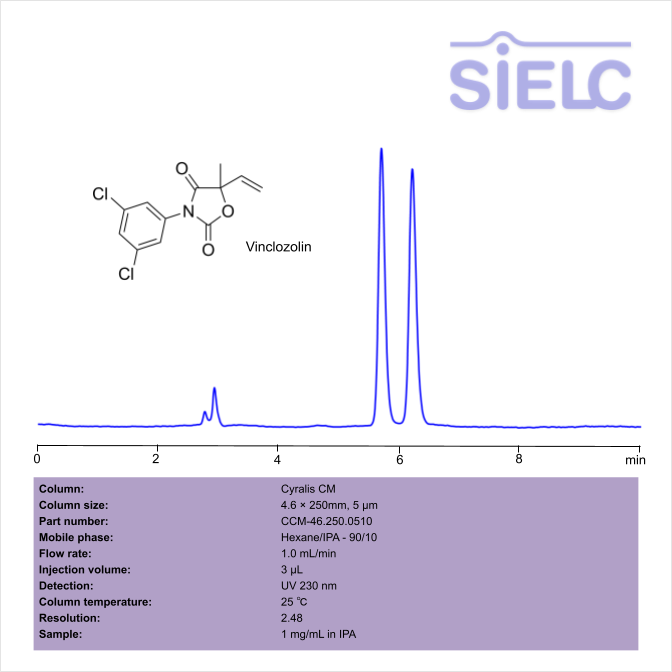
High Performance Liquid Chromatography (HPLC) Method for Analysis of Vinclozolin.
Vinclozolin is a dicarboximide fungicide with the chemical formula C12H9Cl2NO3. It is primarily used to control blights, rots. and molds on fruits, vegetables, and turf. It is considered a possible human carcinogen. It breaks down easily in the environment with the help of microbes between 34 and 94 days, though the half-life residue can reach up to 1000 days. You can find detailed UV spectra of Vinclozolin and information about its various lambda maxima by visiting the following link.
This application describes a normal-phase chiral HPLC method for the separation of Vinclozolin enantiomers using SIELC’s Cyralis CM chiral column. Cyralis CM is a cellulose-based chiral stationary phase (CSP) designed for enantiomeric separations, optical purity testing, chiral impurity analysis, and stereoisomer characterization in pharmaceutical, chemical, agrochemical, and fine chemical applications.
Vinclozolin can be retained and analyzed using the Cyralis CM stationary phase column. The analysis utilizes an isocratic method with a mobile phase consisting of Hexane and IPA. Detection is performed using UV.
Condition
| Column | Cyralis CM, 4.6 x 250 mm, 5 µm, 100 A, normal phase |
| Mobile Phase | Hexane/IPA- 90/10% |
| Flow Rate | 1.0 mL/min |
| Detection | UV 230 nm |
| Resolution | 2.48 |
Description
| Class of Compounds | Fungicide |
| Analyzing Compounds | Vinclozolin |
Application Column
Cyralis CM
Column Diameter: 4.6 mm
Column Length: 250 mm
Particle Size: 5 µm
Pore Size: 100 A
Column options: normal phase