HPLC Method for Copper peptide (GHK-Cu) on BIST B by SIELC Technologies
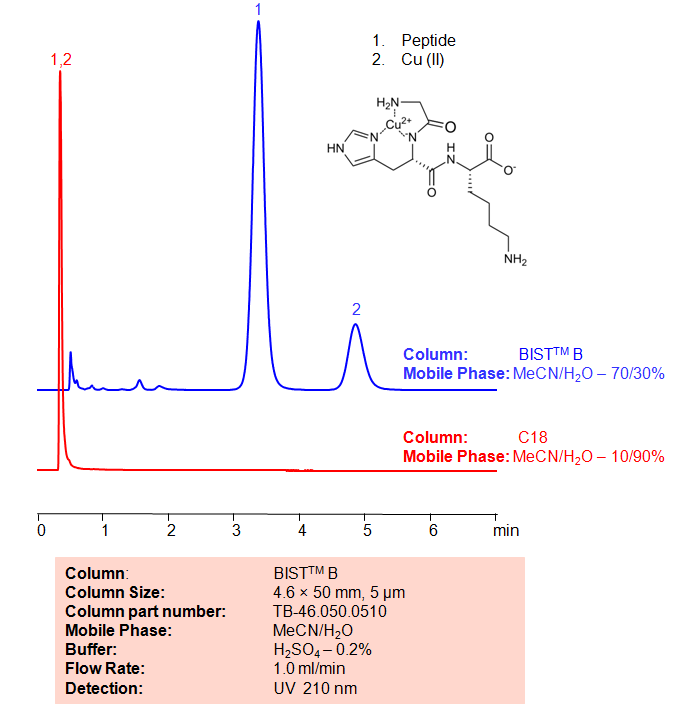
High Performance Liquid Chromatography (HPLC) Method for Analysis of Copper peptide (GHK-Cu).
Copper Peptide GHK-Cu is a naturally occurring copper complex with the molecular formula C14H22CuN6O4•C2H4O2. It is a is a copper complex of glycyl-L-histidyl-lysine and can be naturally found in urine, saliva, and plasma. Research shows that the complex facilitates faster wound healing, improved angiognesis, and elevated level of antioxidant enzymes. Often times, it is used in anti-aging cosmetics.
Using SIELC’s newly introduced BIST™ method, Copper peptide (GHK-Cu), which separates in water, can be retained on a positively-charged anion-exchange BIST B column. There are two keys to this retention method: 1) a multi-charged, negative buffer, such as Sulfuric acid (H2SO4), which acts as a bridge, linking the positively-charged Copper and peptide to the positively-charged column surface and 2) a mobile phase consisting mostly of organic solvent (such as MeCN) to minimize the formation of a solvation layer around the charged analytes. Using this new and unique analysis method, Copper peptide GHK-Cu can be separated, retained, and UV detected at 210 nm
| Column | BIST B, 4.6 x 50 mm, 5 µm, 100 A, dual ended |
| Mobile Phase | MeCN – 70% |
| Buffer | H2SO4 – 0.2% |
| Flow Rate | 1.0 ml/min |
| Detection | UV 210 nm |
| Class of Compounds | Peptide, Metal |
| Analyzing Compounds | Copper peptide (GHK-Cu) |
Application Column
BIST B
Column Diameter: 4.6 mm
Column Length: 50 mm
Particle Size: 5 µm
Pore Size: 100 A
Column options: dual ended