Natamycin

CAS Number7681-93-8
Molecular FormulaC33H47NO13
Molecular Weight665.7
InChI KeyNCXMLFZGDNKEPB-FFPOYIOWSA-N
LogP-1.3
Synonyms
  • NATAMYCIN
  • pimaricin
  • 7681-93-8
  • Myprozine
  • Pimafucin
  • Tennecetin
  • Natacyn
  • Natamicina
  • Natamycine
  • Delvocid
  • Mycophyt
  • Pimaracin
  • Synogil
  • Natamycinum
  • Pimarizin
  • Antibiotic A-5283
  • Delvolan
  • Pimaricine
  • CL 12,625
  • 8O0C852CPO
  • INS NO.235
  • INS-235
  • NSC-759167
  • CL 12625
  • CL-12625
  • DTXCID301163
  • E-235
  • 16-(3-Amino-3,6-didesoxy-beta-D-mannopyranosyloxy)-5,6-epoxy-8,12,14-trihydroxy-26-methyl-2,10-dioxo-1-oxacyclohexacosa-3,17,19,21,23-pentaen-13-carbonsaeure
  • DTXSID6021163
  • CHEBI:7488
  • (1R,3S,5R,7R,8E,12R,14E,16E,18E,20E,22R,24S,25R,26S)-22-((2R,3S,4S,5S,6R)-4-amino-3,5-dihydroxy-6-methyloxan-2-yl)oxy-1,3,26-trihydroxy-12-methyl-10-oxo-6,11,28-trioxatricyclo(22.3.1.05,7)octacosa-8,14,16,18,20-pentaene-25-carboxylic acid
  • (1R,3S,5R,7R,8E,12R,14E,16E,18E,20E,22R,24S,25R,26S)-22-[(2R,3S,4S,5S,6R)-4-amino-3,5-dihydroxy-6-methyloxan-2-yl]oxy-1,3,26-trihydroxy-12-methyl-10-oxo-6,11,28-trioxatricyclo[22.3.1.05,7]octacosa-8,14,16,18,20-pentaene-25-carboxylic acid
  • RefChem:56874
  • DTXCID501473823
  • (1R,3S,5R,7R,12R,22R,24S,25R,26S)-22-(((3S,4S,5S,6R)-4-amino-3,5-dihydroxy-6-methyloxan-2-yl)oxy)-1,3,26-trihydroxy-12-methyl-10-oxo-6,11,28-trioxatricyclo(22.3.1.0^(5,7))octacosa-8,14,16,18,20-pentaene-25-carboxylic acid
  • (1R*,3S*,5R*,7R*,8E,12R*,14E,16E,18E,20E,22R*,24S*,25R*,26S*)-22-(3-Amino-3,6-dideoxy-beta-D-mannopyranosyloxy)-1,3,26-trihydroxy-12-methyl-10-oxo-6,11,28-trioxatricyclo(22.3.1.05,7)octacosa-8,14,16,18,20-pentaene-25-carboxylic acid
  • 231-683-5
  • 6,11,28-Trioxatricyclo(22.3.1.05,7)octacosa-8,14,16,18,20-pentaene-25-carboxylic acid, 22-((3-amino-3,6-dideoxy-beta-D-mannopyranosyl)oxy)-1,3,26-trihydroxy-12-methyl-10-oxo-, (1R,3S,5R,7R,8E,12R,14E,16E,18E,20E,22R,24S,25R,26S)-
  • DTXSID201015573
  • MFCD00135085
  • Delvopos
  • Natafucin
  • Natamycin(Pimaricin)
  • C33H47NO13
  • Tymasil
  • 6,11,28-Trioxatricyclo[22.3.1.05,7]octacosa-8,14,16,18,20-pentaene-25-carboxylic acid, 22-[(3-amino-3,6-dideoxy-.beta.-D-mannopyranosyl)oxy]-1,3,26-trihydroxy-12-methyl-10-oxo-, (1R,3S,5R,7R,8E,12R,14E,16E,18E,20E,22R,24S,25R,26S)-
  • Pimarizin [German]
  • Natamycine [INN-French]
  • Natamycinum [INN-Latin]
  • Natamicina [INN-Spanish]
  • UNII-8O0C852CPO
  • Tennecetin;
  • Myprozine;
  • Natafucin;
  • Pimafucin;
  • Pimafugin;
  • Mycophyt;
  • Natacyn;
  • Synogil;
  • Natamycin [USAN:USP:INN:BAN]
  • NCGC00016686-01
  • (1R,3S,5R,7R,8E,12R,14E,16E,18E,20E,22R,24S,25R,26S)-22-[(3-amino-3,6-dideoxy-beta-D-mannopyranosyl)oxy]-1,3,26-trihydroxy-12-methyl-10-oxo-6,11,28-trioxatricyclo[22.3.1.0~5,7~]octacosa-8,14,16,18,20-pentaene-25-carboxylic acid
  • 6,11,28-TRIOXATRICYCLO(22.3.1.05,7)OCTACOSA-8,14,16,18,20-PENTAENE-25-CARBOXYLIC ACID, 22-((3-AMINO-3,6-DIDEOXY-.BETA.-D-MANNOPYRANOSYL)OXY)-1,3,26-TRIHYDROXY-12-METHYL-10-OXO-, (1R,3S,5R,7R,8E,12R,14E,16E,18E,20E,22R,24S,25R,26S)-
  • CAS-7681-93-8
  • EINECS 231-683-5
  • Pimaricin; Natamycin
  • Natamycin (Standard)
  • NATAMYCIN [FCC]
  • NATAMYCIN [INN]
  • PIMARICIN [JAN]
  • NATAMYCIN [MI]
  • NATAMYCIN [USAN]
  • NATAMYCIN [VANDF]
  • NATAMYCIN [MART.]
  • NATAMYCIN [USP-RS]
  • NATAMYCIN [WHO-DD]
  • SCHEMBL18140
  • 0(5,7)]octacosa-8,14,16,18,20-pentaene-25-carboxylic ac
  • orb1310363
  • orb3025289
  • NATAMYCIN [ORANGE BOOK]
  • CHEMBL1200656
  • HY-B0133R
  • MSK2531
  • NATAMYCIN [USP MONOGRAPH]
  • NCXMLFZGDNKEPB-FFPOYIOWSA-N
  • Pimaricin 100 |Ig/mL in Water
  • (1R,3S,5R,7R,8E,12R,14E,16E,18E,20E,22R,24S,25R,26S)-22-(((2R,3S,4S,5S,6R)-4-amino-3,5-dihydroxy-6-methyltetrahydro-2H-pyran-2-yl)oxy)-1,3,26-trihydroxy-12-methyl-10-oxo-6,11,28-trioxatricyclo[22.3.1.
  • (1R,3S,5R,7R,8E,12R,14E,16E,18E,20E,22R,24S,25R,26S)-22-(((2R,3S,4S,5S,6R)-4-Amino-3,5-dihydroxy-6-methyltetrahydro-2H-pyran-2-yl)oxy)-1,3,26-trihydroxy-12-methyl-10-oxo-6,11,28-trioxatricyclo[22.3.1.05,7]octacosa-8,14,16,18,20-pentaene-25-carboxylic acid
  • EX-A1989
  • HY-B0133
  • Tox21_110561
  • BDBM50370755
  • EBC-27421
  • AKOS030485970
  • 73 - Natamycin (pimaricin) in cheese
  • AN26164
  • CS-1909
  • DB00826
  • NSC 759167
  • NICOTINAMIDE_ADENINE_DINUCLEOTIDE
  • Stereoisomer of 22-((3-amino-3,6-dideoxy-beta-D-mannopyranosyl)oxy)-1,3,26-trihydroxy-12-methyl-10-oxo-6,11,28-trioxatricyclo(22.3.1.0(sup 5,7))octacosa-8,14,16,18,20-pentaene-25-carboxylic acid
  • NS00003340
  • Natamycin, VETRANAL(TM), analytical standard
  • NCGC00373238-02_C33H47NO13_Delvocid
  • EN300-22411493
  • F806751
  • Pimaricin preparation, ~2.5%, aqueous suspension
  • Q248466
  • Natamycin, United States Pharmacopeia (USP) Reference Standard
  • Pimaricin, from Streptomyces chattanoogensis, >=95% (HPLC)
  • Natamycin, Pharmaceutical Secondary Standard; Certified Reference Material
  • (1R,3S,5R,7R,8E,12R,14E,16E,18E,20E,22R,24S,25R,26S)-22-[(2R,3S,4S,5S,6R)-4-amino-3,5-dihydroxy-6-methyl-tetrahydropyran-2-yl]oxy-1,3,26-trihydroxy-12-methyl-10-oxo-6,11,28-trioxatricyclo[22.3.1.05,7]octacosa-8,14,16,18,20-pentaene-25-carboxylic acid
  • (1R,3S,5R,7R,8E,12R,14E,16E,18E,20E,22R,24S,25R,26S)-22-[(3-Amino-3,6-dideoxy-|A-D-mannopyranosyl)oxy]-1,3,26-trihydroxy-12-methyl-10-oxo-6,11,28-trioxatricyclo[22.3.1.05,7]octacosa-8,14,16,18,20-pentaene-25-carboxylic acid
  • (1R,3S,5R,7R,8E,12R,14E,16E,18E,20E,22R,24S,25R,26S)-22-{[(2R,3S,4S,5S,6R)-4-amino-3,5-dihydroxy-6-methyloxan-2-yl]oxy}-1,3,26-trihydroxy-12-methyl-10-oxo-6,11,28-trioxatricyclo[22.3.1.0,5,7]octacosa-8,14,16,18,20-pentaene-25-carboxylic acid

Applications:

HPLC UV Method for Analysis of Natamycin in Yogurt on Primesep 100 Column

July 13, 2026

HPLC Method for Analysis of Natamycin on Primesep 100 Column by SIELC Technologies
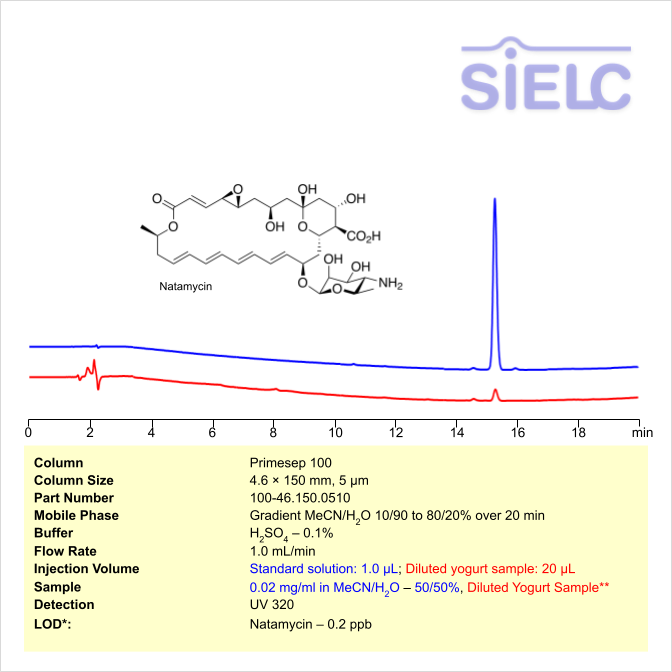
High Performance Liquid Chromatography (HPLC) Method for Analysis of Natamycin.

Natamycin, also known as pimaricin, is an antifungal medication with C33H47NO13 molecular formula. It is primarily used to treat fungal infections of eyelids, conjunctiva, and cornea. On occasion, it is also used as a preservative. It prevents fungi growth by binding to ergosterol in fungal cell membranes and inhibiting amino acid and glucose transport proteins. You can find detailed UV spectra of Natamycin and information about its various lambda maxima by visiting the following link.

**The Yogurt sample was prepared by mixing 5g of yogurt and 5g or acetonitrile. After the mixture separated, the liquid half was removed and filtered.

Natamycin can be retained and analyzed using the Primesep 100 stationary phase column. The analysis utilizes a gradient method with a simple mobile phase consisting of water and acetonitrile (MeCN) and ethanol. Detection is performed using UV.

Condition

ColumnPrimesep 100, 4.6 x 150 mm, 5 µm, 100 A, dual ended
Mobile PhaseGradient MeCN/H2O 10/90 to 80/20% over 20 min
BufferH2SO4 – 0.1%
Flow Rate1.0 ml/min
DetectionUV 320 nm
Limit Of Detection*Natamycin – 0.2 ppb
*LOD was determined for this combination of instrument, method, and analyte, and it can vary from one laboratory to another even when the same general type of analysis is being performed.

Description

Class of CompoundsDrug
Analyzing CompoundsNatamycin

Application Column

Primesep 100

Column Diameter: 4.6 mm
Column Length: 150 mm
Particle Size: 5 µm
Pore Size: 100 A
Column options: dual ended

Add to cart
Application Analytes:
Natamycin

Application Detection:
UV Detection
SIELC Technologies usually develops more than one method for each compound. Therefore, this particular method may not be the best available method from our portfolio for your specific application. Before you decide to implement this method in your research, please send us an email to research@sielc.com so we can ensure you get optimal results for your compound/s of interest.

HPLC Method for Analysis of Natamycin on Primesep 100 Column

July 13, 2026

HPLC Method for Analysis of Natamycin on Primesep 100 Column by SIELC Technologies
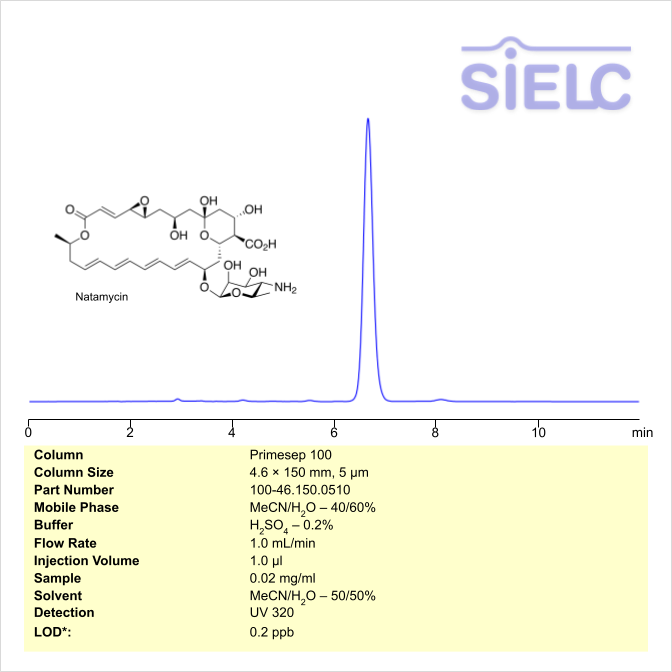
High Performance Liquid Chromatography (HPLC) Method for Analysis of Natamycin.

Natamycin, also known as pimaricin, is an antifungal medication with C33H47NO13 molecular formula. It is primarily used to treat fungal infections of eyelids, conjunctiva, and cornea. On occasion, it is also used as a preservative. It prevents fungi growth by binding to ergosterol in fungal cell membranes and inhibiting amino acid and glucose transport proteins. You can find detailed UV spectra of Natamycin and information about its various lambda maxima by visiting the following link.

Natamycin can be retained and analyzed using the Primesep 100 stationary phase column. The analysis utilizes an isocratic method with a simple mobile phase consisting of water and acetonitrile (MeCN) and ethanol. Detection is performed using UV.

Condition

ColumnPrimesep 100, 4.6 x 150 mm, 5 µm, 100 A, dual ended
Mobile PhaseMeCN/H2O- 40/60%
BufferH2SO4 – 0.2%
Flow Rate1.0 ml/min
DetectionUV 320 nm
Limit Of Detection*0.2 ppb
*LOD was determined for this combination of instrument, method, and analyte, and it can vary from one laboratory to another even when the same general type of analysis is being performed.

Description

Class of CompoundsDrug
Analyzing CompoundsNatamycin

Application Column

Primesep 100

Column Diameter: 4.6 mm
Column Length: 150 mm
Particle Size: 5 µm
Pore Size: 100 A
Column options: dual ended

Add to cart
Application Analytes:
Natamycin

Application Detection:
UV Detection
SIELC Technologies usually develops more than one method for each compound. Therefore, this particular method may not be the best available method from our portfolio for your specific application. Before you decide to implement this method in your research, please send us an email to research@sielc.com so we can ensure you get optimal results for your compound/s of interest.

Uv-Vis Spectrum of Natamycin

July 13, 2026

Access the UV-Vis Spectrum SIELC Library
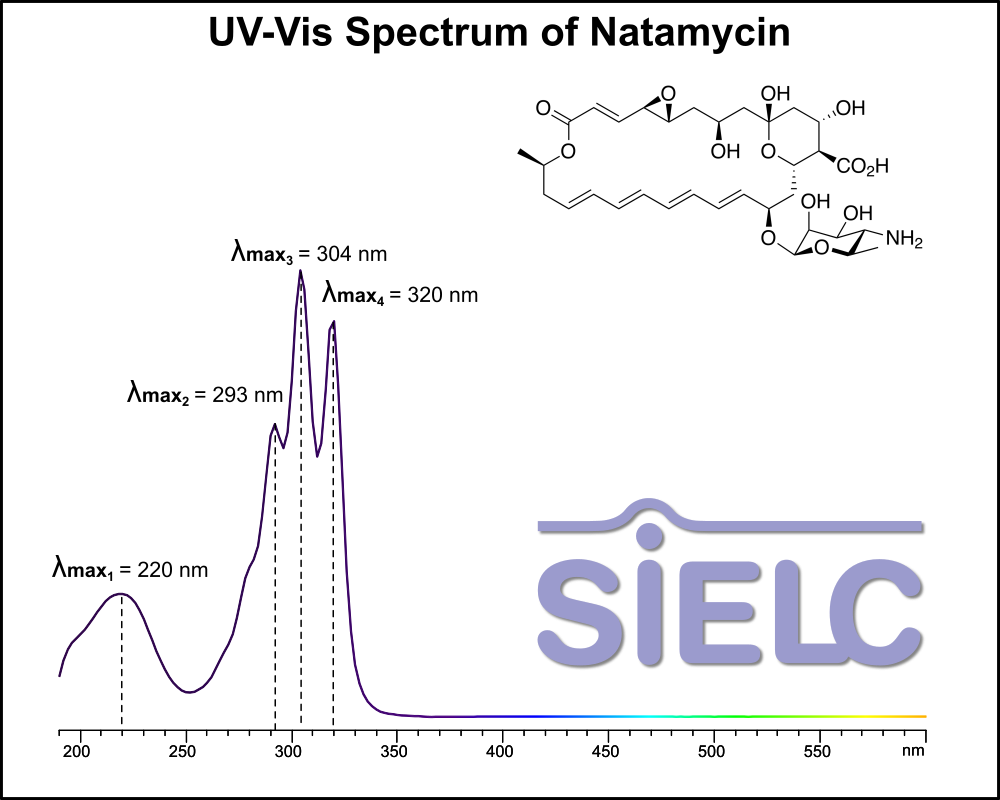
If you are looking for optimized HPLC method to analyze Natamycin check our HPLC Applications library

UV/Vis.: λmax: 220, 293, 304, 320 nm

For optimal results in HPLC analysis, it is recommended to measure absorbance at a wavelength that matches the absorption maximum of the compound(s) being analyzed. The UV spectrum shown can assist in selecting an appropriate wavelength for your analysis. Please note that certain mobile phases and buffers may block wavelengths below 230 nm, rendering absorbance measurement at these wavelengths ineffective. If detection below 230 nm is required, it is recommended to use acetonitrile and water as low UV-transparent mobile phases, with phosphoric acid and its salts, sulfuric acid, and TFA as buffers.
For some compounds, the UV-Vis Spectrum is affected by the pH of the mobile phase. The compound was dissolved in ethanol. This analysis was done with the mobile phase of hexane, IPA, and TFA.

This compound was diluted in a mixture of water and acetonitrile. The method was done with a mixture of water, acetonitrile, and a sulfuric acid buffer.


Application Analytes:
Natamycin
SIELC Technologies usually develops more than one method for each compound. Therefore, this particular method may not be the best available method from our portfolio for your specific application. Before you decide to implement this method in your research, please send us an email to research@sielc.com so we can ensure you get optimal results for your compound/s of interest.