HPLC Method for Separation of Hydrophobic, Cationic and Anionic Surfactants on Newcrom BH by SIELC Technologies
Surfactants, also known as surface-active agents, are compounds that lower the surface tension (or interfacial tension) between two liquids or between a liquid and a solid. Surfactants may act as detergents, wetting agents, emulsifiers, foaming agents, or dispersants.
They are often classified according to the charge of the polar head group:
Anionic Surfactants: These surfactants have a negative charge on their polar head group. Common examples include soap, sodium laureth sulfate, and sodium lauryl sulfate. They are commonly used in detergents and shampoos due to their ability to emulsify oils and hold dirt in suspension, so it can be rinsed away.
Cationic Surfactants: These surfactants have a positive charge on their polar head group. Examples include cetyltrimethylammonium bromide (CTAB) and benzalkonium chloride. These are often used as antiseptics and can also be found in hair conditioners because they reduce static cling.
Nonionic Surfactants: These surfactants have no charge on their polar head group. Examples include alcohol ethoxylates, nonylphenol ethoxylates, and polysorbates. Nonionic surfactants are often used in laundry and dishwasher detergents.
Sodium, which has a chemical symbol of Na, is a soft alkali metal that is highly reactive. It is found in abundance in everyday materials like table salt, sea water, and even the Earth’s crust. It is crucial for the body’s function and fluid balance.
1-Ethylpyridinium bromide is an ionic liquid with the chemical formula C7H10BrN. It is primarily used as a solvent at temperatures below 100oC catalysts, and electrolytes in , It has an ethyl group attached to a pyridinium ring, and its counterion is bromide (Br-). You can find detailed UV spectra of 1-Ethylpyridinium bromide and information about its various lambda maxima by visiting the following link.
Benzalkonium chloride, also known as Zephiran or Alkyldimethylbenzylammonium chloride, is a positively charged surfactant with the chemical formula C6H5CH2N(CH3)2RCl. It is often used as a pharmaceutical preservative and as an antiseptic. You can find detailed UV spectra of Benzalkonium chloride and information about its various lambda maxima by visiting the following link.
Cetylpyridinium Chloride, also written as CPC, is a cationic quaternary ammonium compound with the chemical formula C21H38ClN. It is commonly used in mouthwashes, toothpastes, lozenges, throat sprays, breath sprays, and nasal sprays due to it’s antiseptic abilities. You can find detailed UV spectra of Cetylpyridinium Chloride and information about its various lambda maxima by visiting the following link.
Chloride is typically used to refer to a compound or molecule that contains a chlorine anion: Cl–. It is an electrolyte that is essential for bodily functions including blood pH, fluid balance, cellular functions, and more. Imbalance of chloride can indicate underlying health problems.
1-Pentanesulfonic acid is an organosulfonic acid with the chemical formula C5H12O3S. It is primarily used in it’s sodium salt form as an anionic pairing agent. You can find detailed UV spectra of 1-Pentanesulfonic acid and information about its various lambda maxima by visiting the following link.
Lauric acid, also known as dodecanoic acid, is a saturated fatty acid. Its chemical formula is CH₃(CH₂)₁₀COOH. It is white in color, and it is a solid at room temperature with a melting point of around 44 degrees Celsius (111 degrees Fahrenheit). It is relatively inexpensive and has a long shelf life, which makes it an attractive ingredient in various commercial products. Lauric acid is found naturally in various plant and animal fats and oils, but the largest amounts of lauric acid are found in coconut oil and palm kernel oil. In these oils, lauric acid can make up to 50% of the total fat content. It is commonly used in the manufacturing of soaps and cosmetics due to its ability to form a lather when mixed with water. It is also used in food for its role in digestion and metabolic processes. It’s a medium-chain fatty acid, which means it is more easily absorbed and utilized by the body compared to long-chain fatty acids. You can find detailed UV spectra of Dodecanoic acid (Lauric acid) and information about its various lambda maxima by visiting the following link.
p-Toluenesulfonic Acid, also known as tosylic acid, which are written as PTSA, pTSA, pTsOH, and TsOH, is an organic compound with the chemical formula C7H8O3S. It is used primarily in organic synthesis. You can find detailed UV spectra of p-Toluenesulfonic Acid and information about its various lambda maxima by visiting the following link.
1-Octanesulfonic acid is an anionic organosulfonic acid with the chemical formula C8H18O3S. It is primarily used in it’s sodium salt form as an ion-pairing agent. You can find detailed UV spectra of 1-Heptanesulfonic acid and information about its various lambda maxima by visiting the following link.
Sodium dodecyl sulfate (SDS), or sodium lauryl sulfate (SLS), is a surfactant used in cleaning, hygienic, and food products. It has a chemical formula C12H25NaSO4, meaning it has twelve carbon hydrophobic tail attached to a polar sulfate. At low concentrations, it is used as a whipping aid and emulsifier in foods containing egg whites. It has a similar use in pharmaceutics as an ionic solubilizer and, also, an emulsifier. In laboratory uses, it is used as a component for lysing cells during RNA extraction or DNA extraction. You can find detailed UV spectra of Sodium dodecyl sulfate and information about its various lambda maxima by visiting the following link.
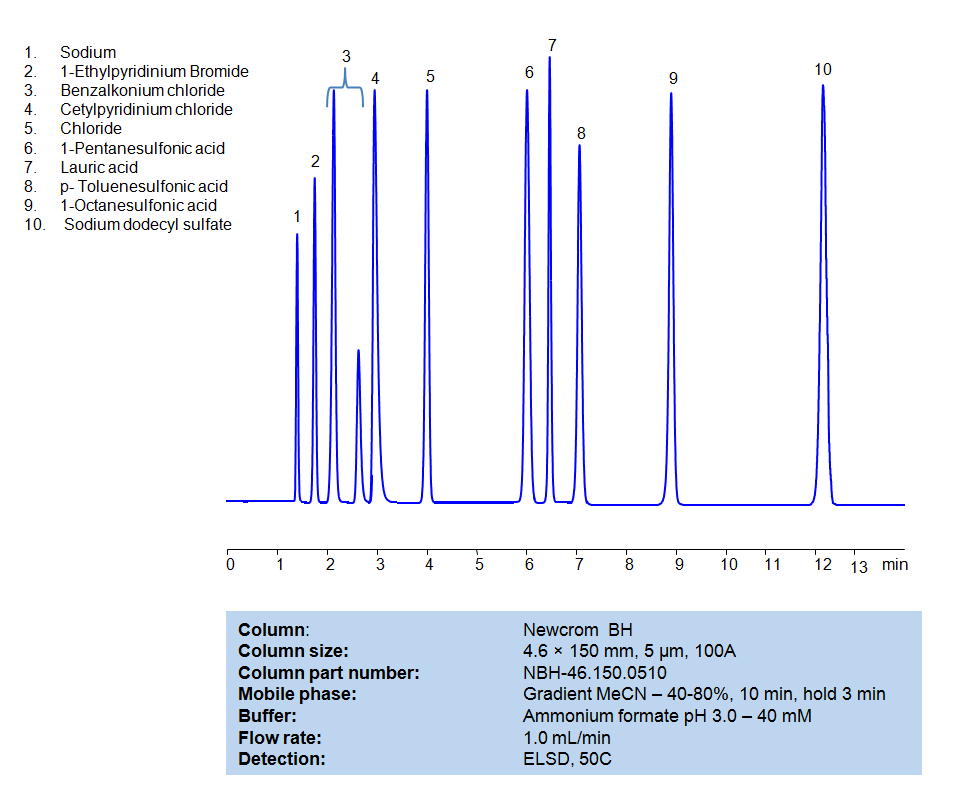
Benzalkonium chloride, Cetylpyridinium Chloride, 1-Pentanesulfonic acid, Dodecanoic acid (Lauric acid), p-Toluenesulfonic Acid (PTSA), 1-Octanesulfonic acid, Sodium dodecyl sulfate, 1-Ethylpyridinium bromide can be retained, separated, and analyzed using a reverse-phase [colimn] column. The mobile phase for this method consists of water, acetonitrile (MeCN), and Ammonium formate, which serves as a buffer. This analytical method can be detected with an Evaporative Light Scattering Detector (ELSD) or any other evaporative detection method (CAD, ESI-MS).
Condition
| Column | Newcrom BH, 4.6 x 150 mm, 5 µm, 100 A, dual ended |
| Mobile Phase | Gradient MeCN -40-80%, 10 min |
| Buffer | Ammonium formate pH 3.0 – 40 mM |
| Flow Rate | 1.0 ml/min |
| Detection | ELSD, 50C |
Description
| Class of Compounds | Surfactants |
| Analyzing Compounds | Benzalkonium chloride, Cetylpyridinium Chloride, 1-Pentanesulfonic acid, Dodecanoic acid (Lauric acid), p-Toluenesulfonic Acid (PTSA), 1-Octanesulfonic acid, Sodium dodecyl sulfate, 1-Ethylpyridinium bromide |
Application Column
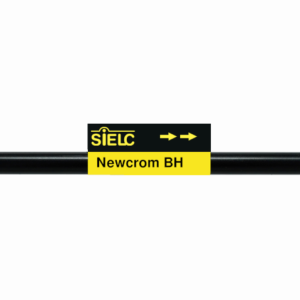
Newcrom BH
Column Diameter: 4.6 mm
Column Length: 150 mm
Particle Size: 5 µm
Pore Size: 100 A
Column options: dual ended
1-Octanesulfonic acid
1-Pentanesulfonic acid
Benzalkonium chloride
Cetylpyridinium Chloride
Dodecanoic acid (Lauric acid)
Sodium dodecyl sulfate
p-Toluenesulfonic Acid (PTSA)