HPLC Method for 2,4,6-Trichloroanisole on Newcrom R1 by SIELC Technologies
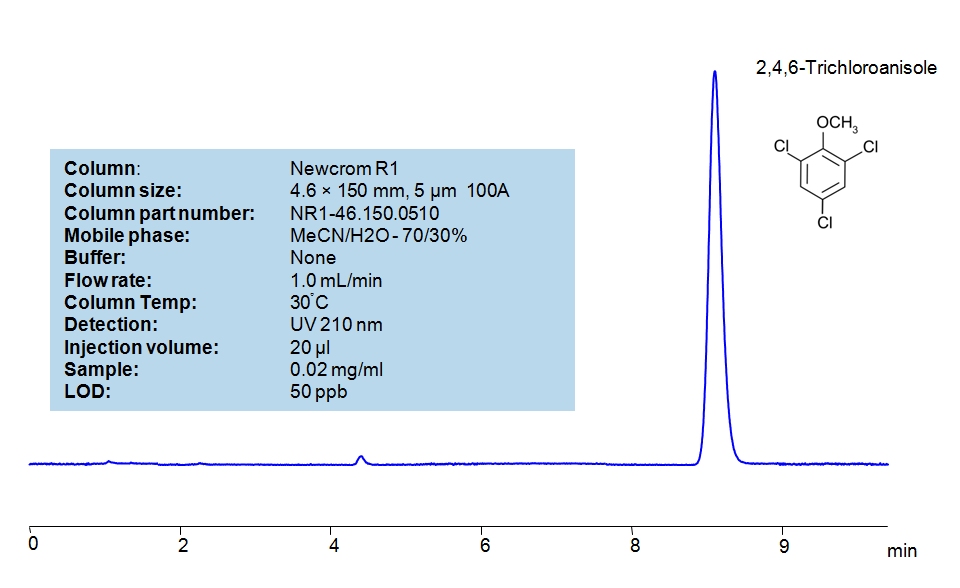
High Performance Liquid Chromatography (HPLC) Method for Analysis of 2,4,6-Trichloroanisole.
2,4,6-Trichloroanisole (TCA) is a fungal metabolite of 2,4,6-Trichlorophenol with the chemical formula C7H5Cl3O. TCA has a distinct musty smell that is most evident when wines develop cork taint. It is formed by the methylation of 2,4,6-trichloropenol. Naturally, it is suspected to be produced when airborne fungi and bacteria are presented with chlorinated phenolic compounds. You can find detailed UV spectra of 2,4,6-Trichloroanisole and information about its various lambda maxima by visiting the following link.
2,4,6-Trichloroanisole can be retained and analyzed using the Newcrom R1 stationary phase column. The analysis utilizes an isocratic method with a simple mobile phase consisting of water and acetonitrile (MeCN). Detection is performed using UV.
| Column | Newcrom R1, 4.6 x 150 mm, 5 µm, 100 A, dual ended |
| Mobile Phase | MeCN/H2O – 70/30% |
| Buffer | None |
| Flow Rate | 1.0 ml/min |
| Detection | UV, 210 nm |
| Class of Compounds |
Haloanisole |
| Analyzing Compounds | 2,4,6-Trichloroanisole |
Application Column
Newcrom R1
Column Diameter: 4.6 mm
Column Length: 150 mm
Particle Size: 5 µm
Pore Size: 100 A
Column options: dual ended