![Benzo[e]pyrene](https://upload.wikimedia.org/wikipedia/commons/thumb/8/82/Benzo%28e%29pyrene.png/250px-Benzo%28e%29pyrene.png)
| CAS Number | 192-97-2 |
|---|---|
| Molecular Formula | C20H12 |
| Molecular Weight | 252.3 |
| InChI Key | TXVHTIQJNYSSKO-UHFFFAOYSA-N |
| LogP | 6.4 |
| Synonyms |
|
Applications:
HPLC UV Method for Analysis of Polycyclic Aromatic Compounds (PACs) on Chromni Column
June 2, 2026
HPLC Method for Pyrene, Benzo[e]pyrene, Benz(a)anthracene, Dibenzothiophene on Chromni by SIELC Technologies
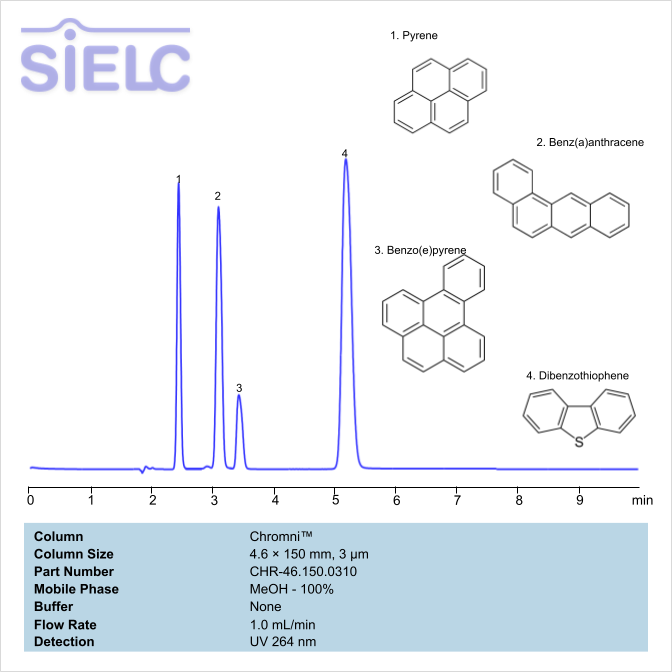
High Performance Liquid Chromatography (HPLC) Method for Analysis of Pyrene, Benzo[e]pyrene, Benz(a)anthracene, Dibenzothiophene.
Pyrene is a polycyclic aromatic hydrocarbon with the chemical formula C16H10. It is formed during incomplete combustion of organic compounds. It is one of the most studied organic molecules in the world when it comes to its photophysical properties. Its fluorescence emission spectrum is sensitive to the polarity of the solvent. You can find detailed UV spectra of Pyrene and information about its various lambda maxima by visiting the following link.
Benz(a)anthracene is a polycyclic aromatic hydrocarbon with the chemical formula C18H12. It is a carcinogen that is produced during incomplete combustion of organic matter. You can find detailed UV spectra of Benz(a)anthracene and information about its various lambda maxima by visiting the following link.
Benzo(e)pyrene is a polycyclic aromatic hydrocarbon with the chemical formula C20H12. You can find detailed UV spectra of Pyrene, Benzo[e]pyrene, Benz(a)anthracene, Dibenzothiophene and information about its various lambda maxima by visiting the following link.
Dibenzothiophene, also written as DBT and diphenylene sulfide, is an organosulfuric compound with the chemical formula C12H8S. It is primarily found as a problematic impurity in petroleum. DBT is prepared by the reaction of biphenyl and sulfur dichloride when aluminum chloride is present. You can find detailed UV spectra of Pyrene, Benzo[e]pyrene, Benz(a)anthracene, Dibenzothiophene and information about its various lambda maxima by visiting the following link.
Pyrene, Benzo[e]pyrene, Benz(a)anthracene, Dibenzothiophene can be retained and analyzed using the Chromni stationary phase column. The analysis utilizes an isocratic method with a simple mobile phase consisting of water and acetonitrile (MeCN) with a [buffer] buffer. Detection is performed using UV.
| Column | Chromni, 4.6 x 150 mm, 3 µm, 100 A, dual ended |
| Mobile Phase | MeOH – 100% |
| Buffer | None |
| Flow Rate | 1.0 mL/min |
| Detection | UV 264 nm |
| Class of Compounds | Polycyclic Aromatic Carbon |
| Analyzing Compounds | Pyrene, Benzo[e]pyrene, Benz(a)anthracene, Dibenzothiophene |
Application Column
Chromni
Column Diameter: 4.6 mm
Column Length: 150 mm
Particle Size: 3 µm
Pore Size: 100 A
Column options: dual ended
Benzo[e]pyrene
Dibenzothiophene
Pyrene

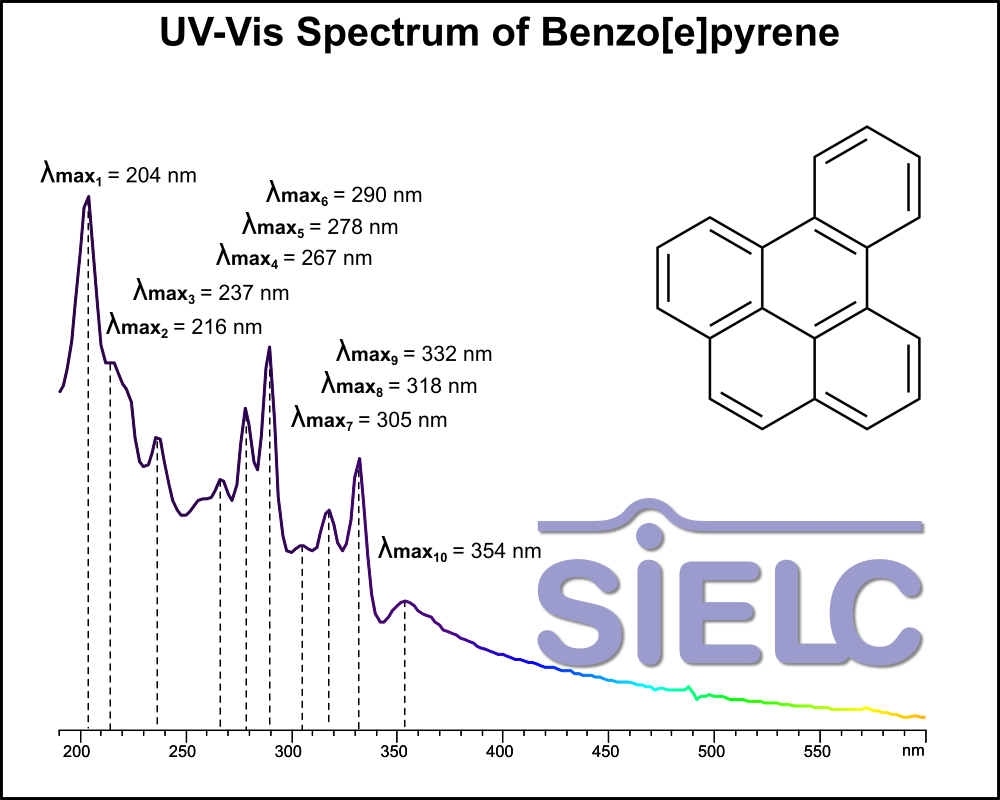
Uv-Vis Spectrum of Benzo[e]pyrene
April 3, 2026
Access the UV-Vis Spectrum SIELC Library
If you are looking for optimized HPLC method to analyze Benzo[e]pyrene check our HPLC Applications library
For optimal results in HPLC analysis, it is recommended to measure absorbance at a wavelength that matches the absorption maximum of the compound(s) being analyzed. The UV spectrum shown can assist in selecting an appropriate wavelength for your analysis. Please note that certain mobile phases and buffers may block wavelengths below 230 nm, rendering absorbance measurement at these wavelengths ineffective. If detection below 230 nm is required, it is recommended to use acetonitrile and water as low UV-transparent mobile phases, with phosphoric acid and its salts, sulfuric acid, and TFA as buffers.
For some compounds, the UV-Vis Spectrum is affected by the pH of the mobile phase. The compound was dissolved with acetonitrile. This analysis was done with the mobile phase made of 20% acetonitrile and 80% water.
