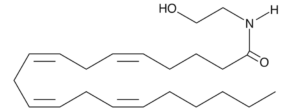
| CAS Number | 94421-68-8 |
|---|---|
| Molecular Formula | C22H37NO2 |
| Molecular Weight | 347.5 |
| InChI Key | LGEQQWMQCRIYKG-DOFZRALJSA-N |
| LogP | 5.4 |
| Synonyms |
|
Applications:
HPLC ELSD Method for Separation of Endocannabinoid-Related Lipids on Chromni Column
June 5, 2026
HPLC Method for Arachidonoyl ethanolamide (AEA), N-Arachidonoyl-3-hydroxy-y-Aminobutyric Acid, N-Arachidonoyl dopamine, N-Arachidonoyl-L-Serine on Chromni by SIELC Technologies
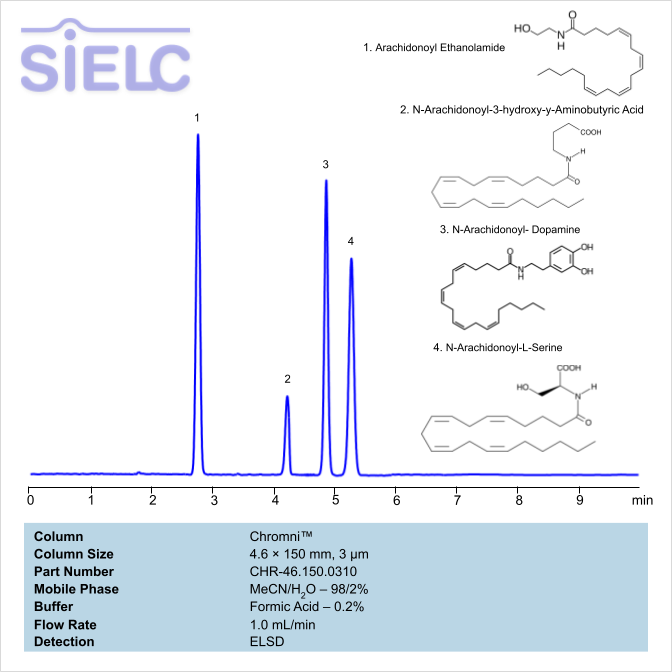
High Performance Liquid Chromatography (HPLC) Method for Analysis of Arachidonoyl ethanolamide (AEA), N-Arachidonoyl-3-hydroxy-y-Aminobutyric Acid, N-Arachidonoyl dopamine, N-Arachidonoyl-L-Serine.
Arachidonoyl ethanolamide, also denoted as AEA, is a bioactive lipid that has the chemical formula C22H37NO2 and plays significant roles in various physiological and biochemical processes. AEA influences inflammatory and pain pathways due to being an endocannabinoid, meaning it binds to cannabinoid receptors as THC in cannabis does. You can find detailed UV spectra of AEA and information about its various lambda maxima by visiting the following link.
N-Arachidonoyl-3-hydroxy-y-Aminobutyric Acid is ab endogenous lipid messenger with the chemical formula C24H39NO4. It occurs naturally in brains of mammals. Due to containing aminobutyric acid, it plays a role in regulating GABAergic pathways. As an endocannabinoid, it also binds to specific g-protein receptors. You can find detailed UV spectra of N-Arachidonoyl-3-hydroxy-y-Aminobutyric Acid and information about its various lambda maxima by visiting the following link
N-Arachidonoyl Dopamine, also written as NADA, is an endocannabinoid with the chemical formula C28H41NO3. It acts as an agonist of the CB1 receptor as well as the transient receptor potential V1. You can find detailed UV spectra of NADA and information about its various lambda maxima by visiting the following link.
N-Arachidonoyl-L-Serine, also written as ARA-S, is an a lipid with the chemical formula C23H37NO4. Unlike classic endocannabinoids, it exhibits only a weak affinity for CB1, CB2, and TRPV-1. Instead, it works as an agonist for GPR55 receptor. You can find detailed UV spectra of ARA-S and information about its various lambda maxima by visiting the following link.
Arachidonoyl ethanolamide (AEA), N-Arachidonoyl-3-hydroxy-y-Aminobutyric Acid, N-Arachidonoyl dopamine, N-Arachidonoyl-L-Serine can be retained and analyzed using the Chromni stationary phase column. The analysis utilizes an isocratic method with a simple mobile phase consisting of water and acetonitrile (MeCN) with an Ammonium Acetate buffer. Detection is performed using MS.
| Column | Chromni, 4.6 x 150 mm, 3 µm, 100 A, dual ended |
| Mobile Phase | MeCN/H2O – 98/2% |
| Buffer | Formic Acid – 0.2% |
| Flow Rate | 1.0 mL/min |
| Detection | ELSD |
| Class of Compounds | Endocannabinoids |
| Analyzing Compounds | Arachidonoyl ethanolamide (AEA), N-Arachidonoyl-3-hydroxy-y-Aminobutyric Acid, N-Arachidonoyl dopamine, N-Arachidonoyl-L-Serine |
Application Column
Chromni
Column Diameter: 4.6 mm
Column Length: 150 mm
Particle Size: 3 µm
Pore Size: 100 A
Column options: dual ended
N-Arachidonoyl dopamine
N-Arachidonoyl-3-hydroxy-y-Aminobutyric Acid
N-Arachidonoyl-L-Serine

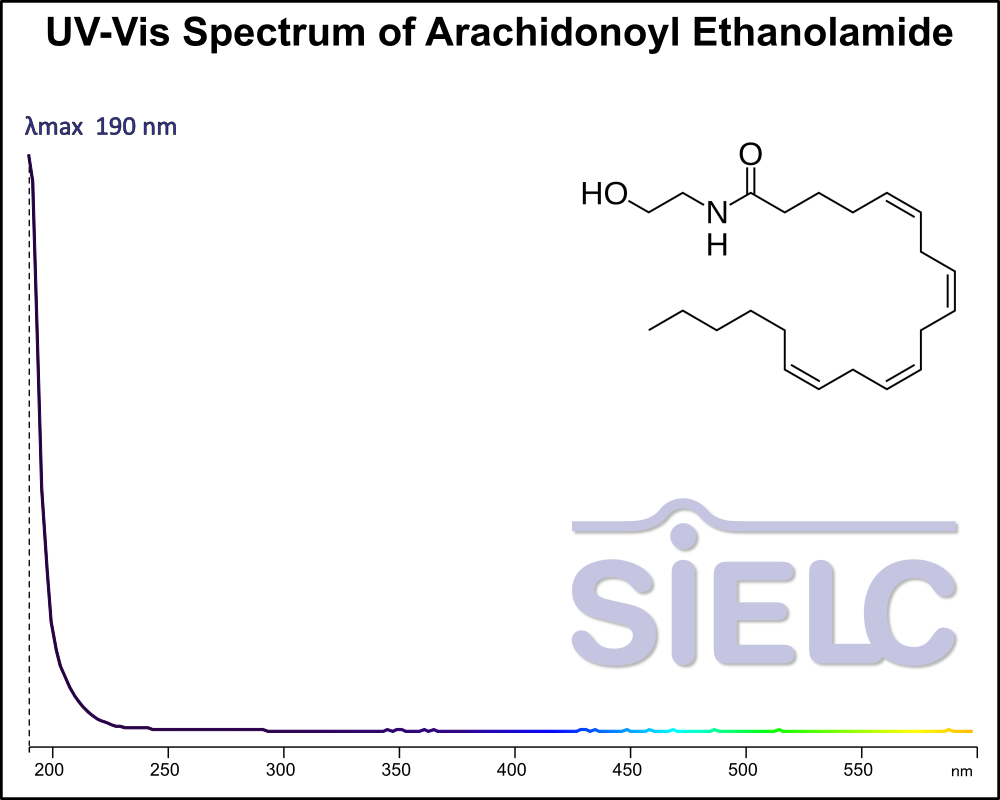
Uv-Vis Spectrum of Arachidonoyl Ethanolamide
March 5, 2026
Access the UV-Vis Spectrum SIELC Library
If you are looking for optimized HPLC method to analyze Arachidonoyl ethanolamide (AEA) check our HPLC Applications library
For optimal results in HPLC analysis, it is recommended to measure absorbance at a wavelength that matches the absorption maximum of the compound(s) being analyzed. The UV spectrum shown can assist in selecting an appropriate wavelength for your analysis. Please note that certain mobile phases and buffers may block wavelengths below 230 nm, rendering absorbance measurement at these wavelengths ineffective. If detection below 230 nm is required, it is recommended to use acetonitrile and water as low UV-transparent mobile phases, with phosphoric acid and its salts, sulfuric acid, and TFA as buffers.
For some compounds, the UV-Vis Spectrum is affected by the pH of the mobile phase. The spectra presented here are measured with an acidic mobile phase that has a pH of 3 or lower.
HPLC ELSD Method for Analysis of Arachidonoyl ethanolamideand Arachidonic acid on Lipak Column
December 18, 2024
HPLC Method for , Arachidonoyl ethanolamide (AEA), Arachidonic acid on Lipak by SIELC Technologies
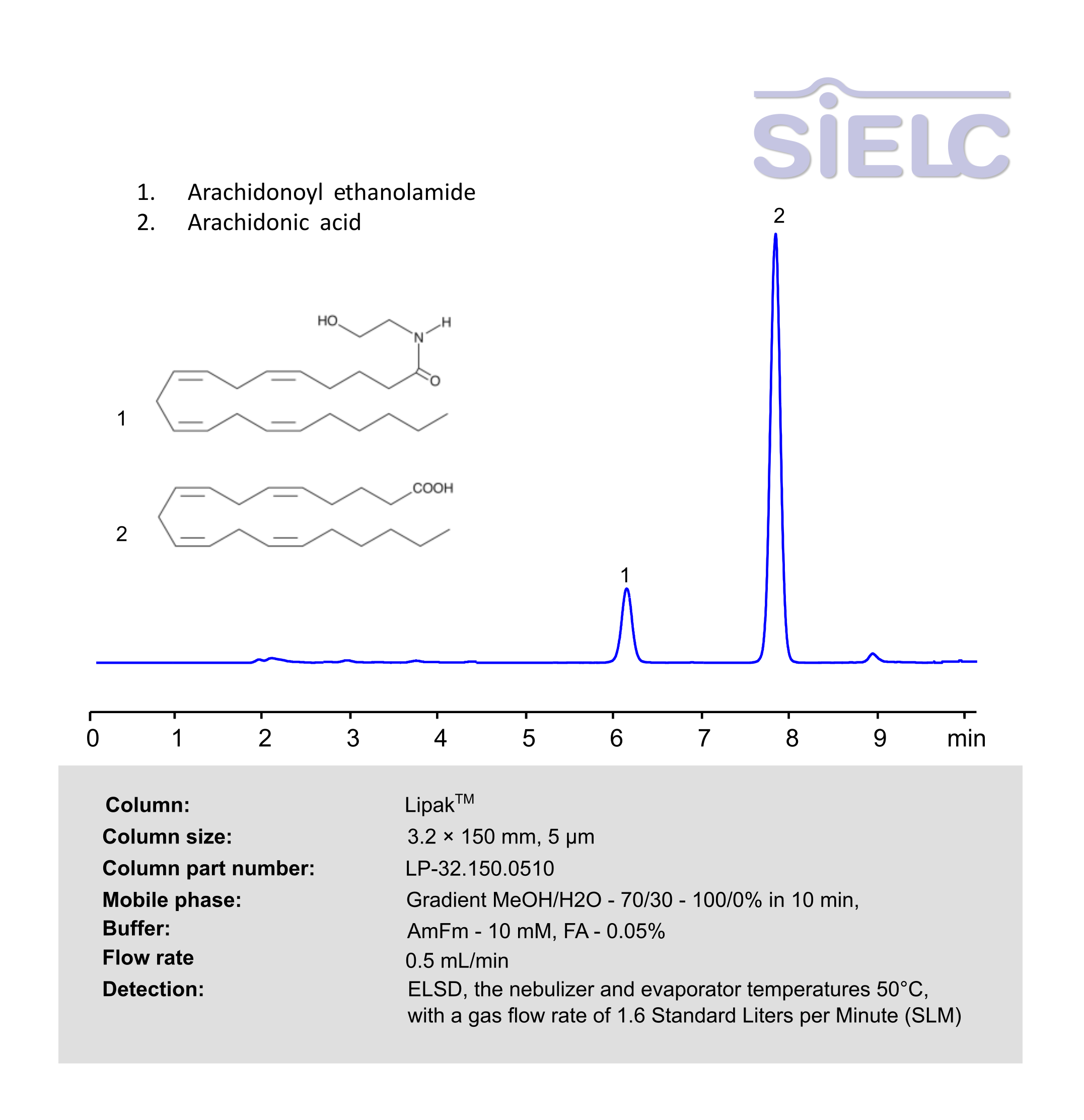
High Performance Liquid Chromatography (HPLC) Method for Analysis of , Arachidonoyl ethanolamide (AEA), Arachidonic acid
Arachidonoyl ethanolamide (AEA) and arachidonic acid (AA) are closely related bioactive lipids that play significant roles in various physiological and biochemical processes.
Arachidonic acid, a polyunsaturated omega-6 fatty acid, is a critical precursor for the biosynthesis of prostaglandins, thromboxanes, and leukotrienes. In cells, nearly all arachidonic acid is stored as an esterified component of membrane phospholipids, with its levels tightly regulated through interconnected metabolic pathways. Upon stimulation, free arachidonic acid is transiently released, serving as a vital substrate for the production of eicosanoid signaling molecules. Processes such as receptor-mediated release, metabolic transformation, and reuptake of free arachidonate are essential for cell signaling and inflammatory responses.
Precursor Relationship: AEA is synthesized from arachidonic acid via enzymatic pathways. AA is first converted to N-arachidonoyl phosphatidylethanolamine (NAPE), then cleaved to form AEA.Biological Cross-Talk:
- Both AEA and AA influence inflammatory and pain pathways.
- AEA’s degradation contributes to free arachidonic acid pools, linking endocannabinoid signaling with eicosanoid production.
, Arachidonoyl ethanolamide (AEA), Arachidonic acid can be retained, and analyzed using a Lipak mixed-mode stationary phase column. The analysis utilizes an gradient method with a mobile phase consisting of water, methanol (MeOH), ammonium formate and formic acid as a buffer. Detection is achieved using ELSD
| Column | Lipak, 3.2 x 150 mm, 5 µm, 100 A, dual ended |
| Mobile Phase | Gradient MeOH/H2O – 70/30 – 100/0% in 10 min |
| Buffer | AmFm– 10 mM, FA – 0.05% |
| Flow Rate | 0.5 ml/min |
| Detection | ELSD, the nebulizer and evaporator temperatures 50°C, with a gas flow rate of 1.6 Standard Liters per Minute (SLM) |
| Class of Compounds | Endocannabinoids |
| Analyzing Compounds | , Arachidonoyl ethanolamide (AEA), Arachidonic acid |
Application Column
Lipak
Column Diameter: 3.2 mm
Column Length: 150 mm
Particle Size: 5 µm
Pore Size: 100 A
Column options: dual ended
Arachidonic acid
Arachidonoyl ethanolamide (AEA)
