| CAS Number | 23828-92-4 |
|---|---|
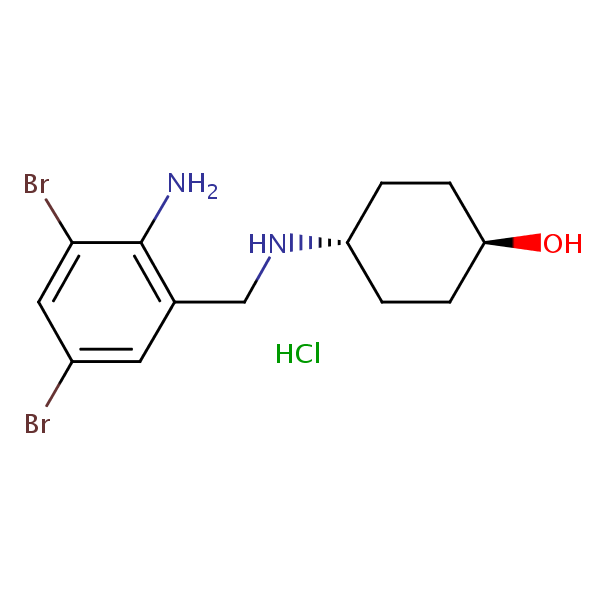
| Molecular Formula | C13H19Br2ClN2O |
| Molecular Weight | 414.571 |
| InChI Key | QNVKOSLOVOTXKF-PFWPSKEQSA-N |
| LogP | 2.54 |
| Synonyms |
|
Applications:
HPLC Method for Separation of Bromhexine and Ambroxol on Primesep 200 Column
January 12, 2023
HPLC Method for Bromhexine, Bromhexine hydrochloride, Ambroxol Hydrochloride, Ambroxol on Primesep 200 by SIELC Technologies
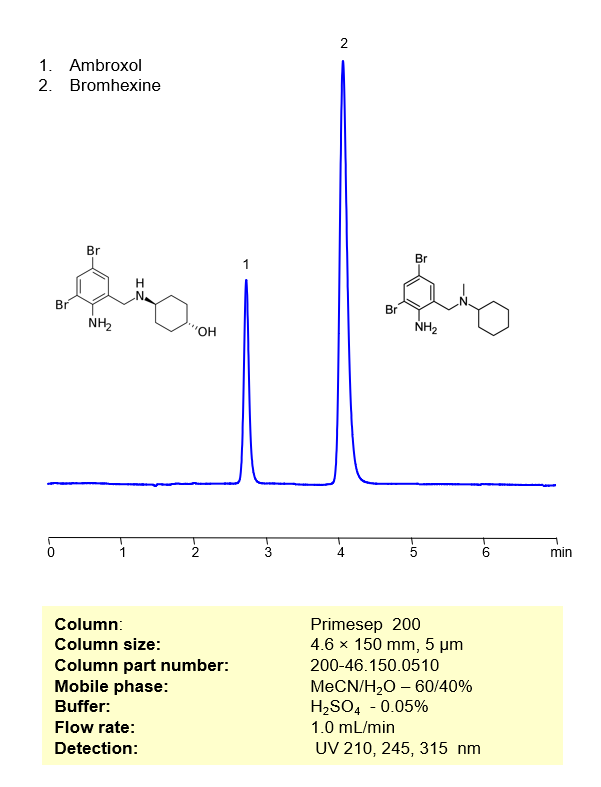
Ambroxol is a well-known expectorant with the chemical formula C13H18Br2N2O. It targets and breaks down phlegm through inhibiting neuronal Na+ channels. It also has anti-inflammatory properties. It has not yet been approved for use by the USA Food and Drug Administration. You can find detailed UV spectra of Ambroxol and information about its various lambda maxima by visiting the following link.
Bromhexine is a popular mucolytic with the chemical formula C14H20Br2N2. It is used to treat excessive mucus found in the respiratory system from a variety of illnesses. It works through increasing the production of serous mucus, which thins phlegm. This helps transport phlegm out of the upper respiratory tract. You can find detailed UV spectra of Bromhexine and information about its various lambda maxima by visiting the following link.
Bromhexine, Bromhexine hydrochloride, Ambroxol Hydrochloride, Ambroxol can be retained and analyzed using the Primesep 200 stationary phase column. The analysis utilizes an isocratic method with a simple mobile phase consisting of water and acetonitrile (MeCN) with a sulfuric acid buffer. This analysis method can be detected in the low UV regime at 210 nm, 245 nm, and 315 nm.
Condition
| Column | Primesep 200, 4.6 x 150 mm, 5 µm, 100 A, dual ended |
| Mobile Phase | MeCN/H2O – 60/40% |
| Buffer | H2SO4 – 0.05% |
| Flow Rate | 1.0 ml/min |
| Detection | UV 210, 245, 315 nm |
| Peak Retention Time | 2.81, 4.22 min |
Description
| Class of Compounds | Drugs |
| Analyzing Compounds | Bromhexine, Bromhexine hydrochloride, Ambroxol Hydrochloride, Ambroxol |
Application Column
Primesep 200
Column Diameter: 4.6 mm
Column Length: 150 mm
Particle Size: 5 µm
Pore Size: 100 A
Column options: dual ended
Ambroxol Hydrochloride
Bromhexine
Bromhexine hydrochloride

HPLC Method for Separation of Terbutaline Sulfate, Guaifenesin and Ambroxol on Primesep 200 Column
January 12, 2023
HPLC Method for Ambroxol Hydrochloride, Guaifenesin, Terbutaline, Ambroxol on Primesep 200 by SIELC Technologies
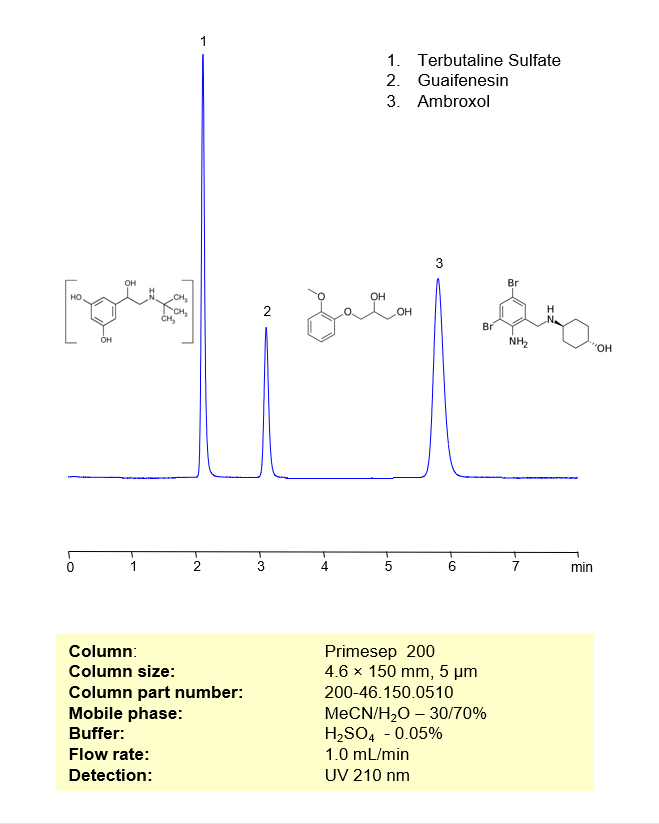
Terbutaline Sulfate is a salt form of Terbutaline, which is a β2 adrenergic receptor agonist with the chemical formula C12H19NO3. It is typically perscribed as an inhaler to assist with managing asthma symptoms as well as a tocolytic to relay preterm labor.. It is prohibited from use by the World Anti-Doping Agency without a Therapeutic Use Exemption (TUE) and is only allowed to be administered by inhalation. You can find detailed UV spectra of Terbutaline and information about its various lambda maxima by visiting the following link.
Guaifenesin, also known as glyceryl guaiacolate, is a drug with the chemical formula C10H14O4. It is used to remove sputum, or phlegm, from the respiratory tract. It works through stimulating the gastric mucosa, which leads to a higher volume and reduced viscosity of secretions in the trachea and the bronchi. You can find detailed UV spectra of Guaifenesin and information about its various lambda maxima by visiting the following link.
Ambroxol is a well-known expectorant with the chemical formula C13H18Br2N2O. It targets and breaks down phlegm through inhibiting neuronal Na+ channels. It also has anti-inflammatory properties. It has not yet been approved for use by the USA Food and Drug Administration. You can find detailed UV spectra of Ambroxol and information about its various lambda maxima by visiting the following link.
Together, these three medicinal compounds are typically found as the active ingredients in many cough syrups.
Ambroxol Hydrochloride, Guaifenesin, Terbutaline, Ambroxol can be retained and analyzed using the Primesep 200 stationary phase column. The analysis utilizes an isocratic method with a simple mobile phase consisting of water and acetonitrile (MeCN) with a phosphoric acid buffer. Detection is performed using UV. This analysis method can be detected in the low UV regime at 210 nm.
Condition
| Column | Primesep 200, 4.6 x 150 mm, 5 µm, 100 A, dual ended |
| Mobile Phase | MeCN/H2O – 30/70% |
| Buffer | H3PO4 – 0.05% |
| Flow Rate | 1.0 ml/min |
| Detection | UV 210 nm |
| Peak Retention Time | 2.09, 3.28, 5.81 min |
Description
| Class of Compounds | Drugs |
| Analyzing Compounds | Ambroxol Hydrochloride, Guaifenesin, Terbutaline, Ambroxol |
Application Column
Primesep 200
Column Diameter: 4.6 mm
Column Length: 150 mm
Particle Size: 5 µm
Pore Size: 100 A
Column options: dual ended
Ambroxol Hydrochloride
Guaifenesin
Terbutaline
Separation of Ambroxolhydrochloride on Newcrom R1 HPLC column
February 16, 2018
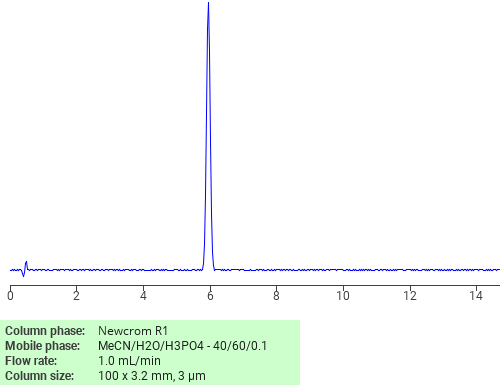
Ambroxolhydrochloride can be analyzed by this reverse phase (RP) HPLC method with simple conditions. The mobile phase contains an acetonitrile (MeCN), water, and phosphoric acid. For Mass-Spec (MS) compatible applications the phosphoric acid needs to be replaced with formic acid. Smaller 3 µm particles columns available for fast UPLC applications. This liquid chromatography method is scalable and can be used for isolation impurities in preparative separation. It also suitable for pharmacokinetics.
Application Column
Newcrom R1
The Newcrom columns are a family of reverse-phase-based columns. Newcrom A, AH, B, and BH are all mixed-mode columns with either positive or negative ion-pairing groups attached to either short (25 Å) or long (100 Å) ligand chains. Newcrom R1 is a special reverse-phase column with low silanol activity.
Select options