
| CAS Number | 14798-03-9 |
|---|---|
| Molecular Formula | H4N |
| Molecular Weight | 18.038 |
| InChI Key | QGZKDVFQNNGYKY-UHFFFAOYSA-O |
| Synonyms |
|
Applications:
HPLC Method for Separation of Sodium, Potassium, Lithium, and Ammonium on Primesep 100 Column
August 7, 2024
High Performance Liquid Chromatography (HPLC) Method for Analysis of Ammonium Ion, Lithium, Potassium, Sodium on Primesep 100 by SIELC Technologies
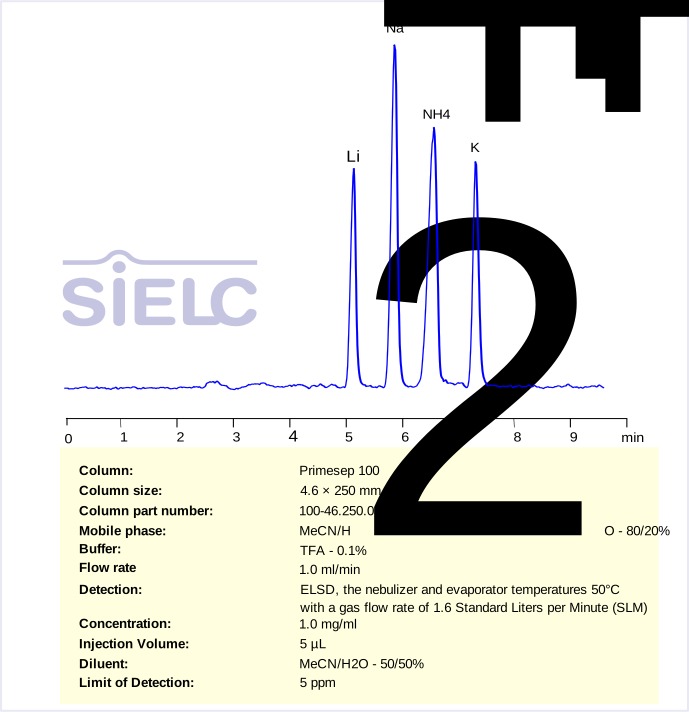
Lithium is a chemical element with the symbol Li. It has the atomic number 3. It is highly reactive and flammable. It tis a good conductor of heat and electricity. It has a wide variety of uses from mood stabilizing medication, to ceramics, to batteries, to lubricants, and more.
Sodium, which has a chemical symbol of Na, is a soft alkali metal that is highly reactive. It is found in abundance in everyday materials like table salt, sea water, and even the Earth’s crust. It is crucial for the body’s function and fluid balance.
Ammonium is a modified form of ammonia with the chemical formula NH4+. It is formed when an ammonia molecule, NH3, takes in another proton, H+, through the Brønsted-Lowry acid-base reaction. It is a key metabolic intermediate in living organisms as well as an essential component of the global nitrogen cycle.
Potassium ions, K+, are essential for cell function. They work as charge carriers inside animal cells to create the membrane. Imbalance of potassium can lead to debilitating health problems, but consumption of it through a diet can help regulate the negative effects of sodium on blood flow.
Inorganic cations and ammonia are usually analyzed by ion-exchange chromatography with a conductivity detector. Mixed-mode chromatography achieves the same goal with an ELSD detector. In addition to retaining ions, mixed-mode column can retain hydrophobic molecules also, making it possible to analyze a wide variety of ionic and non-ionic compounds in one run. In this method sodium, potassium, and lithium ions were separated along with ammonium ions on a Primesep 100 column. Detection technique is ELSD.
| Column | Primesep 100, 4.6 x 250 mm, 5 µm, 100 A, dual ended |
| Mobile Phase | MeCN/H2O – 80/20% |
| Buffer | TFA – 0.1% |
| Flow Rate | 1.0 ml/min |
| Detection | ELSD, the nebulizer and evaporator temperatures 50°C, with a gas flow rate of 1.6 Standard Liters per Minute (SLM) |
| Class of Compounds | Ions, Hydrophilic, Ionizable, Vitamin, Supplements |
| Analyzing Compounds | Sodium, Potassium, Lithium, Ammonium |
Application Column
Primesep 100
Column Diameter: 4.6 mm
Column Length: 250 mm
Particle Size: 5 µm
Pore Size: 100 A
Column options: dual ended
Lithium
Potassium
Sodium

