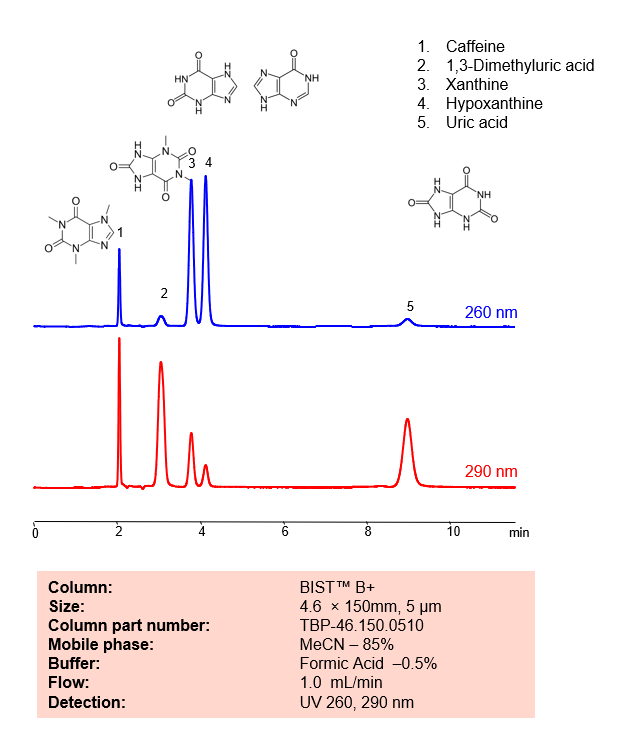
HPLC Method for Analysis mixture of Caffeine, 1,3-Dimethyluric acid, Xanthine, Hypoxanthine, Uric acid by SIELC Technologies.
Xanthines and uric acid are related compounds in the body and both are involved in the metabolism of purines.
Xanthines are a group of alkaloids that are widely distributed in plants, and also occur in the tissues and fluids of animals. They are known to stimulate the central nervous system and cardiac muscle, and also have diuretic effects.
In the body, xanthines are intermediates in the degradation of adenosine monophosphate to uric acid. This metabolic pathway starts with adenosine monophosphate (AMP), which is deaminated to form inosine monophosphate (IMP). IMP is then converted into a xanthine known as hypoxanthine. Hypoxanthine is then oxidized to xanthine, and finally, xanthine is further oxidized to uric acid. Both of the oxidation steps are catalyzed by the enzyme xanthine oxidase.
Caffeine is a natural stimulant and methylxanthine alkaloid. with the molecular formula C6H10N4O2. Caffeine can be found in a variety of plants, including tea, coffea, cocoa, kola nuts, and guarana. Ingestion of it can increase alertness and cognitive function. It can also cause worsening anxiety, heart palpitations, and headaches You can find detailed UV spectra of caffeine and information about its various lambda maxima by visiting the following link.
1,3-Dimethyluric acid is an oxopurine with the chemical formula C7H8N4O3. It is a is a metabolite of caffeine and theophylline with antioxidant properties. It is used as a biomarker in urine for activity of the CYP1A2 enzyme.
Xanthine is a purine base with the chemical formula C5H4N4O2. It is a product on the pathway of purine degradation. Numerous stimulants are derived from xanthine.
Hypoxanthine is a naturally occurring purine derivative with the chemical formula C5H4N4O. It is a reaction intermediate in the metabolism of adenosine as well as a metabolite found in Escherichia coli.
Uric acid is a waste product that’s produced when the body breaks down purines, substances found in foods and drinks like liver, anchovies, mackerel, dried beans, peas, and beer. It is normally excreted from the body in urine. However, if the body produces too much uric acid or doesn’t excrete enough of it, it can build up in the blood and potentially lead to health problems such as gout and kidney stones
Caffeine, 1,3-Dimethyluric acid, Xanthine, Hypoxanthine, Uric acid can be retained, analyzed, and separated using an isocratic analytical method on a BIST B+ column. The simple mobile phase for this method comprises water, acetonitrile (MeCN), and formic acid as an ionic modifier. The analytical method can be monitored with UV detection at 260 nm, an Evaporative Light Scattering Detector (ELSD), or any other evaporative detection method such as Charged Aerosol Detection (CAD) or Electrospray Ionization Mass Spectrometry (ESI-MS)
Condition
| Column | BIST B+, 4.6 x 150 mm, 5 µm, 100 A, dual ended |
| Mobile Phase | MeCN – 85% |
| Buffer | FA – 0.5% |
| Flow Rate | 1.0 ml/min |
| Detection | UV 260, 290 nm |
| Peak Retention Time | 2.01, 3.02, 4.2, 9.09 min |
Description
| Class of Compounds | Acid, Xanthines |
| Analyzing Compounds | Caffeine, 1,3-Dimethyluric acid, Xanthine, Hypoxanthine, Uric acid |
Application Column
BIST B+
Column Diameter: 4.6 mm
Column Length: 150 mm
Particle Size: 5 µm
Pore Size: 100 A
Column options: dual ended
Caffeine
Hypoxanthine
Uric acid
Xanthine