
| CAS Number | 9074-77-5 |
|---|---|
| Molecular Formula | C2H3FO2 or CH2FCOOH |
| Molecular Weight | 78.04 |
| InChI Key | QEWYKACRFQMRMB-UHFFFAOYSA-N |
| LogP | 0.2 |
| Synonyms |
|
Applications:
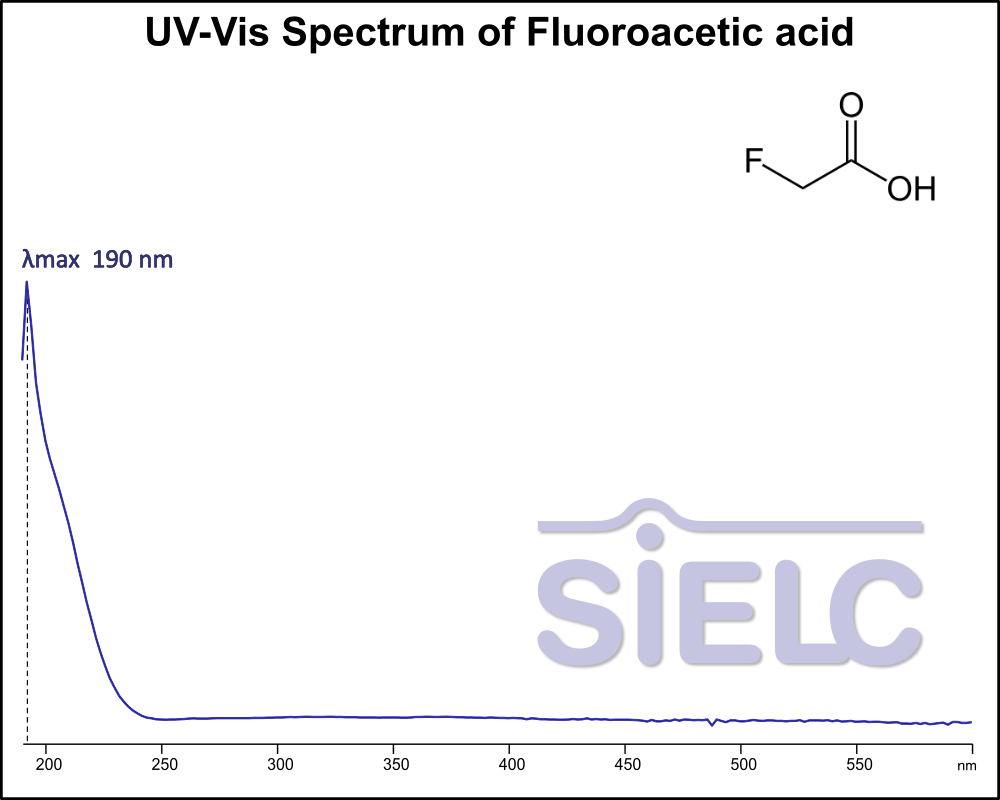
UV-Vis Absorption Spectrum of Fluoroacetic acid
December 18, 2025
If you are looking for optimized HPLC method to analyze Fluoroacetic acid check our HPLC Applications library
For optimal results in HPLC analysis, it is recommended to measure absorbance at a wavelength that matches the absorption maximum of the compound(s) being analyzed. The UV spectrum shown can assist in selecting an appropriate wavelength for your analysis. Please note that certain mobile phases and buffers may block wavelengths below 230 nm, rendering absorbance measurement at these wavelengths ineffective. If detection below 230 nm is required, it is recommended to use acetonitrile and water as low UV-transparent mobile phases, with phosphoric acid and its salts, sulfuric acid, and TFA as buffers.
For some compounds, the UV-Vis Spectrum is affected by the pH of the mobile phase. The spectra presented here are measured with an acidic mobile phase that has a pH of 3 or lower.

HPLC Conductivity Method for Analysis of Fluoroacetic acid, Difluoroacetic acid and Trifluoroacetic acid on BIST A+ Column
July 7, 2022
ConductivityHPLC Method for TFA (Trifluoroacetic Acid), Difluoroacetic acid, Fluoroacetic acid on BIST A+ by SIELC Technologies
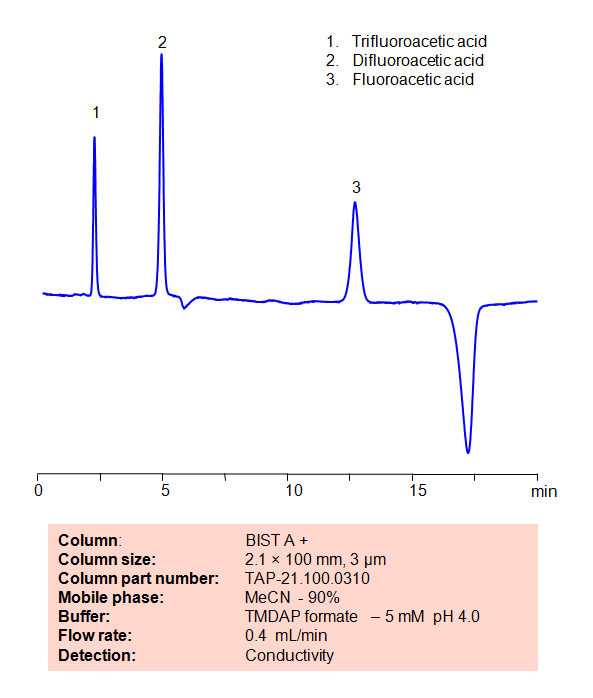
High Performance Liquid Chromatography (HPLC) Method for Analysis of TFA (Trifluoroacetic Acid), Difluoroacetic acid, Fluoroacetic acid.
Trifluoroacetic Acid (TFA) is a synthetic organofluorine acid with the chemical formula C2HF3O2. It is a substitution derivative of acetic acid, with fluorine atoms replacing the hydrogen atoms of the acetyl group. It is also a much stronger acid than acetic acid. TFA is widely used in organic synthesis as well as ion pairing reagent or buffer in HPLC. It is corrosive and toxic to aquatic life and mammals, causing severe irritation and burns to skin, eyes, and the respiratory tract. Not only that, TFA is also highly mobile and persistent, leading to high retention of it in soil and water. Determination of it’s threat level on the environmental and health levels are still ongoing. You can find detailed UV spectra of Trifluoroacetic Acid and information about its various lambda maxima by visiting the following link.
Difluoroacetic Acid (DFA) is a dihalogenocarboxylic acid with the chemical formula CHF2COOH. As a solution, it quickly dissociates to form difluoroacetate ions. You can find detailed UV spectra of Difluoroacetic Acid and information about its various lambda maxima by visiting the following link.
Fluoroacetic Acid is an organofluorine compound with the chemical formula FCH2CO2H. It is widely naturally occurring in plants across Australia, Brazil, and Africa. It is used primarily in manufacturing pesticides. You can find detailed UV spectra of Fluoroacetic Acid and information about its various lambda maxima by visiting the following link.
| Column | BIST A+, 2.1 x 100 mm, 3 µm, 100 A, dual ended |
| Mobile Phase | MeCN – 90% |
| Buffer | TMDAP ( N,N,N’,N’-Tetramethyl-1,3-diaminopropane) formate – 5 mM pH 4.0 |
| Flow Rate | 0.4 ml/min |
| Detection | Conductivity |
| Class of Compounds |
Acids |
| Analyzing Compounds | TFA (Trifluoroacetic Acid), Difluoroacetic acid, Fluoroacetic acid |
Application Column
BIST A+
Column Diameter: 2.1 mm
Column Length: 100 mm
Particle Size: 3 µm
Pore Size: 100 A
Column options: dual ended
Fluoroacetic acid
TFA (Trifluoroacetic Acid)
