HPLC Method for Analysis of Biopterin, Rhamnopterin, Neopterin on Primesep 100 by SIELC Technologies
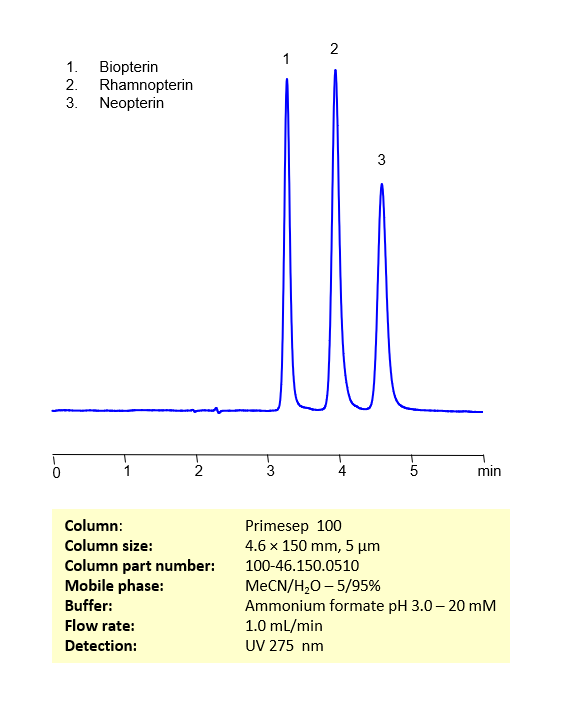
High Performance Liquid Chromatography (HPLC) Method for Analysis of Biopterin, Rhamnopterin, Neopterin.
Biopterin is a coenzyme with the chemical formula C9H11N5O3. It is involved in the biosynthesis of several important bioactive substances, including neurotransmitters like serotonin and dopamine. It’s also integral to the creation of nitric oxide, a potent vasodilator. It plays a critical role in the body as a cofactor in the synthesis of several important neurotransmitters, including serotonin, melatonin, dopamine, norepinephrine, and epinephrine. These neurotransmitters are crucial for many physiological functions, including mood regulation, sleep, and response to stress. Deficiency in biopterin metabolism can lead to various disorders, such as neurodegeneration due to BH4 deficiency, a group of rare inherited neuro-metabolic disorders. This is why understanding and potentially modulating biopterin and its derivatives could be significant for certain therapeutic approaches. You can find detailed UV spectra of Biopterin and information about its various lambda maxima by visiting the following link.
Rhamnopterin is a derivative of biopterin with the chemical formula C10H13N5O4. It demonstrating remarkable properties in dietary studies. Research has shown that when it is administered alongside certain carcinogens, rhamnopterin can decrease the occurrence of liver tumors in rats. Additionally, it serves as an internal standard for measuring biopterin and neopterin concentrations in rat plasma. You can find detailed UV spectra of Rhamnopterin and information about its various lambda maxima by visiting the following link
Neopterin is a catabolic product of guanosine triphosphate (GTP) with the chemical formula C9H11N5O4. It is a molecule involved in energy transfer. It’s often used as a marker for immune system activation, particularly in response to certain diseases, including viral infections, autoimmune diseases, and cancer. It is indicative of a pro-inflammatory immune status, therefore it typically serves as a marker of the activation of the cellular immune system. You can find detailed UV spectra of Neopterin and information about its various lambda maxima by visiting the following link.
Biopterin, Rhamnopterin, Neopterin can be retained, separated and analyzed using a reverse-phase Primesep 100 column. The mobile phase for this method consists of water, acetonitrile (MeCN), and ammonium formate, which serves as a buffer. This analytical method can be monitored using UV detection at 275 nm, an Evaporative Light Scattering Detector (ELSD), or any other evaporative detection method such as Charged Aerosol Detection (CAD) or Electrospray Ionization Mass Spectrometry (ESI-MS)
LOD was determined for this combination of instrument, method, and analyte, and it can vary from one laboratory to another even when the same general type of analysis is being performed.
Condition
| Column | Primesep 100, 4.6 x 150 mm, 5 µm, 100 A, dual ended |
| Mobile Phase | MeCN/H2O -5/95% |
| Buffer | Ammonium formate pH 3.0 – 20 mM |
| Flow Rate | 1.0 ml/min |
| Detection | UV 275 nm |
| Peak Retention Time | 3.28, 4.01, 4.85 min |
| Sample concentration | 0.02 mg/ml |
| Injection volume | 5 µl |
| Sample diluent | H2O + NaOH |
| LOD | 20 ppb |
Description
| Class of Compounds | Pteridines |
| Analyzing Compounds | Biopterin, Rhamnopterin, Neopterin |
Application Column
Primesep 100
Column Diameter: 4.6 mm
Column Length: 150 mm
Particle Size: 5 µm
Pore Size: 100 A
Column options: dual ended
Neopterin
Rhamnopterin