HPLC Method for Analysis of Glucose 6-Phosphate, Fructose 6-Phosphate on Newcrom B Column by SIELC Technologies.
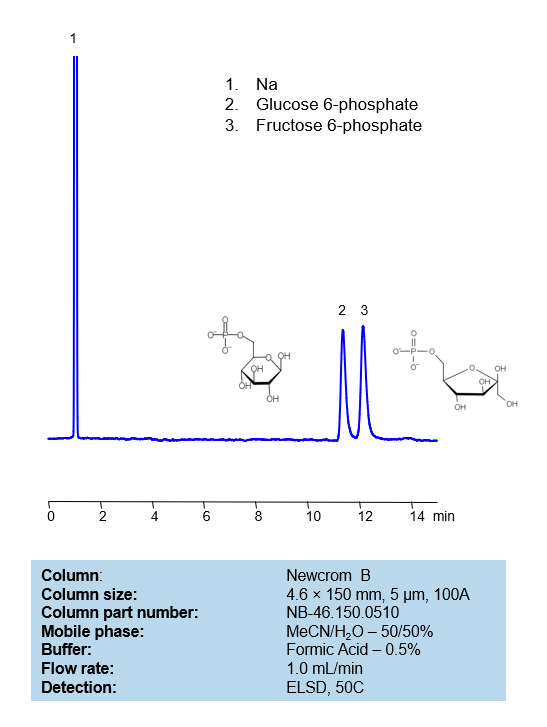
Glucose 6-phosphate, also known as Robison ester, is a glucose sugar with the chemical formula C6H13O9P. It is a derivative of glucose that forms during cellular metabolism. It is also produced during the breakdown of glycogen polymers. You can find detailed UV spectra of Glucose 6-phosphate and information about its various lambda maxima by visiting the following link.
Glucose 6-phosphate is first formed by cells to ensure it does not diffuse out of the cell, and then through the process of glycolysis, it’s isomerized into Fructose 6-phosphate.
Fructose 6-phosphate, known as Neuberg ester, is a derivatives of fructose that forms during cellular metabolism with the chemical formula C6H13O9P. It’s alternate name comes from the biochemist, Carl Neuberg, who discovered that the compound was produced during hydrolysis of fructose 2,6-biphosphate. You can find detailed UV spectra of Glucose 6-Phosphate, Fructose 6-Phosphate and information about its various lambda maxima by visiting the following link.
These 2 phosphorylated sugars can be retained, separated, and analyzed on a mixed-mode Newcrom B column with a mobile phase consisting of water, Acetonitrile (MeCN), and Formic acid (FA). This analytical method can be analyzed via any evaporative detector, including ELSD, CAD, and ESI-MS with high resolution and peak symmetry.
Condition
| Column | Newcrom B, 4.6 x 150 mm, 5 µm, 100 A, dual ended |
| Mobile Phase | MeCN – 50% |
| Buffer | Formic Acid – 0.5% |
| Flow Rate | 1.0 ml/min |
| Detection | ELSD, 50C |
| Peak Retention Time | 11.4, 12.2 min |
Description
| Class of Compounds | Sugar |
| Analyzing Compounds | Glucose 6-Phosphate, Fructose 6-Phosphate |
Application Column
Newcrom B
Column Diameter: 4.6 mm
Column Length: 150 mm
Particle Size: 5 µm
Pore Size: 100 A
Column options: dual ended
Glucose 6-Phosphate