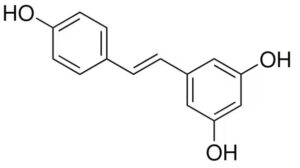
| CAS Number | 501-36-0 |
|---|---|
| Molecular Formula | C14H12O3 |
| Molecular Weight | 228.24 |
| Synonyms |
|
Applications:
UV-Vis Spectrum of Trans-Resveratrol
July 15, 2024
Access the UV-Vis Spectrum SIELC Library
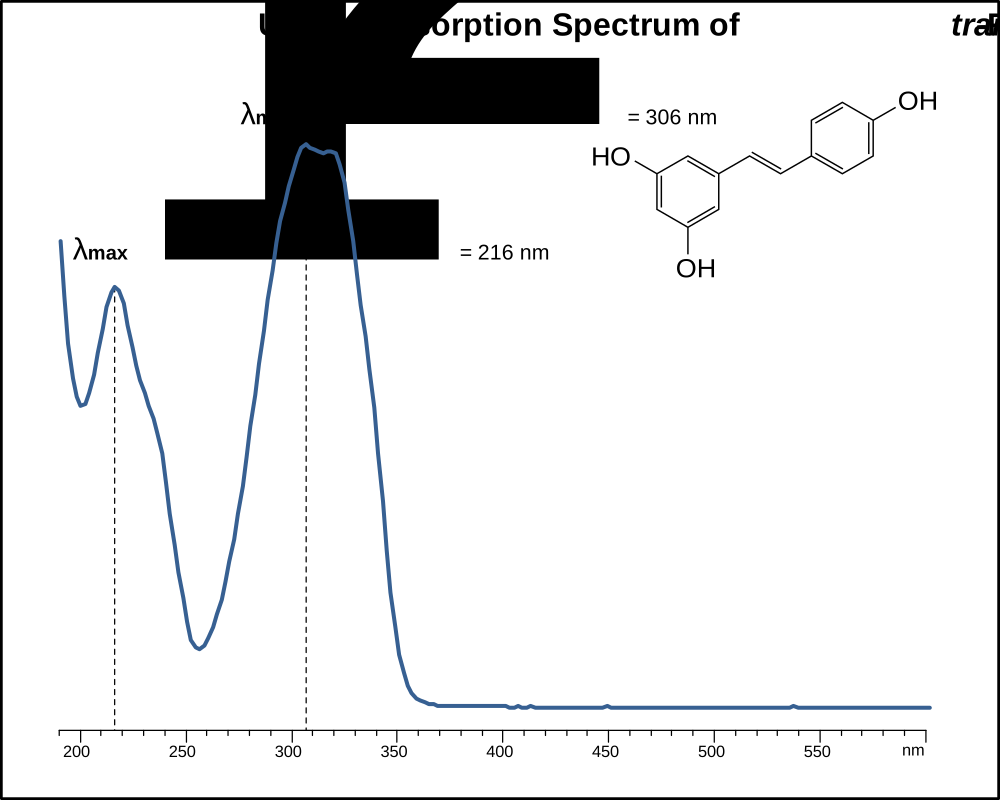
UV-Vis Spectrum of Trans-Resveratrol, Resveratrol. Absorption Maxima: 216 nm, 306 nm.
For optimal results in HPLC analysis, it is recommended to measure absorbance at a wavelength that matches the absorption maximum of the compound(s) being analyzed. The UV spectrum shown can assist in selecting an appropriate wavelength for your analysis. Please note that certain mobile phases and buffers may block wavelengths below 230 nm, rendering absorbance measurement at these wavelengths ineffective. If detection below 230 nm is required, it is recommended to use acetonitrile and water as low UV-transparent mobile phases, with phosphoric acid and its salts, sulfuric acid, and TFA as buffers.
Trans-Resveratrol

HPLC Method for Analysis of Trans – Resveratrol on Newcrom R1 Column
February 21, 2024
HPLC Method for Analysis of Trans-Resveratrol on Newcrom R1 Column by SIELC Technologies
Trans-resveratrol is a natural compound with the chemical formula C14H12O3. It belongs to a class of polyphenolic compounds called stilbenes. Polyphenols are organic compounds found in plants and are known for their antioxidant properties. Resveratrol is specifically found in various plants, including the skin of red grapes, peanuts, and certain berries. Resveratrol exists in two main isomeric forms: trans-resveratrol and cis-resveratrol. The trans form is the more stable and biologically active isomer. Resveratrol can help neutralize free radicals in the body. Free radicals are unstable molecules that can contribute to oxidative stress and damage cells. Resveratrol has been studied for its potential health benefits, including its role in cardiovascular health, anti-inflammatory effects, and potential anti-cancer properties. Some research suggests that resveratrol may have cardioprotective effects and could contribute to overall health. Red wine is often cited as a dietary source of resveratrol, as the compound is present in grape skins. However, the concentration of resveratrol in red wine is relatively low, and it would be challenging to consume enough through wine alone to achieve potential health benefits. Resveratrol supplements are also available and are marketed for their potential health-promoting properties. However, the effectiveness of these supplements and the optimal dosage for various health conditions are still subjects of ongoing research. You can find detailed UV spectra of Trans-Resveratrol and information about its various lambda maxima by visiting the following link.
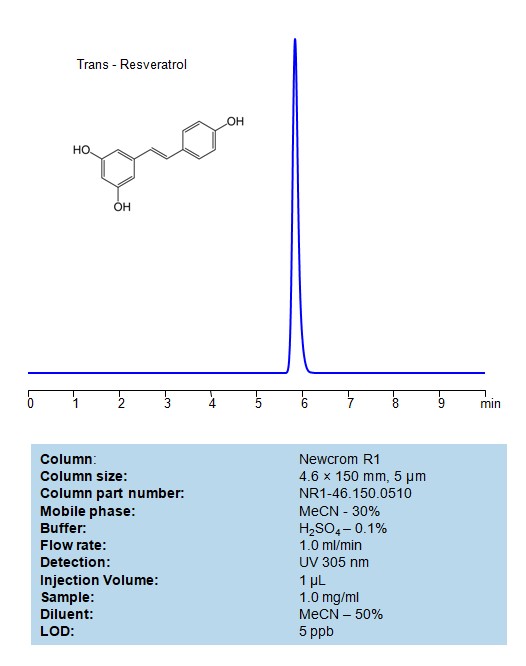
Trans-Resveratrol be retained and analyzed on a reversed-phase Newcrom R1 column with a mobile phase consisting of water, Acetonitrile (MeCN), and sulfuric acid. This analytical method can be detected with high resolution and peak symmetry at a wavelength of 265 nm using UV detection
Condition
| Column | Newcrom R1, 4.6 x 150 mm, 5 µm, 100 A, dual ended |
| Mobile Phase | MeCN – 30% |
| Buffer | H2SO4 – 0.1% |
| Flow Rate | 1.0 ml/min |
| Detection | UV 305 nm |
| Injection volume: | 1 µL |
| Sample | 1 mg/ml |
| Sample Diluent | MeCN/H2O – 50/50% |
| LOD* | 5 ppb |
Description
| Class of Compounds | Polyphenols |
| Analyzing Compounds | Trans-Resveratrol |
Application Column
Newcrom R1
Column Diameter: 4.6 mm
Column Length: 150 mm
Particle Size: 5 µm
Pore Size: 100 A
Column options: dual ended
