High Performance Liquid Chromatography (HPLC) Method for Analysis of Pamoic acid, Ivermectin B1a, Pyrantel on Primesep 100 by SIELC Technologies
Pamoic acid, also known as embonic acid, is a compound with the chemical formula C23H16O6. It is used in the formation of salts, particularly pamoate salts. The pamoate salts of various drugs are often employed to enhance their solubility, stability, and overall pharmaceutical properties. Pamoic acid itself is characterized by its ability to form stable complexes with a variety of drugs, and these complexes can be more easily processed into pharmaceutical formulations. The use of pamoic acid and its salts is common in the pharmaceutical industry to improve the bioavailability and effectiveness of certain medications. The formation of pamoate salts is a strategy employed in drug development to optimize the therapeutic delivery and performance of various pharmaceutical compounds. You can find detailed UV spectra of Pamoic acid and information about its various lambda maxima by visiting the following link.
Ivermectin is an anti-parasitic drug with the chemical formula C48H74O14. It is often used to treat or prevent parasites in animals and humans. In dogs, it is routinely used to treat heartworm, though, certain breeds, can be severely poisoned by this medication. It belongs to the class of drugs called avermectins. Ivermectin works by interfering with the nervous system of parasites, leading to their paralysis and eventual death. You can find detailed UV spectra of Ivermectin B1a and information about its various lambda maxima by visiting the following link.
Pyrantel is an anthelmintic or deworming medication with the chemical formula C11H14N2S. It is commonly used to treat infections caused by roundworms and hookworms. Pyrantel works by causing neuromuscular blockade in the parasites, leading to their expulsion from the digestive tract. You can find detailed UV spectra of Pyrantel and information about its various lambda maxima by visiting the following link.
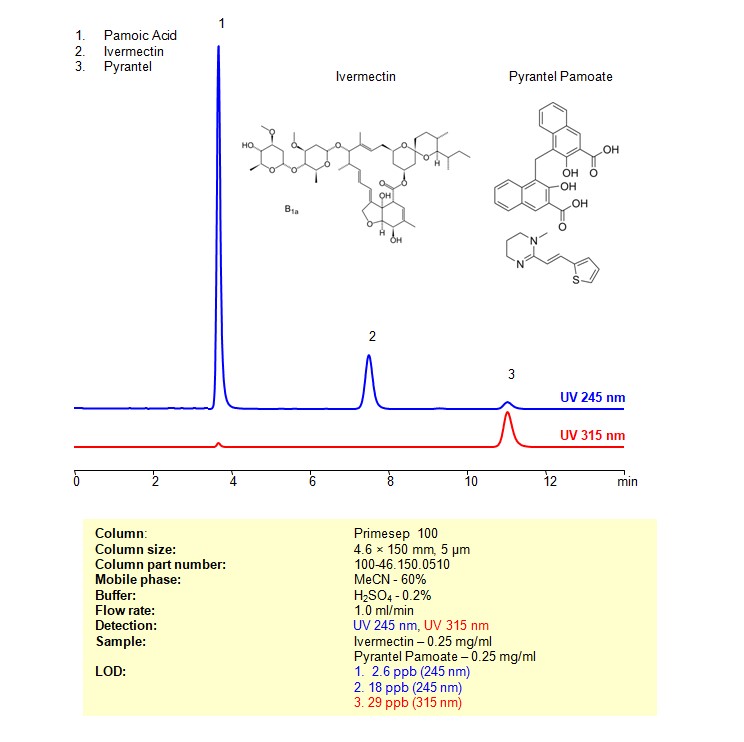
Pamoic acid, Ivermectin B1a, Pyrantel can be retained, separated and analyzed using a Primesep 100 mixed-mode stationary phase column. The analysis employs an isocratic method with a simple mobile phase comprising water, acetonitrile (MeCN), and sulfuric acid as a buffer. This method allows for detection using UV 245 and 315 nm
| Column | Primesep 100, 4.6 x 150 mm, 5 µm, 100 A, dual ended |
| Mobile Phase | MeCN – 60% |
| Buffer | H2SO4 -0.2% |
| Flow Rate | 1.0 ml/min |
| Detection | UV 245, 315 nm |
| Samples | Ivermectin – 0.25 mg/ml Pyrantel Pamoate – 0.25 mg/ml |
| Injection volume | 2 µl |
| LOD* | 1. 2.6 ppb (245 nm) 2. 18 ppb (245 nm) 3. 29 ppb (315 nm) |
| Class of Compounds | Drugs |
| Analyzing Compounds | Pamoic acid, Ivermectin B1a, Pyrantel |
Application Column
Primesep 100
Column Diameter: 4.6 mm
Column Length: 150 mm
Particle Size: 5 µm
Pore Size: 100 A
Column options: dual ended
Pamoic acid
Pyrantel