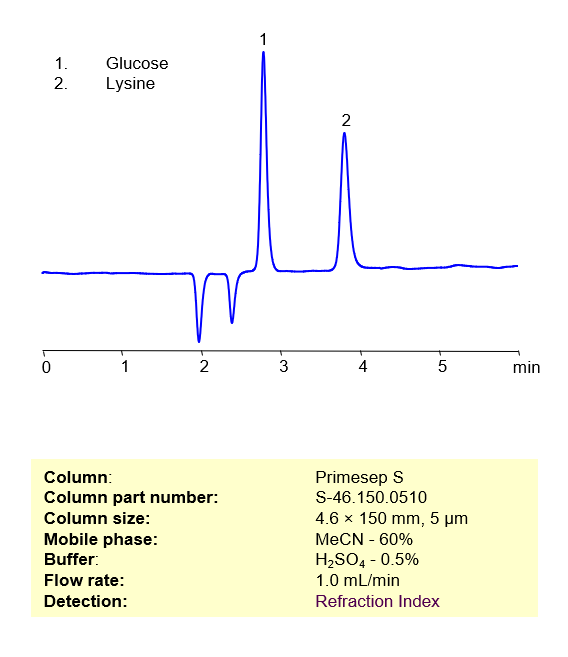
HPLC Method for Separation of Glucose, Lysine on Primesep S by SIELC Technologies
Glucose is a simple sugar that is generated during photosynthesis. In humans, it is produced during hepatic gluconeogenesis. In many living organisms, it acts as an essential energy source. It is the most commonly occurring isomer of glucose in nature. It’s chemical formula is C₆H₁₂O₆.You can find detailed UV spectra of Glucose and information about its various lambda maxima by visiting the following link.
Lysine is an essential amino acid with the chemical formula C6H14N2O2. It’s primary role is in proteinogenesis, but it also plays a part in uptake of essential mineral nutrients, production of carnitine, and histone modification. Lysine is known in pop culture thanks to Jurassic Park, in which dinosaurs were genetically altered to be unable to produce lysine. While in the story, this made the dinosaurs be unable to survive in the wild due to needing the lysine supplements provided by the staff at Jurassic Park, no real animal can produce lysine naturally. Lysine is another essential amino acid typically found in meat, and also cereal grains. You can find detailed UV spectra of Lysine and information about its various lambda maxima by visiting the following link.
Glucose, Lysine can be retained, separated, and analyzed on a normal-phase Primesep S column with a simple isocratic mobile phase consisting of Acetonitrile (MeCN), water (H2O), and Sulfuric acid (H2SO4). This analysis method can be detected via Refraction Index (RI) Detection.
Condition
| Column | Primesep S2, 4.6 x 150 mm, 5 µm, 100 A, dual ended |
| Mobile Phase | MeCN/H2O – 75/25% |
| Buffer | H2SO4 – 0.5% |
| Flow Rate | 1.0 ml/min |
| Detection | Refraction Index |
| Peak Retention Time | 4.81 min |
Description
Application Column
Primesep S2
Column Diameter: 4.6 mm
Column Length: 150 mm
Particle Size: 5 µm
Pore Size: 100 A
Column options: dual ended
Lysine