HPLC Method for Separation of of Dopamine, m-Xylylenediamine, 2,4,6-Tris(dimethylaminomethyl)phenol in Non Aqueous MP on BIST B+ by SIELC Technologies
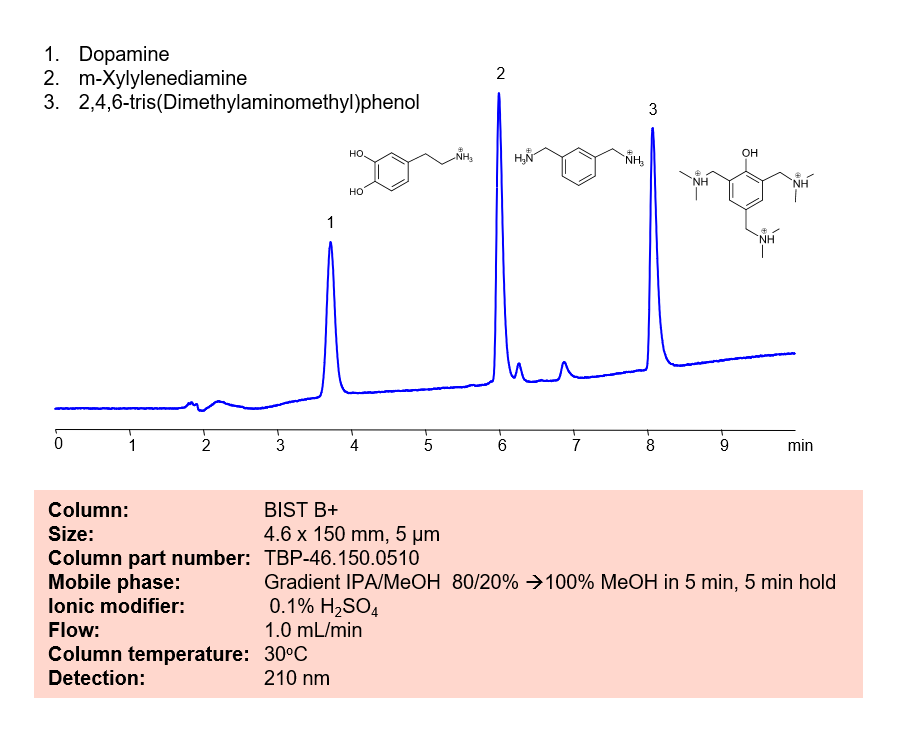
Dopamine is a neurotransmitter with the chemical formula C8H11NO2. It is released during pleasurable activities, reinforcing those behaviors, and motivating people to continue seeking them out. It is often used to treat low blood pressure, low heart rate, and heart attacks Dopamine influences the release of other hormones. A deficiency of it can influence movement and lead to conditions like Parkinson’s disease. You can find detailed UV spectra of Dopamine and information about its various lambda maxima by visiting the following link.
m-Xylylenediamine (MXDA) is a popular curing agent used on epoxy resins with the chemical formula C8H12N2. When MXDA undergoes the Sommelet reaction, it results in a isophthalaldehyde. You can find detailed UV spectra of m-Xylylenediamine and information about its various lambda maxima by visiting the following link.
2,4,6-Tris(dimethylaminomethyl)phenol is an organic compound with the chemical formula C15H27N3O. It is amine-based curing agent used on epoxy resins and as an accelerator for epoxy resin curing agents. It is considered to be one of the most widely used room temperature accelerators for two-component resin systems. Less commonly, it is used in polyurethane chemistry. You can find detailed UV spectra of 2,4,6-Tris(dimethylaminomethyl)phenoland information about its various lambda maxima by visiting the following link.
Using SIELC’s newly introduced BIST method, Dopamine, m-Xylylenediamine, 2,4,6-Tris(dimethylaminomethyl)phenol can be retained on a positively-charged anion-exchange BIST B+ column. There are two keys to this retention method: 1) a multi-charged, negative buffer, such as Sulfuric acid (H2SO4), which acts as a bridge, linking the positively-charged analytes to the positively-charged column surface and 2) a mobile phase consisting mostly of less polar organic solvent (such as IPA) to minimize the formation of a solvation layer around the charged analytes. This method uses an entirely non-aqueous mobile phase to drive BIST retention. The gradient starts with a high concentration of the less polar IPA to generate the initial BIST retention and progresses to the more polar MeOH to elute the longer-retaining amines in a reasonable time. Using this new and unique analysis method, these 3 amines can be retained and UV detected at 210 nm.
Condition
| Column | BIST B+, 4.6 x 150 mm, 5 µm, 100 A, dual ended |
| Mobile Phase | Gradient IPA/MeOH- 80/20% to 100% MeOH, 5 min , 5 min hold |
| Buffer | H2SO4 – 0.2% |
| Flow Rate | 1.0 ml/min |
| Detection | UV 210 nm |
| Peak Retention Time | 3.52 min, 6.12 min, 8.57 min |
Description
| Class of Compounds | Amines |
| Analyzing Compounds | Dopamine, m-Xylylenediamine, 2,4,6-Tris(dimethylaminomethyl)phenol |
Application Column
BIST B+
Column Diameter: 4.6 mm
Column Length: 150 mm
Particle Size: 5 µm
Pore Size: 100 A
Column options: dual ended
Dopamine
m-Xylylenediamine