HPLC Method for Analysis of Polyhexanide PHMB on BIST B+ by SIELC Technologies.
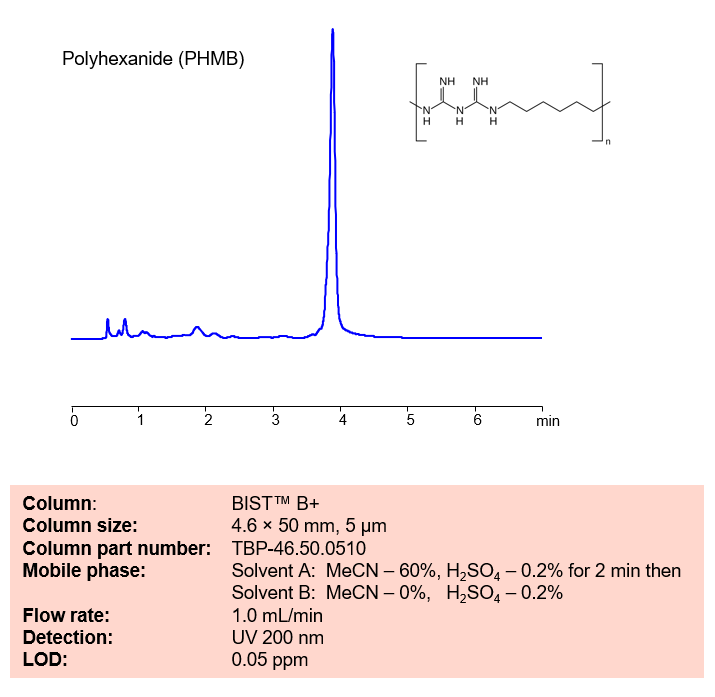
Polyhexanide (polyhexamethylene biguanide, PHMB) is a disinfectant with the chemical formula (C8H17N5)n. It has multiple industrial, medical, biological and research applications especially for materials that could be a possible source of bacterial contamination. Dermatologically, it is sold as polihexanide. From 2011, it has been classified as a category 2 carcinogen. You can find detailed UV spectra of Polyhexanide PHMB and information about its various lambda maxima by visiting the following link.
Using SIELC’s newly introduced BIST™ method, Polyhexanide (polyhexamethylene biguanide, PHMB) can be retained on a positively-charged anion-exchange BIST B+ column. There are two keys to this retention method: 1) a multi-charged, negative buffer, such as Sulfuric acid (H2SO4), which acts as a bridge, linking the positively-charged analytes to the positively-charged column surface and 2) a mobile phase consisting of a majority of organic solvent (such as MeCN) to minimize the formation of a solvation layer around the charged analytes. Utilizing a step gradient to switch to a completely aqueous MP after 2 minutes allows for retention to occur while also preventing the method from being too long. Using this new and unique analysis method, Polyhexanide PHMB can be separated, retained, and UV detected at 200 nm.
Condition
| Column | BIST B+, 4.6 x 50 mm, 5 µm, 100 A, dual ended |
| Mobile Phase | MeCN Step gradient |
| Buffer | H2SO4 – 0.2% |
| Flow Rate | 1.0 ml/min |
| Detection | UV 200 nm |
| Peak Retention Time | 3.3 min |
Description
| Class of Compounds | Polymers |
| Analyzing Compounds | Polyhexanide PHMB |
Application Column
BIST B+
Column Diameter: 4.6 mm
Column Length: 50 mm
Particle Size: 5 µm
Pore Size: 100 A
Column options: dual ended