HPLC Method for Analysis of Nimesulide on Newcrom R1 by SIELC Technologies
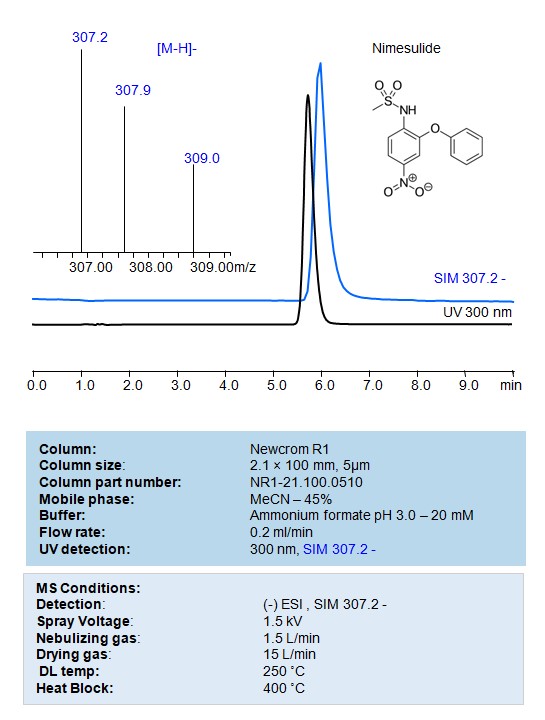
Nimesulide is a non-steroidal anti-inflammatory drug (NSAID) with the chemical formula C13H12N2O5S. It possesses analgesic and antipyretic properties. It inhibits the enzyme cyclooxygenase, specifically COX-2, which is responsible for the synthesis of prostaglandins, compounds that play a key role in promoting inflammation, pain, and fever. Due to concerns regarding liver toxicity, the use of Nimesulide is restricted or banned in some countries.
Nimesulide is synthesized via various chemical routes which generally involve the condensation of 4-nitro-2-phenoxyaniline with formaldehyde and subsequent sulfonation of the resulting methylene intermediate.
Nimesulide can be retained, separated and analyzed on a Newcrom R1 reverse phase stationary phase column using an isocratic analytical method with a simple mobile phase of water, Acetonitrile (MeCN), and a ammonium format as a buffer. This analysis method can be detected using UV at 300 nm, an Evaporative Light Scattering Detector (ELSD), or any other evaporative detection method (CAD, ESI-MS)
| Column | Newcrom R1, 2.1 x 100 mm, 5 µm, 100 A, dual ended |
| Mobile Phase | MeCN – 50%, |
| Buffer | Ammonium Formate pH 3.0-20 mM |
| Flow Rate | 0.2 ml/min |
| Detection | UV 300 nm, SIM 307.2- |
| Spray Voltage: | 1.5 kV |
| Nebulizing gas: | 1.5 L/min |
| Drying gas: | 15 L/min |
| DL temp: | 250 ˚C |
| Heat Block: | 400 ˚C |
| Class of Compounds | Drug |
| Analyzing Compounds | Nimesulide |
Application Column
Newcrom R1
Column Diameter: 2.1 mm
Column Length: 100 mm
Particle Size: 5 µm
Pore Size: 100 A
Column options: dual ended