HPLC Method for Chloroacetic acid, Dichloroacetic acid, Trichloroacetic acid on BIST A+ by SIELC Technologies
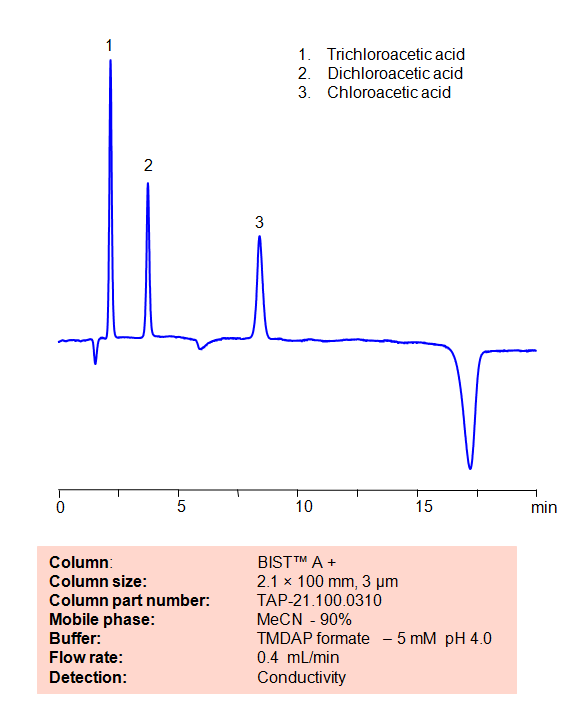
High Performance Liquid Chromatography (HPLC) Method for Analysis of Chloroacetic acid, Dichloroacetic acid, Trichloroacetic acid.
Chloroacetic Acid, also known as monochloroacetic acid (MCA), is a very toxic acid with the chemical formula ClCH2CO2H. It is most often used in the production of other chemicals such as phenoxy herbicides, carboxymethyl cellulose, and carboxymethyl starch. It is considered extremely hazardous as it can cause burns on skin and eyes as well as be fatal if inhaled or swallowed. Despite that, it is a popular building block in organic syntheses. You can find detailed UV spectra of Chloroacetic Acid and information about its various lambda maxima by visiting the following link.
Dichloroacetic Acid (DCA), also known as bichloroacetic acid (BCA), is a highly corrosive acid with the chemical formula C2H2Cl2O2. While it is used in personal care items and disinfectants, it is a known carcinogen. Despite that, research shows that it may be a plausible treatment for certain cancers. You can find detailed UV spectra of Dichloroacetic Acid and information about its various lambda maxima by visiting the following link.
Trichloroacetic Acid (TCA), also known as trichloroethanoic acid, is an analogue of acetic acid with the chemical formula C2HCl3O2. It is often used as a skin peeling treatment to exfoliate damaged skin and encourage collagen production. In laboratory research, it is used for precipitating proteins and to extract and prepare standards for ascorbic acid (Vitamin C) assays. You can find detailed UV spectra of Trichloroacetic Acid and information about its various lambda maxima by visiting the following link.
Using SIELC’s newly introduced BIST™ method, a mixture of these three acidscan be separated on a negatively-charged, cation-exchange BIST A+ column, contrary to conventional chromatographic wisdom. There are two keys to this retention method: 1) a multi-charged, positive buffer, such as N,N,N’,N’-Tetramethyl-1,3-propanediamine (TMDAP), which acts as a bridge, linking the negatively-charged anion analytes to the negatively-charged column surface and 2) a mobile phase consisting mostly of organic solvent (such as MeCN) to minimize the formation of a solvation layer around the charged analytes. Other positively-charged buffers that can generate BIST™ include Calcium acetate and Magnesium acetate. Using this new and unique analysis method, these anions can be separated, retained, and detected with a Conductivity Detector.
Condition
| Column | BIST A+, 2.1 x 100 mm, 3 µm, 100 A, dual ended |
| Mobile Phase | MeCN – 90% |
| Buffer | TMDAP ( N,N,N’,N’-Tetramethyl-1,3-diaminopropane) formate – 5 mM pH 4.0 |
| Flow Rate | 0.4 ml/min |
| Detection | Conductivity |
Description
| Class of Compounds | Acid, Carboxylic acid, Haloacetic acid |
| Analyzing Compounds | Chloroacetic acid, Dichloroacetic acid, Trichloroacetic acid |
Application Column
BIST A+
Column Diameter: 2.1 mm
Column Length: 100 mm
Particle Size: 3 µm
Pore Size: 100 A
Column options: dual ended
Dichloroacetic acid
Trichloroacetic acid