HPLC Method for Analysis of C.I. Acid Red 1 on BIST A Column by SIELC Technologies
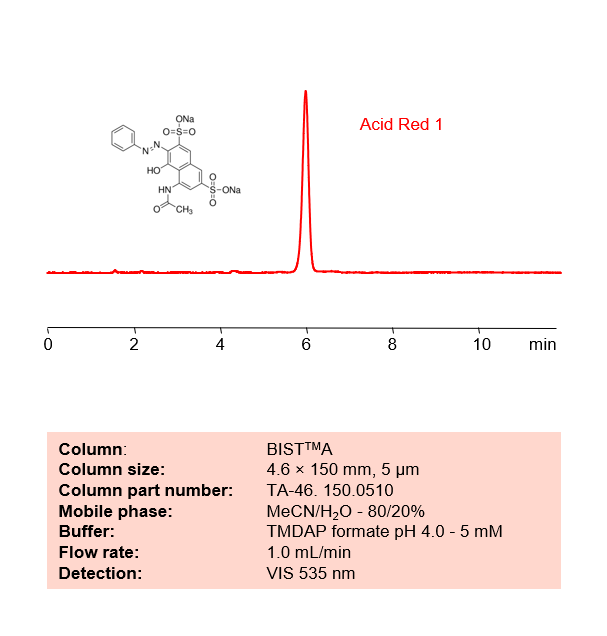
Acid Red 1, also known as Red 2G, is a popular red synthetic dye used in a wide variety of food products with the chemical formula C18H13N3Na2O8S2. It is banned for food use in Australia, Canada, Japan, Norway, Malaysia, and Israel due to being an potential carcinogen. In certain European countries, it is heavily restricted. Outside of use, it is used in inks and in histology. You can find detailed UV spectra of C.I. Acid Red 1 and information about its various lambda maxima by visiting the following link.
Using SIELC’s newly introduced BIST™ method, C.I. Acid Red 1, which ionizes in water, can be retained on a negatively-charged, cation-exchange BIST A column. There are two keys to this retention method: 1) a multi-charged, positive buffer, such as N,N,N’,N’-Tetramethyl-1,3-propanediamine (TMDAP), which acts as a bridge, linking the negatively-charged Acid Red 1 analytes to the negatively-charged column surface and 2) a mobile phase consisting mostly of organic solvent (such as MeCN) to minimize the formation of a solvation layer around the charged analytes. The effect of reducing the solvation layer by increasing the organic component concentration in the mobile phase can be clearly seen above. Using this new and unique analysis method, Acid Red 1 can be retained and UV detected at 270 nm.
Condition
| Column | BIST A, 4.6 x 150 mm, 5 µm, 100 A, dual ended |
| Mobile Phase | MeCN – 80/20% |
| Buffer | TMDAP formate pH 4.0 – 5,0 mM |
| Flow Rate | 1.0 ml/min |
| Detection | Vis 535 nm |
Description
| Class of Compounds | Acid, Dye |
| Analyzing Compounds | C.I. Acid Red 1 |
Application Column
BIST A
Column Diameter: 4.6 mm
Column Length: 150 mm
Particle Size: 5 µm
Pore Size: 100 A
Column options: dual ended