
| Molecular Formula | C47H73NO17 |
|---|---|
| Molecular Weight | 924.1 |
| InChI Key | APKFDSVGJQXUKY-INPOYWNPSA-N |
| Synonyms |
Applications:
UV-Vis Spectrum of Amphotericin B
July 10, 2024
Access the UV-Vis Spectrum SIELC Library
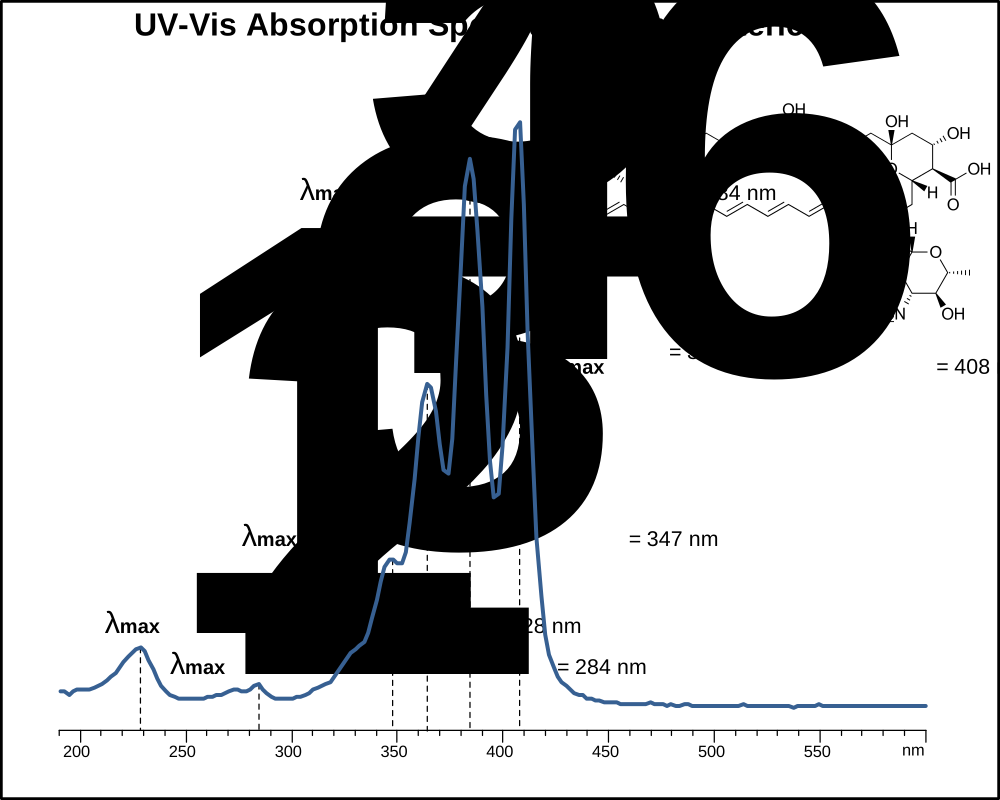
UV-Vis Spectrum of Amphotericin B. Absorption Maxima: 228 nm, 284 nm, 347 nm, 364 nm, 384 nm, 408 nm.
If you are looking for optimized HPLC method to analyze Amphotericin B check our HPLC Applications library
For optimal results in HPLC analysis, it is recommended to measure absorbance at a wavelength that matches the absorption maximum of the compound(s) being analyzed. The UV spectrum shown can assist in selecting an appropriate wavelength for your analysis. Please note that certain mobile phases and buffers may block wavelengths below 230 nm, rendering absorbance measurement at these wavelengths ineffective. If detection below 230 nm is required, it is recommended to use acetonitrile and water as low UV-transparent mobile phases, with phosphoric acid and its salts, sulfuric acid, and TFA as buffers.

HPLC Method for Analysis of Amphotericin B on Primesep 100 Column
March 12, 2024
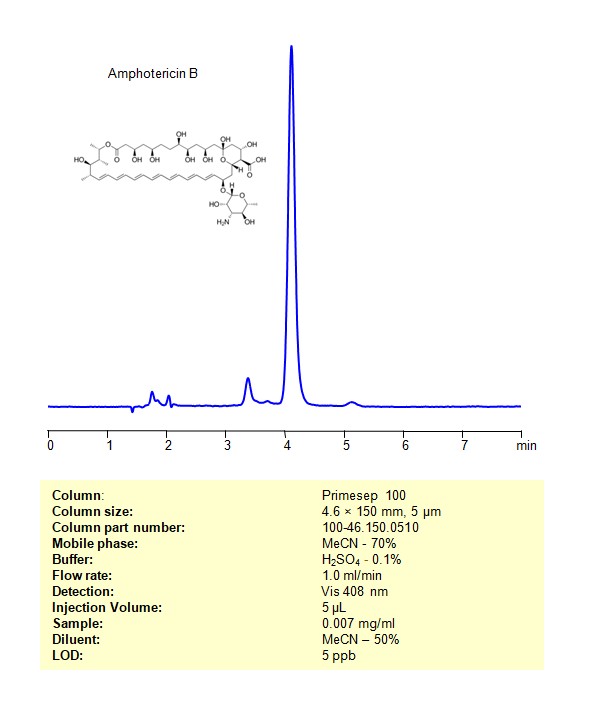
HPLC Method for Analysis of Amphotericin B on Primesep 100 Column
Amphotericin B is an antifungal medication with the chemical formula C47H73NO17. It is used to treat serious fungal infections and belongs to the polyene class of antifungal drugs and is known for its broad-spectrum activity against a variety of fungi. Amphotericin B works by binding to ergosterol, a component of fungal cell membranes. This binding disrupts the integrity of the fungal cell membrane, leading to leakage of cellular contents and ultimately causing cell death. It is effective against a broad spectrum of fungi, including Candida species, Aspergillus species, Cryptococcus neoformans, and various molds and dimorphic fungi.
It’s important for healthcare professionals to carefully weigh the potential benefits and risks of using Amphotericin B, considering the severity of the fungal infection and the patient’s overall health. As with any medication, it should be administered under the supervision of a qualified medical professional.
You can find detailed UV spectra of Amphotericin B and information about its various lambda maxima by visiting the following link.
Amphotericin B can be retained and analyzed using a Primesep 100 mixed-mode stationary phase column. The analysis employs an isocratic method with a simple mobile phase comprising water, acetonitrile (MeCN), and sulfuric acid as a buffer. This method allows for detection using Vis at 408 nm
| Column | Primesep 100, 4.6 x 150 mm, 5 µm, 100 A, dual ended |
| Mobile Phase | MeCN – 70% |
| Buffer | H2SO4 – 0.1% |
| Flow Rate | 1.0 ml/min |
| Detection | Vis 408 nm |
| Samples | 0.007 mg/ml in MeCN/H2O – 50/50% |
| Injection volume | 5 µl |
| LOD* | 5 ppb |
| Class of Compounds | Drug |
| Analyzing Compounds | Amphotericin B |
Application Column
Primesep 100
Column Diameter: 4.6 mm
Column Length: 150 mm
Particle Size: 5 µm
Pore Size: 100 A
Column options: dual ended
